. 2025 Apr 30;26(9):4282.
doi: 10.3390/ijms26094282.

Advancing Measurable Residual Disease Detection in Pediatric BCP-ALL: Insights from Novel Immunophenotypic Markers

Affiliations

Advancing Measurable Residual Disease Detection in Pediatric BCP-ALL: Insights from Novel Immunophenotypic Markers

Alexandra Baldzhieva et al. Int J Mol Sci. .

Abstract

Measurable Residual Disease (MRD) assessment in pediatric acute lymphoblastic leukemia (ALL) is crucial for relapse prediction and treatment guidance. Multiparameter flow cytometry (MFC) enhances detection but faces limitations due to insufficient leukemia-associated immunophenotypes (LAIPs) and antigen modulation. This study explores new markers to improve MFC-based MRD detection in B-cell precursor ALL (BCP-ALL). Expression-patterns of seven aberrancy markers, i.e., CD44, CD304, CD73, CD86, CD123, CD99, CD58, and one B-cell maturation marker, CD22, were studied in 143 samples with leukemic-blasts from sixty-one childhood BCP-ALL patients and in hematogones of 20 non-leukemic bone marrow (BM) samples using fourteen-color MFC. The highest relative frequences of LAIPs amounted to 82.50%, reported for CD99 and CD58, followed by CD44 (81.10%), CD73 (76.20%), CD22 (73.40%), CD304 and CD86 (68.50%), while the lowest relative frequence was CD123 (44.40%). Differential expression of CD58, CD304, and CD73 in diagnostic samples was highly significant (p < 0.01) between pre-B-I, pre-B-II, immature B cells, and BCP-ALL blasts. In MRD-positive samples CD73 showed significantly high (p < 0.01) differential expression between all stages of hematogones and residual blasts, followed by CD304, CD58, and CD22. CD73 and CD304 were identified as the most reliable among the tested markers for distinguishing both diagnostic and MRD blasts from normal B cell precursors.

Keywords: blasts; childhood B-cell precursor acute lymphoblastic leukemia; flow cytometry; immunophenotyping; leukemia; measurable residual disease.


Conflict of interest statement

The authors declare no conflicts of interest.

Figures

Figure 1
Figure 1
Relative proportions of positive and negative expression in novel markers (a); relative proportions of high/overexpression in novel markers (b) among the cases analyzed.
Figure 2
Figure 2
Co-expression patterns for the three markers (CD99, CD58, and CD44) with the highest relative expression in BCP-ALL samples.
Figure 3
Figure 3
Box plots of individual values, medians, and interquartile ranges of MFI for the new markers in diagnostic BCP-ALL blasts. CD44 (a), CD304 (b), CD99 (c), CD86 (d), CD73 (e), CD123 (f), CD22 (g), and CD58 (h). MFI CD304 (b) and MFI CD58 (h) showed significantly higher value in diagnostic BCP-ALL blasts compared to Pre-B-II, immature B, and mature B cells. MFI CD73 (e) showed significantly higher value in diagnostic BCP-ALL blasts compared to Pre-B-I, Pre-B-II, and immature B cells. MFI CD22 demonstrated significantly higher value in blasts compared to late hematogones and immature B cells. ** Significant difference at p < 0.01; *** Significant difference at p < 0.001.
Figure 4
Figure 4
Box plots of individual values, medians, and interquartile ranges of MFI for the new markers in residual BCP-ALL blasts. CD44 (a), CD304 (b), CD99 (c), CD86 (d), CD73 (e), CD123 (f), CD22 (g), and CD58 (h). Residual BCP-ALL blasts displayed significantly higher MFI values for CD73 across all stages of normal B-cell differentiation, for CD58 and CD304—compared to Pre-B-II, immature B, and mature B cells, for CD22—to Pre-B-II and immature B cells, and for CD44—to Pre-B-II cells. * Significant difference at p < 0.05; ** Significant difference at p < 0.01; *** Significant difference at p < 0.001.
Figure 5
Figure 5
Visualization of the cell clusters of residual blasts based on mean fluorescence intensity (MFI) for specific surface markers (CD44, CD304, CD86, CD73, CD123, CD22, CD58, and CD99) against side scatter (SSC), reflecting variations in cell complexity and activation states.
Figure 6
Figure 6
This FC analysis displays scatter plots illustrating the separation of cell clusters from a bone marrow aspirate. Notably, the sample showed a low presence of Pre-B I and immature B lymphocytes. Among the most effective CD markers for detecting residual blasts, CD73 exhibited strong positivity in leukemic cells compared to both mature B cells and Pre-B II cells. Similar trends were observed with the markers CD304 and CD58.
Figure 7
Figure 7
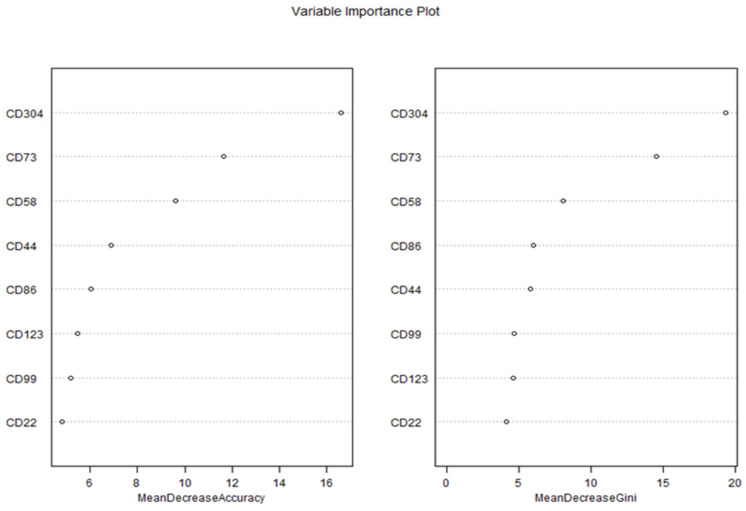
Variable importance plot of biomarkers for predicting MRD status using Random Forest.
Figure 8
Figure 8
ROC curves for the diagnostic potential of MFI CD73 in differentiating BCP-ALL blasts from Pre-B-I and Pre-B-II cells. (a) ROC curve for CD73 in differentiating diagnostic BCP-ALL blasts from Pre-B-I lymphocytes. (b) ROC curve for CD73 expression levels in discriminating diagnostic BCP-ALL blasts from Pre-B-II cells. (c) ROC curve demonstrating the diagnostic potential of CD73 in differentiating residual blasts from Pre-B-I lymphocytes. (d) ROC curve for CD73 expression levels in discriminating minimal residual disease (MRD) blasts from Pre-B-II cells.
Figure 9
Figure 9
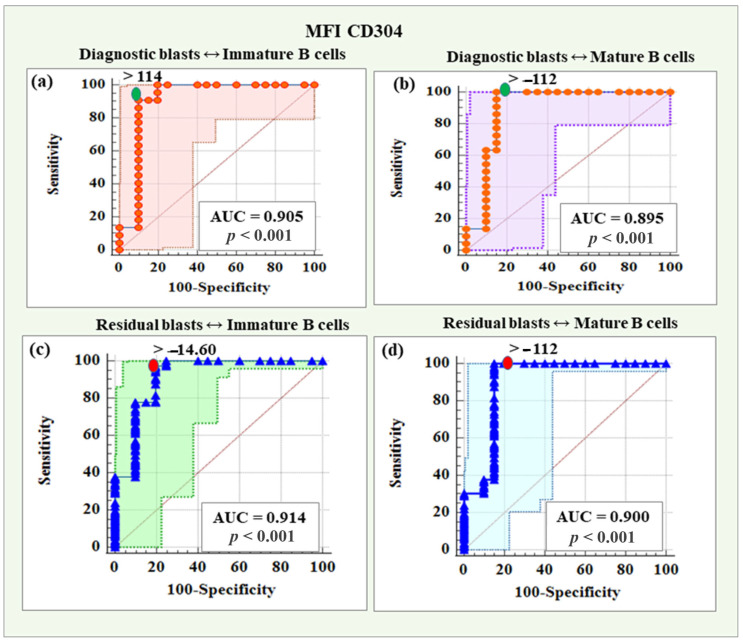
ROC curves for the diagnostic potential of MFI CD304 in distinguishing diagnostic and residual blasts from immature and mature B cells. (a) ROC curve for CD304 in differentiating diagnostic BCP-ALL blasts from immature B lymphocytes. (b) ROC curve for CD304 expression levels in discriminating diagnostic BCP-ALL blasts from mature B cells. (c) ROC curve demonstrating the diagnostic potential of CD304 in differentiating residual blasts from immature B lymphocytes. (d) ROC curve for CD304 expression levels in discriminating minimal residual disease (MRD) blasts from mature B cells.
Figure 10
Figure 10
Gating strategy of the lymphocytes in the bone marrow.

References

    1. Pui C.H., Evans W.E. Acute Lymphoblastic Leukemia. N. Engl. J. Med. 2013;368:1461–1472. doi: 10.1056/NEJM199808273390907. - DOI - PubMed
    1. Hoffman R., Benz E.J., Silberstein L.E., Heslop H.E., Weitz J.I., Anastasi J., Salama M.E. Hematology: Basic Principles and Practice. 7th ed. Elsevier Inc.; Amsterdam, The Netherlands: 2019. Abutalib; p. 2374. - DOI
    1. Szczepański T., Willemse M.J., Kamps W.A., van Wering E.R., Langerak A.W., van Dongen J.J. Molecular discrimination between relapsed and secondary acute lymphoblastic leukemia: Proposal for an easy strategy. Med. Pediatr. Oncol. 2001;36:352–358. doi: 10.1002/mpo.1085. - DOI - PubMed
    1. Rosenberg A., Brunson A., Paulus J., Tuscano J., Wun T., Keegan T.H.M. Secondary acute lymphoblastic leukemia is a distinct clinical entity with prognostic significance. Blood Cancer J. 2017;7:e605. doi: 10.1038/bcj.2017.81. - DOI - PMC - PubMed
    1. Hourigan C.S., Gale R.P., Gormley N.J., Ossenkoppele G.J. Measurable residual disease testing in acute myeloid leukaemia. Leukemia. 2017;31:1482–1490. doi: 10.1038/leu.2017.113. - DOI - PubMed

MeSH terms

LinkOut - more resources