


A Comparative Evaluation of the Primary and Secondary Stability of Dental Implants with Progressive and Conventional Thread Designs: A Prospective Non-Interventional Study of 100 Implants in 62 Patients
- PMID: 40364071
- PMCID: PMC12072641
- DOI: 10.3390/jcm14093040
A Comparative Evaluation of the Primary and Secondary Stability of Dental Implants with Progressive and Conventional Thread Designs: A Prospective Non-Interventional Study of 100 Implants in 62 Patients
Abstract
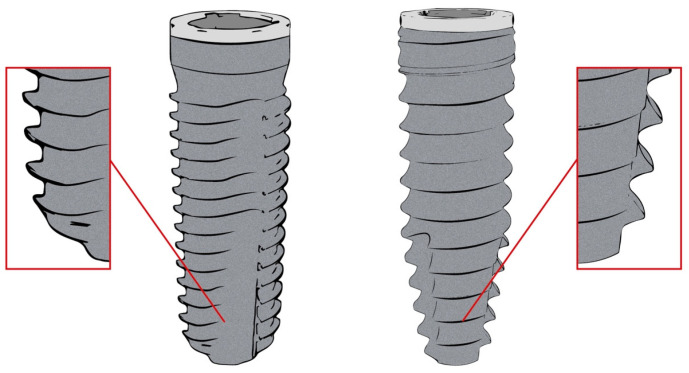
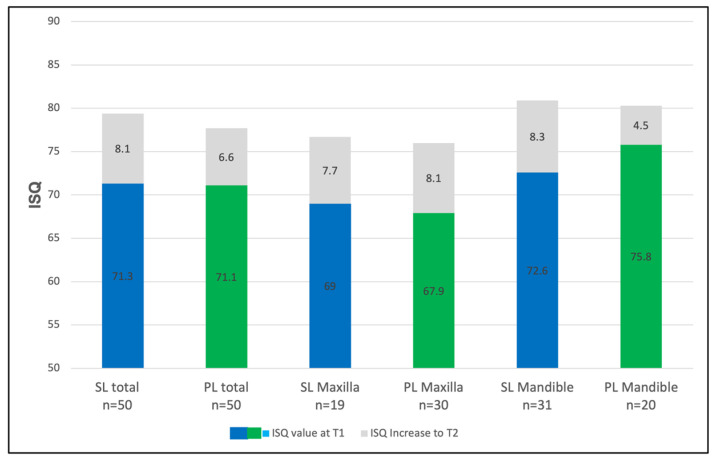
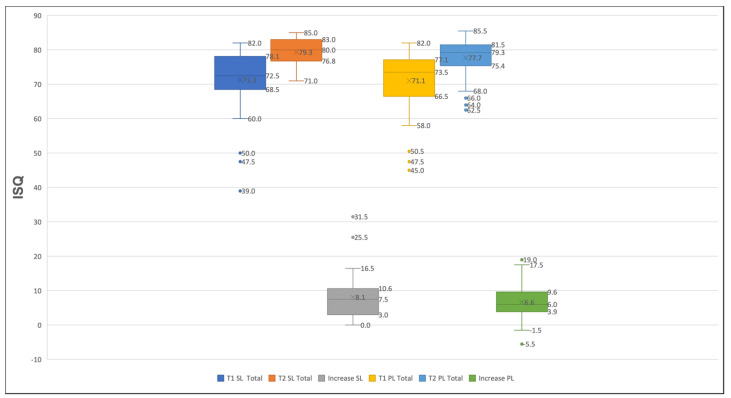
Objectives: We wished to compare the primary and secondary stability of dental implants with a progressive design (PL) versus a conventional thread design (SL) across various clinical settings. Methods: A total of 100 implants (50 PL and 50 SL) were placed in 62 patients. The stability of the implants was assessed using a resonance frequency analysis (RFA) at the time of placement (T1) and 20 weeks postoperatively before prosthetic loading (T2). Bone density was measured in Hounsfield units (HU) using cone-beam computed tomography (CBCT). The ISQ values were recorded for each group and anatomical region, including both inter- and intragroup comparisons over time. Results: Both implant designs showed a significant increase in stability during the healing period. At T1, the ISQ values were comparable between groups (SL: 71.3 ± 8.6; PL: 71.1 ± 8.7). At T2, the ISQ values increased significantly in both groups (SL and PL: p < 0.01), with no statistically significant difference in the degree of the gain in stability. The ISQ values were generally lower in the maxilla compared to those in the mandible. In the posterior mandible, the SL implants demonstrated a greater increase in stability compared to that with the PL implants. A strong positive correlation between the HU and ISQ values was observed for both groups (SL: r = 0.95; PL: r = 1.00), without reaching statistical significance. Conclusions: While the progressive thread design aims to enhance the primary stability, it did not outperform the conventional design in this study. Both implant types proved effective in achieving stable and predictable clinical outcomes.
Keywords: implant macro-design; implant stability quotient (ISQ); primary stability; resonance frequency analysis (RFA); secondary stability; thread design.
Conflict of interest statement
The authors declare no conflicts of interest.
Figures



References
-
- Moraschini V., Poubel L.A., Ferreira V.F., Barboza Edos S. Evaluation of survival and success rates of dental implants reported in longitudinal studies with a follow-up period of at least 10 years: A systematic review. Int. J. Oral Maxillofac. Surg. 2015;44:377–388. doi: 10.1016/j.ijom.2014.10.023. - DOI - PubMed
-
- Raghavendra S., Wood M.C., Taylor T.D. Early wound healing around endosseous implants: A review of the literature. Int. J. Oral Maxillofac. Implants. 2005;20:425–431. - PubMed
LinkOut - more resources
Full Text Sources
