


The Effect of Fistula Care Education Given with a Mobile Application on Disease Adherence and Self-Care Behaviors in Hemodialysis Patients: A Quasi-Experimental Study
- PMID: 40366273
- PMCID: PMC12046137
- DOI: 10.5152/FNJN.2025.24057
The Effect of Fistula Care Education Given with a Mobile Application on Disease Adherence and Self-Care Behaviors in Hemodialysis Patients: A Quasi-Experimental Study
Abstract
Aim: It was aimed to determine the effect of fistula care education provided through mobile health applications on disease adaptation and self-care behaviors in hemodialysis patients.
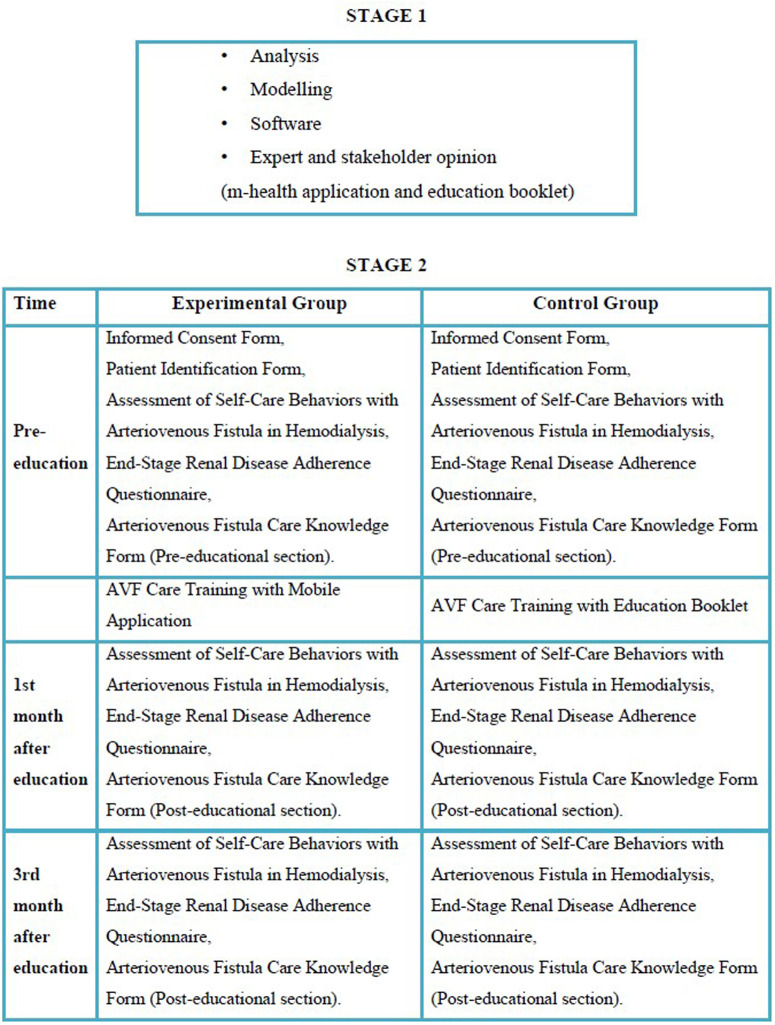
Methods: This is an quasi-experimental study with the pretest-posttest control group design. The research was carried out between June and October 2020 in two private dialysis centers, with the experimental group (n = 30) using the mobile health application in arteriovenous fistula care education and the control group (n = 30) adopting the education guide. "Patient Identification Form," the "Arteriovenous fistula care knowledge form," the "Assessment of self-care behaviors with arteriovenous fistula in hemodialysis," "End-stage renal disease adherence questionnaire," and the "Visual comparison scale" were used to collect the research data. Parametric and nonparametric tests were used to analyze the data. In this study, the STROBE checklist was followed for reporting.
Results: It was observed that hemodialysis patients in the study groups had similar socio-demographic characteristics. According to the pre-education evaluation, there was no statistically significant difference between the groups in terms of commitment to the disease, arteriovenous fistula care knowledge levels, and self-care behaviors (p > .05), while a statistically significant difference was found in the same variables between the groups in the first and third months after the education (p < .05). According to the evaluation, statistically significant differences were found between the groups in terms of knowledge of arteriovenous fistula care, development of self-care behaviors, and adherence to the disease after the first and third months following the education (p < .05).
Conclusion: Patients using the mobile health application had higher levels of disease adherence, knowledge of arteriovenous fistula care, and developing self-care behavior compared to the patients using the education booklet.
Keywords: Fistula; mobile health; nursing; self-care; treatment adherence.
Conflict of interest statement
References
-
- Aljuaid M. M., Alzahrani N. N., Alshehri A. A., Alkhaldi L. H., Alosaimi F. S., Aljuaid N. W., Asiri O. A., Atalla A. A. (2020). Complications of arteriovenous fistula in dialysis patients: Incidence and risk factors in Taif city, KSA. Journal of Family Medicine and Primary Care, 9(1), 407–411. (10.4103/jfmpc.jfmpc_848_19) - DOI - PMC - PubMed
-
- Arjunan P., Arulappan J., Bhaskara Kurup S., Subramaniam A., & Ramasamy Venkatasalu M. (2018). Medication, diet, fluid and treatment adherence behavior among patients subjected to hemodialysis in selected hospital, India. Biosciences, Biotechnology Research Asia, 15(2), 257–264. (10.13005/bbra/2629) - DOI
-
- Daugirdas J. T., Blake P. G., Ing T. S. (2014). Handbook of dialysis (5th ed). Philadelphia: Lippincott Williams & Wilkins (LWW).
LinkOut - more resources
Full Text Sources