


Surgical Outcomes of Retropupillary Iris-Claw Intraocular Lens Implantation for Various Indications
- PMID: 40366604
- PMCID: PMC12167421
- DOI: 10.1007/s40123-025-01153-8
Surgical Outcomes of Retropupillary Iris-Claw Intraocular Lens Implantation for Various Indications
Abstract
Introduction: The retropupillary iris-claw intraocular lens (RP-IOL) offers a sutureless solution to complications like aphakia, intraocular lens (IOL) dislocation, and opacification post-cataract surgery. Unlike time-consuming, complication-prone traditional methods, RP-IOL potentially reduces surgical time and complications. This study evaluates RP-IOL's clinical outcomes to assess its efficacy and safety.
Methods: This single-center retrospective case series reviewed medical records of 68 eyes from 68 patients who underwent RP-IOL implantation between January 2017 and May 2023. Preoperative and postoperative data, including visual acuity (VA), intraocular pressure (IOP), and spherical equivalent (SE), were analyzed.
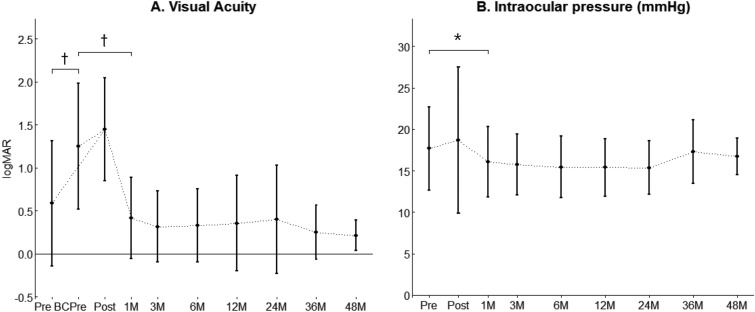
Results: The mean uncorrected VA improved significantly from 1.25 ± 0.73 (logarithm of the minimum angle of resolution) preoperatively to 0.42 ± 0.47 at 1 month postoperatively (P < 0.001). The mean IOP decreased significantly from 17.69 ± 5.01 mmHg preoperatively to 16.09 ± 4.23 mmHg 1 month postoperatively (P = 0.041). Postoperative complications occurred in 35.3% of cases, with the most common being IOP elevation (13.2%), cystoid macular edema (11.8%), and disenclavation of IOL (7.4%). Most complications were successfully managed. The study also included a subanalysis of seven patients with IOL opacification, showing improved VA postoperatively, although without statistical significance due to the small sample size.
Conclusions: RP-IOL implantation is an effective and safe option for secondary IOL implantation or exchange in cases of aphakia, IOL dislocation, and IOL opacification. The procedure offers significant improvements in visual acuity and a reduction in intraocular pressure, with manageable postoperative complications. While the study supports the use of RP-IOL as a viable option, further research with larger sample sizes and prospective designs is recommended to establish its long-term efficacy and safety compared to traditional methods.
Keywords: IOL dislocation; IOL opacification; Retropupillary iris-claw IOL.
© 2025. The Author(s).
Conflict of interest statement
Declarations. Conflict of Interest: Hyo Song Park has nothing to disclose. Sung Chul Park has nothing to disclose. Jin Ha Kim has nothing to disclose. Young Hoon Ohn has nothing to disclose. Tae Kwann Park has nothing to disclose. Jung Woo Han has nothing to disclose. Ethical Approval: Ethical approval for this study was obtained from the institutional review board of Soonchunhyang University Hospital (IRB No.2024-06-009). The requirement of informed consent was waived due to the retrospective nature of the study, and the data were anonymized before the analysis. Informed consent was waived from the IRB due to the retrospective design.
Figures

References
-
- Shuaib AM, El Sayed Y, Kamal A, El Sanabary Z, Elhilali H. Transscleral sutureless intraocular lens versus retropupillary iris-claw lens fixation for paediatric aphakia without capsular support: a randomized study. Acta Ophthalmol. 2019;97(6):e850–9. 10.1111/aos.14090. - PubMed
-
- Davies EC, Pineda R. Complications of scleral-fixated intraocular lenses. Semin Ophthalmol. 2018;33(1):23–8. 10.1080/08820538.2017.1353808. - PubMed
-
- Sawada T, Kimura W, Kimura T, et al. Long-term follow-up of primary anterior chamber intraocular lens implantation. J Cataract Refract Surg. 1998;24(11):1515–20. 10.1016/s0886-3350(98)80176-4. - PubMed
Grants and funding
LinkOut - more resources
Full Text Sources
