. 2025 May 14;16(1):4459.
doi: 10.1038/s41467-025-59775-2.

Unraveling mutagenic processes influencing the tumor mutational patterns of individuals with constitutional mismatch repair deficiency

Affiliations

Unraveling mutagenic processes influencing the tumor mutational patterns of individuals with constitutional mismatch repair deficiency

Dilys D Weijers et al. Nat Commun. .

Abstract

Constitutional mismatch repair deficiency (CMMRD), caused by bi-allelic germline variants in mismatch repair (MMR) genes, is associated with high cancer incidence early in life. A better understanding of mutational processes driving sequential CMMRD tumors can advance optimal treatment. Here, we describe a genomic characterization on a representative collection of CMMRD-associated tumors consisting of 41 tumors from 17 individuals. Mutational patterns in these tumors appear to be influenced by multiple factors, including the affected MMR gene and tumor type. Somatic polymerase proofreading mutations, commonly present in brain tumors, are also found in a T-cell lymphoblastic lymphoma displaying associated mutational patterns. We show prominent mutational patterns in two second primary hematological malignancies after temozolomide treatment. Furthermore, an indel signature, characterized by one-base pair cytosine insertions in cytosine homopolymers, is found in 54% of tumors. In conclusion, analysis of sequential CMMRD tumors reveals diverse mutational patterns influenced by the affected MMR gene, tumor type and treatment history.


Conflict of interest statement

Competing interests: The authors declare no competing interests.

Figures
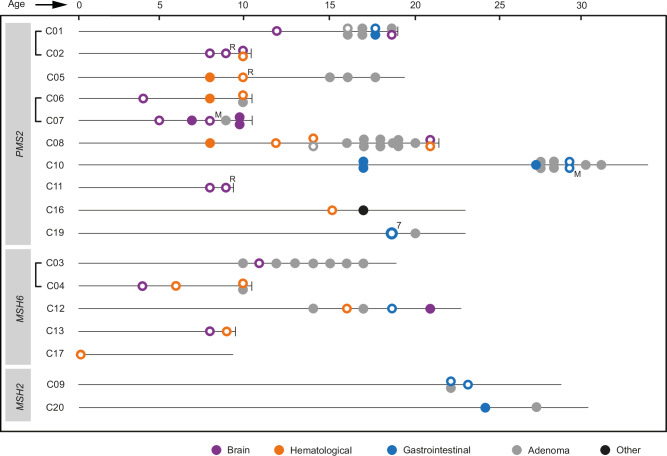
Fig. 1
Fig. 1. Schematic overview of tumors developed by individuals in the CMMRD cohort.
Siblings are connected by a bracket. For each individual, malignancies, including relapses (R) and metastases (M), and the occasions at which liver or GI adenomas were detected during surveillance are indicated on a timeline according to age at diagnosis. The death of an individual is indicated by a vertical dash at the end of the timeline. For tumors marked with a white dot, material was collected and sequenced. Individual C19 was diagnosed with seven simultaneous colorectal adenocarcinomas, all of which were sequenced. Previous studies have described individuals C03 and C04, C01 and C06, C09 and C20, C02, C04, C05, C06, C08, C12, C16 and C17, C11, and C10. Source data are provided as a Source Data file.
Fig. 2
Fig. 2. Overview of mutational patterns in all 41 CMMRD tumors sequenced.
Total TML in each tumor is reported, the ultrahypermutation ( >100mutations/Megabase(Mb)) and hypermutation ( >10mutations/Megabase(Mb)) thresholds are indicated by dashed lines. Tumor type, affected MMR gene and presence of somatic driver mutations in POLE or POLD1 are reported below. The contributions of COSMIC and de novo single base substitution (SBS) and indel mutational signatures indicated result from the signature extraction with MutationalPatterns. Mutational signatures are associated with various processes, SBS1 and SBS5: clock-like signatures, related to aging, SBS11: prior temozolomide treatment, SBS14: combined MMR and POLE deficiency, SBS15: MMR deficiency, SBS20: combined MMR and POLD1 deficiency, SBS26: MMR deficiency, ID1: aging and MMR deficiency, ID2: aging and MMR deficiency, ID12: unknown aetiology, IDA-IDC: de novo extracted signatures. The cosine similarity between the original and reconstructed mutational profile is specified below the signature contributions. Tumors are identified by the individual ID, followed by tumor type (B=brain, G = gastrointestinal (GI), H=hematological), treatment-status (N= treatment-naïve, A= after treatment), tumor status (P=primary tumor, M=metastasis or relapse) and the order in which they occurred (Fig. 1 and Table S2). *In C04-BNP01, a somatic POLD1 mutation was validated in transcriptomic data only. Source data are provided as a Source Data file.
Fig. 3
Fig. 3. Tumor mutational load (TML) and mutational signatures in CMMRD tumors differ depending on the tumor type.
The single base substitution (SBS) TML and relative contribution of SBS14 and ID1 are significantly higher in malignant brain tumors (n = 14) than in gastrointestinal tumors (n = 15) and hematological malignancies (n = 12). Conversely, compared to malignant brain tumors, the relative contribution of ID2 is significantly higher in gastrointestinal tumors and hematological malignancies, and the relative contribution of SBS26 is significantly higher in hematological malignancies. The indel TML and relative contribution of SBS15 is significantly higher in malignant brain tumors and gastrointestinal tumors than in hematological malignancies. The center line of the box displays the median, the box limits represent the first and third quartiles and the whiskers indicate the minimum and maximum, or, in case of outliers, 1.5 times the interquartile range. P-values were calculated with a Kruskal-Wallis test, followed by a Dunn’s test with Bonferroni adjustment. ns = not significant, *p < 0.05, **p < 0.01, ***p < 0.001, ****p < 0.0001. Means and p-values are reported in Table S6. Source data are provided as a Source Data file.
Fig. 4
Fig. 4. Tumor mutational load (TML) and mutational signature contributions differ between CMMRD tumors with different affected MMR genes.
The indel TML is significantly lower and the relative contribution of signature ID2 is significantly higher in MSH6-deficient tumors (n = 9). PMS2-deficient tumors (n = 30) have significantly higher contributions of ID1 and, although not significant, higher contributions of SBS26. The center line of the box displays the median, the box limits represent the first and third quartiles and the whiskers indicate the minimum and maximum, or, in case of outliers, 1.5 times the interquartile range. P-values were calculated with a two-sided Mann-Whitney U test. ns = not significant, *p < 0.05, **p < 0.01, ****p < 0.0001. Means and p-values are reported in Table S8. Source data are provided as a Source Data file.
Fig. 5
Fig. 5. Contributions of signature SBS11 in second (primary) tumors of individuals with CMMRD who were treated with temozolomide (TMZ).
Five individuals in the CMMRD cohort were treated with temozolomide for a total of six primary malignant brain tumors. The cumulative temozolomide dose is indicated for each primary malignant brain tumor. Individual C02 was treated with temozolomide for two primary brain tumors, further increasing the cumulative dose (milligrams (mg)). After variable timeframes following the start of temozolomide treatment, these individuals developed a second primary tumor, or a metastasis (M) or relapse (R) of the primary malignant brain tumor. In these subsequent tumors, the single base substitution (SBS) tumor mutational load (TML) ranges between 5.4 and 214.2 mutations/megabase (mut/Mb) and in two hematological malignancies, SBS11 contributed >35% of mutations to the mutational profile. *Dose administered during a second treatment protocol with temozolomide. Source data are provided as a Source Data file.

References

    1. Kunkel, T. A. & Erie, D. A. Eukaryotic Mismatch Repair in Relation to DNA Replication. Annu Rev. Genet. 49, 291–313 (2015). - PMC - PubMed
    1. Lynch, H. T., Snyder, C. L., Shaw, T. G., Heinen, C. D. & Hitchins, M. P. Milestones of Lynch syndrome: 1895-2015. Nat. Rev. Cancer15, 181–194 (2015). - PubMed
    1. Wimmer, K. et al. Diagnostic criteria for constitutional mismatch repair deficiency syndrome: suggestions of the European consortium ‘Care for CMMRD’ (C4CMMRD). J. Med. Genet.51, 355 (2014). - PubMed
    1. Ercan, A. B. et al. Clinical and biological landscape of constitutional mismatch-repair deficiency syndrome: an International Replication Repair Deficiency Consortium cohort study. Lancet Oncol.25, 668–682 (2024). - PubMed
    1. Sanders, M. A., et al. Life without mismatch repair. bioRxiv, 2021.2004.2014.437578, 10.1101/2021.04.14.437578 (2021).

Supplementary concepts

LinkOut - more resources
