


Role play versus video-based learning for interprofessional communication and teamwork skills in nursing and medical students: a mixed-methods study in Pakistan
- PMID: 40369548
- PMCID: PMC12077007
- DOI: 10.1186/s12909-025-06840-5
Role play versus video-based learning for interprofessional communication and teamwork skills in nursing and medical students: a mixed-methods study in Pakistan
Abstract
Background: Effective interprofessional communication (IPC) is crucial for patient safety. However, IPC training is often insufficient in medical and nursing education in Pakistan. This study compares the effectiveness of Video-Based Learning (VBL) and Role Play (RP) in enhancing IPC and teamwork skills among undergraduate medical and nursing students.
Methods: A mixed-method approach encompassed a quasi-experimental design with focused group discussions. 64 participants were randomly divided into two groups (n = 32 each), each receiving training through either VBL or RP. The study employed the Communication and Teamwork Skills (CATS) assessment instrument utilized by two independent raters to evaluate improvements in coordination, situational awareness, cooperation, and communication skills before and after the interventions. Additionally, focus group discussions provided qualitative insights regarding the teaching strategies.
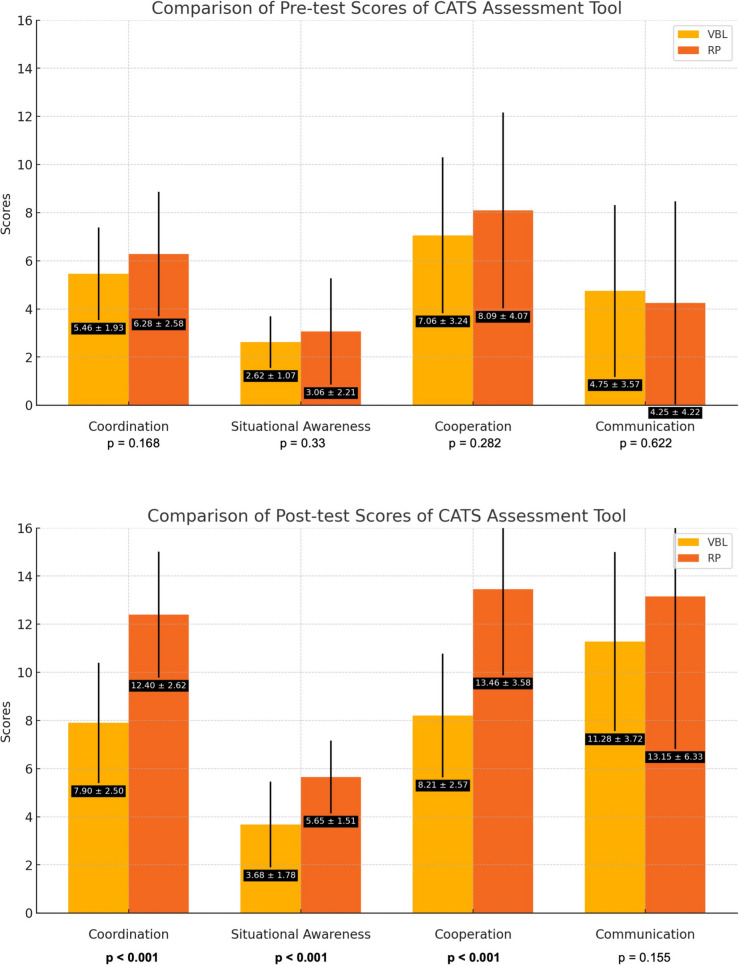
Results: Both RP and VBL significantly improved IPC and teamwork skills compared to baseline. RP showed greater enhancements across coordination, cooperation, and situational awareness compared to VBL. (p < 0.001). In the VBL group, significant improvements were observed in coordination (pre: 5.46 ± 1.93, post: 7.90 ± 2.50, p < 0.001), situational awareness (pre: 2.62 ± 1.07, post: 3.68 ± 1.78, p = 0.006), and communication (pre: 4.75 ± 3.57, post: 11.28 ± 3.72, p < 0.001), but not in cooperation (pre: 7.06 ± 3.24, post: 8.21 ± 2.57, p = 0.119). The RP group showed significant improvements in coordination (pre: 6.28 ± 2.58, post: 12.40 ± 2.62, p < 0.001), situational awareness (pre: 3.06 ± 2.21, post: 5.65 ± 1.51, p < 0.001), cooperation (pre: 8.09 ± 4.07, post: 13.46 ± 3.58, p < 0.001), and communication (pre: 4.25 ± 4.22, post: 13.15 ± 6.33, p < 0.001). Qualitatively, both methods were perceived as engaging and interactive, with the hands-on component in RP regarded by the participants as very valuable to actively practice their skills in a simulated environment.
Conclusions: RP significantly outperforms VBL in enhancing IPC and teamwork skills, making it a superior tool for healthcare education. The findings suggest that RP's practical, interactive nature makes it a more effective tool for teaching IPC and teamwork in medical and nursing education. Integrating RP activities into the curriculum could enhance communication and teamwork skills among students. Evaluating the longitudinal impact of this integration on patient care could be an area for future research.
Keywords: Communication skills; Interprofessional skills; Medical education; Nursing education; Teamwork.
© 2025. The Author(s).
Conflict of interest statement
Declarations. Ethics approval and consent to participate: Ethical approval was sought and obtained from the ethical review committees of Liaquat College of Medicine & Dentistry (Reference number: Ref.No.IRB/M-000072/23) and the Aga Khan University (Reference number: AKU ERC 2023–9153–26758) prior to the initiation of the study. Written informed consents were obtained after thorough discussions regarding the study’s purpose and procedures with all the participants prior to participation in the interventions and the FGDs. Consent for publication: Not applicable. Competing interests: The authors declare no competing interests.
Figures
References
-
- Dixon JF, Larison K, Zabari M. Skilled communication. AACN Adv Crit Care. 2006;17(4):376–82. - PubMed
-
- Joint Commission International. Communicating clearly and effectively to patients. Joint Commission International; 2018. Available from: https://www.jointcommissioninternational.org/what-we-offer/publications/.... [cited 2024 Aug 22].
Publication types
MeSH terms
LinkOut - more resources
Full Text Sources
Miscellaneous
