


Determinants of implementation of a stepped care intervention for adolescents and youth living with HIV in Kenya: a qualitative evaluation
- PMID: 40369586
- PMCID: PMC12079965
- DOI: 10.1186/s12913-025-12875-7
Determinants of implementation of a stepped care intervention for adolescents and youth living with HIV in Kenya: a qualitative evaluation
Abstract
Background: Differentiation of HIV services, a client-centered strategy, may improve care outcomes among adolescents and youth living with HIV (AYLHIV). Understanding health provider perceptions of barriers and facilitators that influence implementation can optimize adoption and sustainment of health systems interventions.
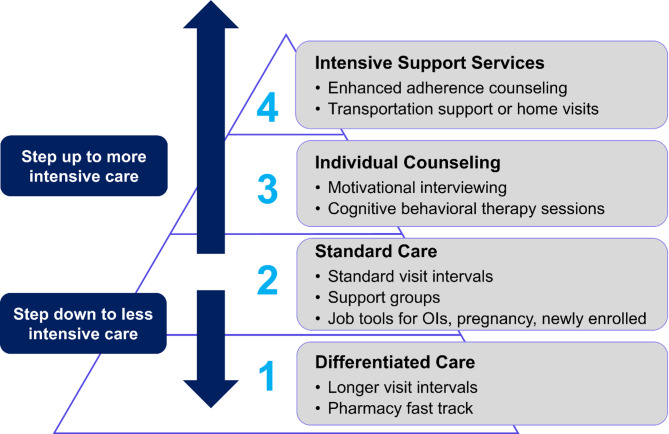
Methods: The Data-informed Stepped Care (DiSC) study was a cluster randomized controlled trial of a stepped care intervention in 24 HIV care facilities in Kenya. At each visit, providers used an assessment tool to allocate AYLHIV to services according to level of need. Stable clients were allocated to differentiated service delivery (DSD) with less frequent visits. Intensified services, including behavioral counseling, were provided for those with greater likelihood of loss to follow-up, mental health issues, or viral non-suppression. We conducted focus group discussions (FGDs) with providers across 12 intervention sites between January-February 2023. FGDs used a semi-structured interview guide, grounded in the Consolidated Framework for Implementation Research, which were audio-recorded and transcribed. Transcripts were analyzed using a team-based rapid turnaround approach to characterize key determinants influencing adoption, reach, and fidelity.
Results: Providers were enthusiastic about, and quick to adopt, the DiSC intervention. They found the DiSC tool easy to use and felt it provided a relative advantage by improving service delivery efficiency and prioritizing time with higher need AYLHIV. Providers noted the importance of tool flexibility to align with changing national guidelines. They expressed concerns about compatibility with existing workflows at facilities exclusively using electronic medical record (EMR) systems, suggesting EMR integration will be needed for intervention sustainment. AYLHIV eligible for DSD benefited from clinic visit intervals that aligned with the school calendar, which posed a challenge for reaching AYLHIV in more intensive steps. Provider collective efficacy was important in consistent implementation of DiSC and was facilitated by continuous quality improvement meetings, access to knowledge and information, and perceived intervention effectiveness. Supportive leadership was an important driver of implementation success, through availing space for mental health counseling sessions and time for client-provider interactions outside standard operating hours.
Conclusions: Consideration of alignment with national policy, integration into clinic workflows, school schedules, and leadership engagement, will be important for sustained use of differentiated care interventions.
Trial registration: ClinicalTrials.gov, NCT05007717. Registration date: July 13, 2021.
Keywords: Adolescents and young adults; Consolidated framework for implementation research (CFIR); Differentiated service delivery; HIV; Implementation determinants; Implementation science; Kenya.
© 2025. The Author(s).
Conflict of interest statement
Declarations. Ethics approval and consent to participate: Study procedures were approved by Maseno University Ethical Review Committee (MUERC/00917/20), the Kenya National Commission for Science, Technology and Innovation (444824) and the University of Washington Institutional Review Board (STUDY00011096). All participants provided written informed consent. Consent for publication: Not applicable. Competing interests: The authors declare no competing interests.
Figures
References
-
- Ruel T, Mwangwa F, Balzer LB, Ayieko J, Nyabuti M, Mugoma WE, et al. A multilevel health system intervention for virological suppression in adolescents and young adults living with HIV in rural Kenya and Uganda (SEARCH-Youth): a cluster randomised trial. Lancet HIV. 2023;10(8):e518–27. - PMC - PubMed
-
- Han WM, Law MG, Egger M, Wools-Kaloustian K, Moore R, McGowan C, et al. Global estimates of viral suppression in children and adolescents and adults on antiretroviral therapy adjusted for missing viral load measurements: a multiregional, retrospective cohort study in 31 countries. Lancet HIV. 2021;8(12):e766–75. - PMC - PubMed
Publication types
MeSH terms
Associated data
Grants and funding
LinkOut - more resources
Full Text Sources
Medical
