


How parental depression influences the development of adolescent depression: based on data from China family panel studies
- PMID: 40370400
- PMCID: PMC12076221
- DOI: 10.3389/fpsyg.2025.1514024
How parental depression influences the development of adolescent depression: based on data from China family panel studies
Abstract
Background: Previous studies on the impact of paternal and maternal depression on adolescent depression have shown inconsistent findings, and none have examined the influence of parental depression trajectories on adolescent depression trajectories. This study aims to explore the natural developmental patterns of paternal, maternal, and adolescent depression, as well as the predictive effects of parental depression trajectories on adolescent depression trajectories through a longitudinal survey.
Methods: Based on the China Family Panel Studies (CFPS), a total of 1,378 adolescents and their parents were ultimately included in the study. The adolescents and their parents underwent up to three waves of assessments, with each wave separated by 2 years, spanning 6 years (from 2016 to 2020). Latent Growth Modeling (LGM) was used to examine the developmental trajectories of paternal, maternal, and adolescent depression, and the predictive effects of parental depression trajectories on adolescent depression trajectories.
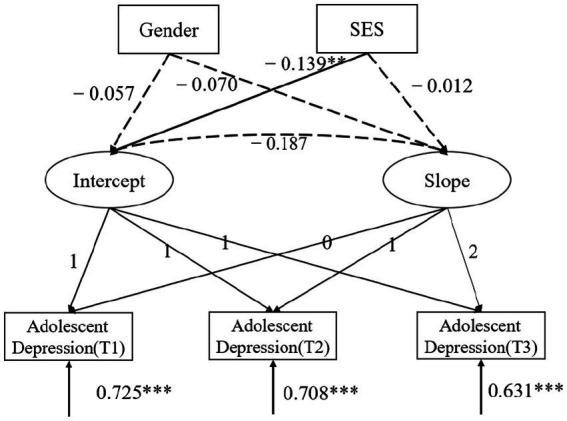
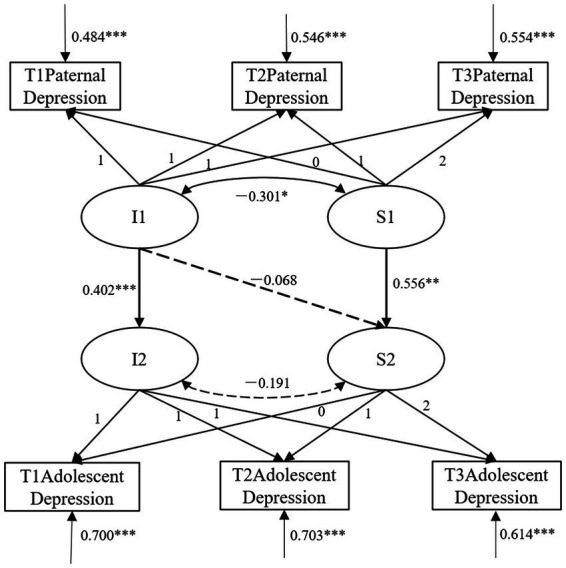
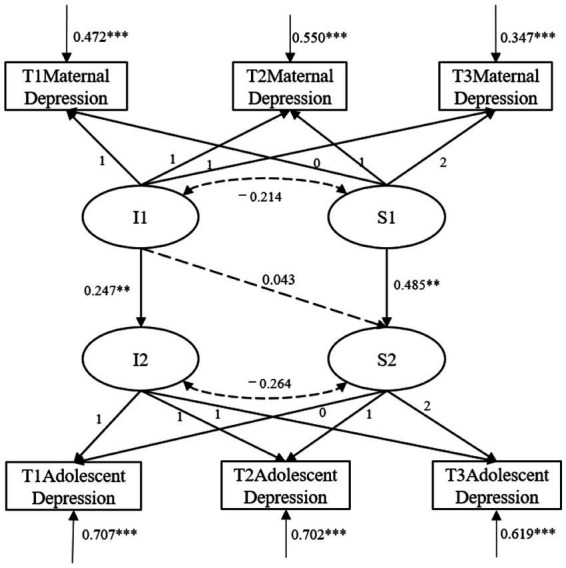
Results: The results of the Latent Growth Curve Analysis revealed an upward trend in the longitudinal measurement of paternal depression (β = 0.483, p < 0.001) and adolescent depression (β = 0.318, p < 0.001), while maternal depression showed a downward trend (β = -0.340, p = 0.015). The results of the parallel process model indicated that the intercept and slope of paternal depression significantly predicted the intercept and slope of adolescent depression, respectively (βIntercept = 0.169, p = 0.015; βSlope = 0.488, p = 0.008). However, the intercept of paternal depression did not significantly predict the slope of adolescent depression (β = 0.129, p > 0.05). Similarly, the intercept and slope of maternal depression significantly predicted the intercept and slope of adolescent depression, respectively (βIntercept = 0.253, p < 0.001; βSlope = 0.371, p = 0.006). The intercept of maternal depression did not significantly predict the slope of adolescent depression (β = 0.033, p > 0.05).
Conclusion: Both paternal and maternal depression should be given equal attention. The developmental trajectories of both paternal and maternal depression influence the developmental trajectory of adolescent depression.
Keywords: adolescent depression; development trajectory; latent growth analysis; maternal depression; paternal depression.
Copyright © 2025 Zhai and Yang.
Conflict of interest statement
The authors declare that the research was conducted in the absence of any commercial or financial relationships that could be construed as a potential conflict of interest.
Figures
References
-
- Bi K., Li T., Merrin G. J., Zhang C., Wang Y., Xiao Y., et al. (2024). Are there reciprocal interplays among Chinese adolescents’, fathers’, and mothers’ depression at the within-family level? A family systems perspective. J. Psychopathol. Clin. Sci. 133, 140–154. doi: 10.1037/abn0000883, PMID: - DOI - PubMed
Publication types
LinkOut - more resources
Full Text Sources
