


Quantifying evolutionary changes to temperature-CO2 growth response surfaces in Skeletonema marinoi after adaptation to extreme conditions
- PMID: 40371177
- PMCID: PMC12075770
- DOI: 10.1093/ismeco/ycaf069
Quantifying evolutionary changes to temperature-CO2 growth response surfaces in Skeletonema marinoi after adaptation to extreme conditions
Abstract
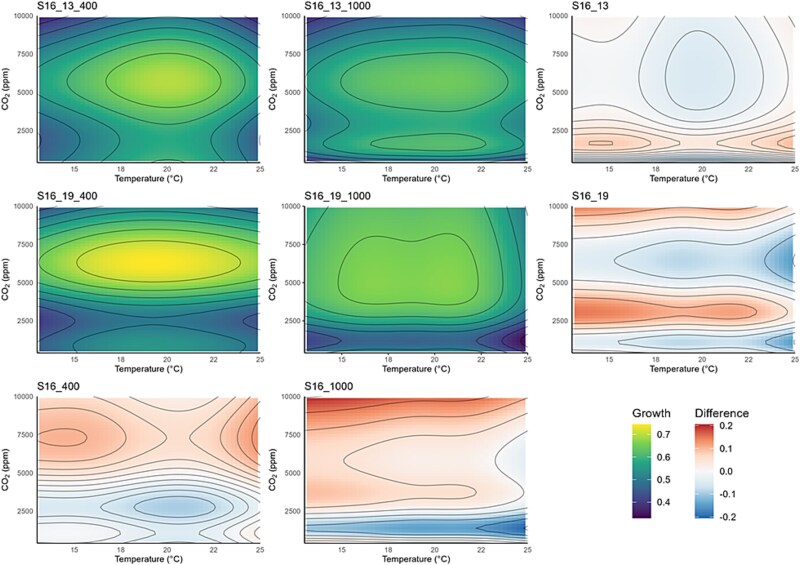
Global warming and ocean acidification are having an unprecedented impact on marine ecosystems, yet we do not yet know how phytoplankton will respond to simultaneous changes in multiple drivers. To better comprehend the combined impact of oceanic warming and acidification, we experimentally estimated how evolution shifted the temperature-CO2 growth response surfaces of two strains of Skeletonema marinoi that were each previously adapted to four different temperature × CO2 combinations. These adapted strains were then grown under a factorial combination of five temperatures and five CO2 concentrations to capture the temperature-CO2 response surfaces for their unacclimated growth rates. The development of the first complete temperature-CO2 response surfaces showed the optimal CO2 concentration for growth to be substantially higher than expected future CO2 levels (~6000 ppm). There was minimal variation in the optimal CO2 concentration across the tested temperatures, suggesting that temperature will have a greater influence on growth rates compared to enhanced CO2. Optimal temperature did not show a unimodal response to CO2, either due to the lack of acclimation or the highly efficient CO2 concentrating mechanisms, which diatoms (e.g. Skeletonema) can up-/downregulate depending on the CO2 conditions. We also found that both strains showed evidence of evolutionary shifts as a result of adaptation to temperature and CO2. The evolutionary response differed between strains, underscoring how genetic differences (perhaps related to historical regimes) can impact phytoplankton performance. Understanding how a dominant algal species responds to multiple drivers provides insight into real-world scenarios and helps construct theoretical predictions of environmental change.
Keywords: adaptation; diatoms; generalized additive models; response surfaces; trade-offs.
© The Author(s) 2025. Published by Oxford University Press on behalf of the International Society for Microbial Ecology.
Conflict of interest statement
None declared.
Figures


References
-
- Wang S, Foster A, Lenz EA. et al. Mechanisms and impacts of earth system tipping elements. Rev Geophys 2023;61:e2021RG000757. 10.1029/2021RG000757 - DOI
-
- Calvin K, Dasgupta D, Krinner G. et al. IPCC, 2023: Climate Change 2023: Synthesis Report. Contribution of Working Groups I, II and III to the Sixth Assessment Report of the Intergovernmental Panel on Climate Change [Core Writing Team, H. Lee and J. Romero (Eds.)]. Geneva, Switzerland: Intergovernmental Panel on Climate Change: IPCC, 2023, 35–115.
-
- Friedlingstein P, O’sullivan M, Jones MW. et al. Global carbon budget 2022. Earth System Science Data 2022;14:4811–900. 10.5194/essd-14-4811-2022 - DOI
-
- Maugendre L, Gattuso JP, Louis J. et al. Effect of ocean warming and acidification on a plankton community in the NW Mediterranean Sea. ICES J Mar Sci 2015;72:1744–55. 10.1093/icesjms/fsu161 - DOI
-
- Phillips JC, McKinley GA, Bennington V. et al. The potential for CO2-induced acidification in freshwater: a Great Lakes case study. Oceanography 2015;25:136–45. 10.5670/oceanog.2015.37 - DOI
LinkOut - more resources
Full Text Sources
