


Concepts for point-of-care ultrasound training in low resource settings: a scoping review
- PMID: 40372568
- PMCID: PMC12081813
- DOI: 10.1186/s13089-025-00427-3
Concepts for point-of-care ultrasound training in low resource settings: a scoping review
Abstract
Background: Point-of-care ultrasound (POCUS) is a potent diagnostic tool especially in resource-limited settings. The implementation of POCUS diagnostics requires adequate training of POCUS operators. This scoping review aimed to identify and describe POCUS training concepts that have been applied in low-and middle-income countries (LMICs).
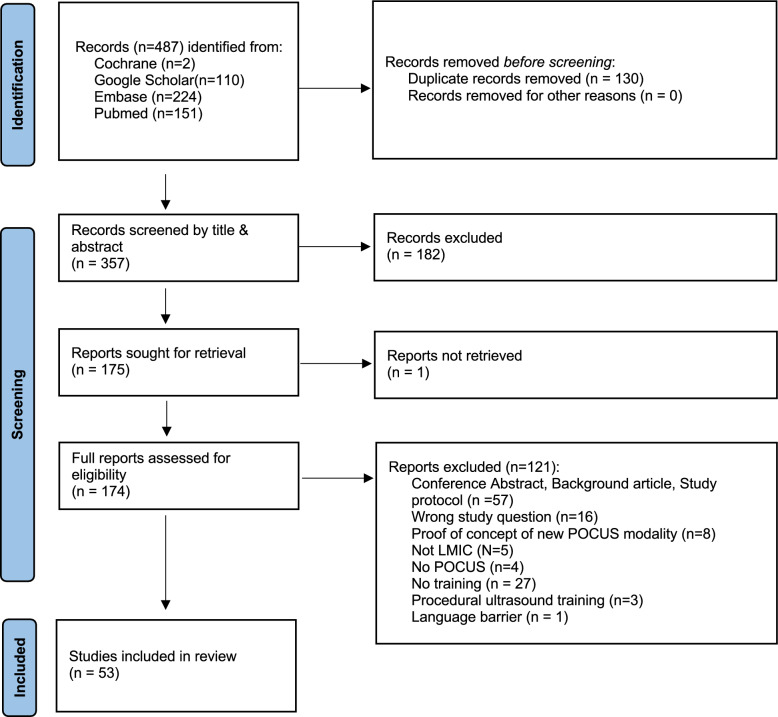
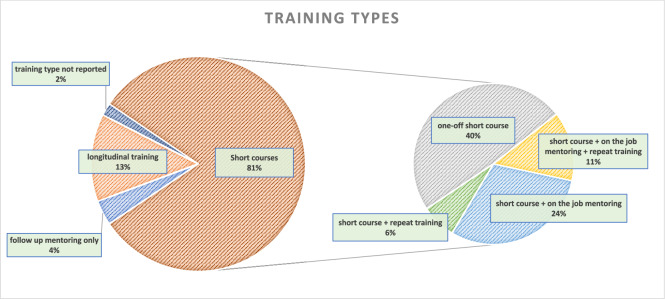
Methods and findings: All studies on diagnostic POCUS training in LMICs that could be found in the Cochrane, Embase, Google Scholar, and Medline databases up to July 6, 2023, were included and data was extracted for descriptive analysis. The review protocol was registered at OSF https://doi.org/10.17605/OSF.IO/8FQJW . A total of 53 publications were included with 59% of studies (n = 31) conducted in Africa and 23% (n = 12) in Asia. The majority of studies (n = 41, 81%) described short courses amongst which 40% were one-off sessions and 60% described longitudinal trainings. Curricula were mostly related to emergency medicine and obstetrics and organ-focused protocols (lung n = 29 (54%), cardiac n = 28 (53%), obstetric n = 23 (43%)). Trainees were largely medical doctors and clinical officers with minimal or absent ultrasound skills. Training challenges included resource constraints and lack of context adaptation. Best practice recommendations included focus on hands-on training, low trainer to trainee ratio, protected training time, online training options, use of local trainers, short and concise training manuals in print, continuous supervision and early and on-going evaluation, as well as tele-mentoring.
Conclusions: Context integration and focus on local needs, trainer availability and suitability, durable equipment and maintenance, as well as emphasis on hands on training including patients with relevant pathology, were key aspects for targeted and sustainable POCUS training in LMICs identified in this review.
Keywords: LMIC; POCUS; Point of care ultrasound; Training.
© 2025. The Author(s).
Conflict of interest statement
Declarations. Conflict of interest: The authors declare that they have no competing interests. Ethical approval and consent to participate:: As published and publicly available literature forms the basis of the review, ethical approval was not required for this investigation. Consent for publication: Not applicable.
Figures

References
-
- Belard S, Tamarozzi F, Bustinduy AL, Wallrauch C, Grobusch MP, Kuhn W et al (2016) Point-of-care ultrasound assessment of tropical infectious diseases–a review of applications and perspectives. Am J Trop Med Hyg 94(1):8–21. 10.4269/ajtmh.15-0421. (Epub 20150928. PubMed PMID: 26416111; PubMed Central PMCID: PMCPMC4710450) - DOI - PMC - PubMed
-
- Huson MAM, Kaminstein D, Kahn D, Belard S, Ganesh P, Kandoole-Kabwere V et al (2019) Cardiac ultrasound in resource-limited settings (CURLS): towards a wider use of basic echo applications in Africa. Ultrasound J 11(1):34. 10.1186/s13089-019-0149-0. (Epub 20191227. PubMed PMID: 31883027; PubMed Central PMCID: PMCPMC6934640) - DOI - PMC - PubMed
-
- Remppis J, Verheyden A, Bustinduy AL, Heller T, Garcia-Tardon N, Manouana GP et al (2020) Focused Assessment with Sonography for Urinary Schistosomiasis (FASUS)-pilot evaluation of a simple point-of-care ultrasound protocol and short training program for detecting urinary tract morbidity in highly endemic settings. Trans R Soc Trop Med Hyg 114(1):38–48. 10.1093/trstmh/trz101. (PubMed PMID: 31735956) - DOI - PubMed
Publication types
LinkOut - more resources
Full Text Sources