


Rudhira-mediated microtubule stability controls TGFβ signaling during mouse vascular development
- PMID: 40372775
- PMCID: PMC12080998
- DOI: 10.7554/eLife.98257
Rudhira-mediated microtubule stability controls TGFβ signaling during mouse vascular development
Abstract
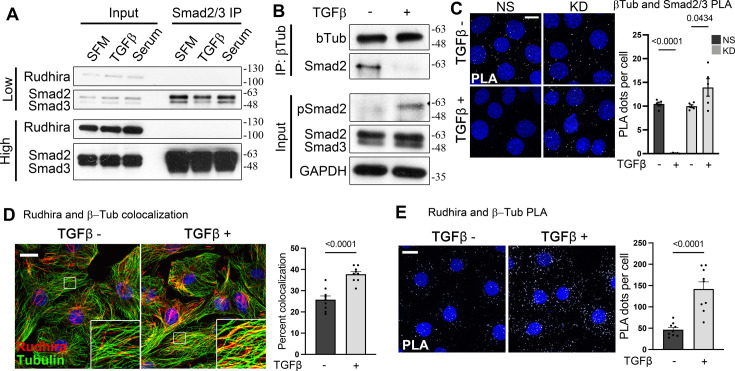
The transforming growth factor β (TGFβ) signaling pathway is critical for survival, proliferation, and cell migration, and is tightly regulated during cardiovascular development. Smads, key effectors of TGFβ signaling, are sequestered by microtubules (MTs) and need to be released for pathway function. Independently, TGFβ signaling also stabilizes MTs. Molecular details and the in vivo relevance of this cross-regulation remain unclear, understanding which is important in complex biological processes such as cardiovascular development. Here, we use rudhira/Breast Carcinoma Amplified Sequence 3 (Bcas3), an MT-associated, endothelium-restricted, and developmentally essential proto-oncogene, as a pivot to decipher cellular mechanisms in bridging TGFβ signaling and MT stability. We show that Rudhira regulates TGFβ signaling in vivo, during mouse cardiovascular development, and in endothelial cells in culture. Rudhira associates with MTs and is essential for the activation and release of Smad2/3 from MTs. Consequently, Rudhira depletion attenuates Smad2/3-dependent TGFβ signaling, thereby impairing cell migration. Interestingly, Rudhira is also a transcriptional target of Smad2/3-dependent TGFβ signaling essential for TGFβ-induced MT stability. Our study identifies an immediate early physical role and a slower, transcription-dependent role for Rudhira in cytoskeleton-TGFβ signaling crosstalk. These two phases of control could facilitate temporally and spatially restricted targeting of the cytoskeleton and/or TGFβ signaling in vascular development and disease.
Keywords: BCAS3; Rudhira; Smad2/3; TGFβ signaling; cell biology; developmental biology; microtubule cytoskeleton; mouse.
© 2024, Joshi, Jindal et al.
Conflict of interest statement
DJ, PJ, RS No competing interests declared, MI Reviewing editor, eLife
Figures





Update of
- doi: 10.1101/2024.04.23.590724
- doi: 10.7554/eLife.98257.1
- doi: 10.7554/eLife.98257.2
- doi: 10.7554/eLife.98257.3
References
-
- Bärlund M, Monni O, Weaver JD, Kauraniemi P, Sauter G, Heiskanen M, Kallioniemi O-P, Kallioniemi A. Cloning of BCAS3 (17q23) and BCAS4 (20q13) genes that undergo amplification, overexpression, and fusion in breast cancer. Genes, Chromosomes & Cancer. 2002;35:311–317. doi: 10.1002/gcc.10121. - DOI - PubMed
MeSH terms
Substances
Grants and funding
LinkOut - more resources
Full Text Sources
