Firing Activities of REM- and NREM-Preferring Neurons Are Differently Modulated by Fast Network Oscillations and Behavior in the Hippocampus, Prelimbic Cortex, and Amygdala
- PMID: 40374559
- PMCID: PMC12118951
- DOI: 10.1523/ENEURO.0575-24.2025
Firing Activities of REM- and NREM-Preferring Neurons Are Differently Modulated by Fast Network Oscillations and Behavior in the Hippocampus, Prelimbic Cortex, and Amygdala
Abstract
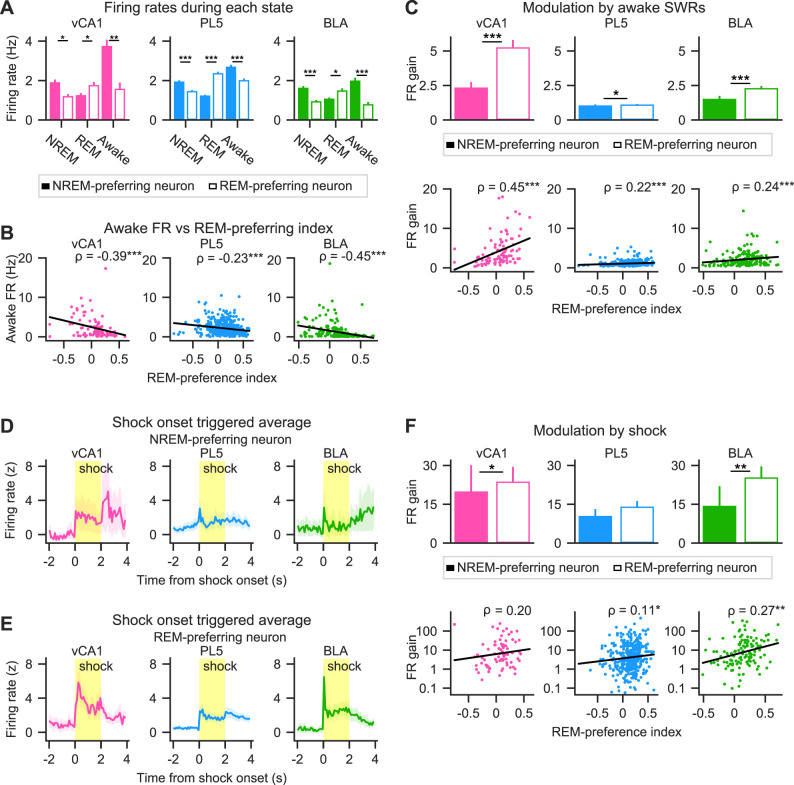
Sleep consists of two alternating states-rapid eye movement (REM) and non-REM (NREM) sleep. Neurons adjust their firing activity based on brain state, however, the extent to which this modulation varies across neurons and brain regions remains poorly understood. This study analyzed previously acquired 17-h continuous recordings of single-unit activity and local field potentials in the ventral hippocampal CA1 region, prelimbic cortex layer 5, and basolateral nucleus of the amygdala of fear-conditioned rats. The findings indicate that more than half of the neurons fired faster during REM sleep than during NREM sleep, although a notable subset of neurons exhibited the opposite preference, firing preferentially during NREM sleep. During sleep, the overall firing activity of both REM- and NREM-preferring neurons decreased. However, fast network oscillations, including hippocampal sharp-wave ripples (SWRs), amygdalar high-frequency oscillations, cortical ripples, and cortical spindles, differentially modulated REM- versus NREM-preferring neurons. During wakefulness, REM-preferring neurons fired more slowly but were more intensely activated by SWRs and shock presentations than NREM-preferring neurons. Moreover, during fast network oscillations in sleep, neurons with similar REM/NREM preferences exhibited stronger within- and cross-regional coactivation than those with differing preferences. Conversely, during awake SWRs in fear conditioning sessions, neurons with different REM/NREM preferences showed stronger interregional coactivation than those with similar preferences. These findings suggest that the distinct activity patterns of REM- and NREM-preferring neurons, potentially reflecting different roles in memory, affect local and global networks differently, thereby balancing experience-dependent network modifications with sleep-dependent homeostatic regulation of neuronal excitability.
Keywords: REM sleep; cortical ripples; inter-regional coactivation; non-REM sleep; sharp-wave ripples; spindles.
Copyright © 2025 Kajiya et al.
Conflict of interest statement
The authors declare no competing financial interests.
Figures




References
MeSH terms
LinkOut - more resources
Full Text Sources
Miscellaneous