Clinical Trial
. 2025 May 15;15(1):16897.
doi: 10.1038/s41598-025-01705-9.

Effects of metformin on transcriptomic and metabolomic profiles in breast cancer survivors enrolled in the randomized placebo-controlled MetBreCS trial

Affiliations
Clinical Trial

Effects of metformin on transcriptomic and metabolomic profiles in breast cancer survivors enrolled in the randomized placebo-controlled MetBreCS trial

Pouda Panahandeh Strømland et al. Sci Rep. .

Abstract

Metformin reduces the incidence of breast cancer in patients with obesity and type 2 diabetes. However, our knowledge of the effects of metformin on breast cancer recurrence is limited. Within the randomized double-blind placebo-controlled phase II trial MetBreCS, we examined changes in breast tissue from breast cancer survivors with BMI > 25 kg/m2 after treatment with metformin. To identify metformin-regulated signaling pathways, we integrated the transcriptomic, metabolomic and steroid hormone profiles using bivariate and functional analyses. We identified MS4A1, HBA2, MT-RNR1, MT-RNR2, EGFL6 and FDCSP expression to be differentially expressed in breast tissues from metformin-treated postmenopausal women. The integration of transcriptomic and metabolomic profiles revealed down-regulation of immune response genes associated with reduced levels of arginine and citrulline in the metformin-treated group. The integration of transcriptomic and steroid hormone profiles showed an enrichment of steroid hormone biosynthesis and metabolism pathways with highly negatively correlated CYP11A1 and CYP1B1 expression in breast tissue from postmenopausal metformin-treated women. Our results indicate that postmenopausal breast cancer survivors treated with metformin have specific changes in breast tissue gene expression that may prevent the development of new tumors.Trial registration: MetBreCs trial is registered at European Union Clinical Trials Register (EudraCT Protocol # 2015-001001-14) on 07/10/2015.

Keywords: 17β-estradiol; Breast cancer recurrence; Estrone; Metabolomics; Metformin; Sex steroid hormones.


Conflict of interest statement

Declarations. Competing interests: The authors declare no competing interests.

Figures
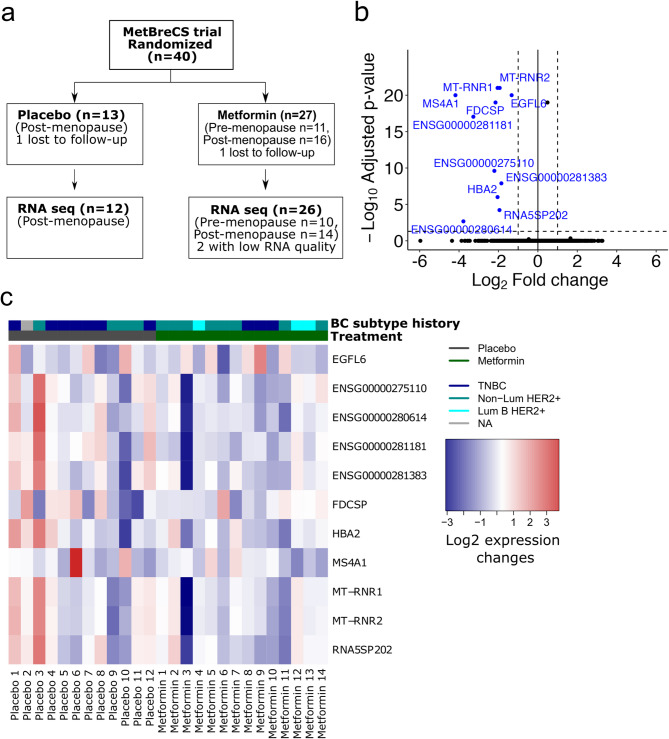
Fig. 1
Fig. 1
Metformin reduces the expression of tumorigenic genes MS4A1, MT-RNR1/2 and HBA2 in breast tissue. (a) Flow diagram of the pre- and postmenopausal women who participated in the MetBreCS trial. (b) Volcano plot showing deregulated genes comparing the transcriptomic profile of postmenopausal women treated with metformin (n = 14) vs. those treated with placebo (n = 12) using a time course likelihood ratio test analysis. The significant (adjusted p < 0.01) down-regulated genes (blue) are represented as log2 fold changes < 1.0 when comparing metformin vs. placebo. (c) Heatmap presenting the log2 gene expression changes (post-treatment vs. baseline) of the differentially expressed genes in panel B. The values are centered on the median of each gene expression change.
Fig. 2
Fig. 2
Metformin-induced decreases in plasma arginine and citrulline are associated with the down-regulation of immune response-related genes in postmenopausal women. (a) Functional analysis on the Spearman´s rank correlation between breast tissue gene expression changes (post-treatment vs., baseline) and plasma level changes (post-treatment vs. baseline) of the amino acid arginine revealed down-regulation of fat cell differentiation and endothelial proliferation and migration in the postmenopausal women treated with metformin compared to placebo. (b) Functional analysis on the Spearman´s rank correlation between breast tissue gene expression changes and plasma level changes of the amino acid citrulline revealed down-regulation of immune cell activation, proliferation and differentiation, and increased mammary gland morphogenesis in the postmenopausal women treated with metformin compared to those treated with placebo. The bar plots in panels A and B show the top 20 highly enriched pathways in placebo-treated and metformin-treated postmenopausal women, respectively. The bars represent the NESs. The significantly enriched pathways are shown as adjusted p-value < 0.01.
Fig. 3
Fig. 3
Changes in serum estrogens are associated with plasma metabolite changes in postmenopausal metformin-treated women. (a) The box plots represent changes (post-treatment vs. baseline) in serum E1 and E2 in the postmenopausal women treated with placebo or metformin in the MetBreCS trial. The negative β-regression coefficients derived from the multivariable linear model fit on these changes, adjusted for the baseline value of each steroid hormone and baseline BMI, indicate a decrease in serum E1 and E2 in the metformin arm. The p-value of the treatment covariate (Metformin vs. Placebo) from the multivariate linear model fit and the FDR-corrected p-value are indicated above the graphs. (b,c) Highly correlated plasma metabolite changes (post-treatment vs. baseline) with serum E1 and E2 changes in postmenopausal placebo- (panel B) and metformin-treated (panel C) groups. Positively and negatively correlated metabolites are represented by blue and red lines, respectively. The thickness of the lines indicates the correlation coefficient values (Spearman´s correlation coefficient > 0.5, p < 0.05).
Fig. 4
Fig. 4
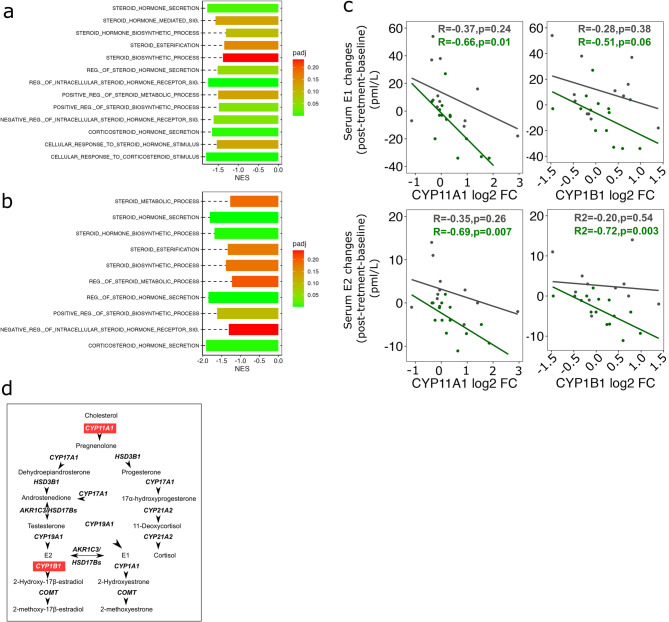
Serum estrogens are associated with the steroid metabolism pathway in breast tissue from metformin-treated postmenopausal women. (a,b) Functional analysis of the Spearman´s rank correlation between breast tissue gene expression changes (post-treatment vs. baseline) and serum level changes (post-treatment vs. baseline) of the steroid hormones E1 (a) and E2 (b) revealed enrichment of steroid hormone biosynthesis and metabolism pathways in the postmenopausal metformin-treated group. The bars represent NESs. The significant enriched pathways are shown as adjusted p-value (p-adj) < 0.25. (c) Significantly correlated CYP11A1 and CYP1B1 gene expression changes and serum level changes of E1 and E2. The linear regression lines are plotted for placebo- (gray) and metformin-treated (green) groups. (d) Summary of the steroid biosynthesis and metabolism pathway (adapted from KEGG, hsa00140 with permission from Kanehisa Laboratories). CYP11A1 catalyzes the conversion of cholesterol to pregnenolone, the first and rate-limiting step in steroid biosynthesis. CYP1B1, a major E2 hydroxylase, catalyzes the metabolism of E2 to catechol estrogens (2-OHE2 and 4-OHE2) and highly reactive estrogen quinones (E2-2, 3-Q and E2-3, 4-Q)

References

    1. van den Brandt, P. A. et al. Pooled analysis of prospective cohort studies on height, weight, and breast cancer risk. Am. J. Epidemiol.152, 514–527. 10.1093/aje/152.6.514 (2000). - PubMed
    1. De Bruijn, K. M. et al. Systematic review and meta-analysis of the association between diabetes mellitus and incidence and mortality in breast and colorectal cancer. Br. J. Surg.100, 1421–1429. 10.1002/bjs.9229 (2013). - PubMed
    1. Calle, E. E., Rodriguez, C., Walker-Thurmond, K. & Thun, M. J. Overweight, obesity, and mortality from cancer in a prospectively studied cohort of U.S. Adults. N. Engl. J. Med.348, 1625–1638. 10.1056/NEJMoa021423 (2003). - PubMed
    1. Goodwin, P. J. et al. Fasting insulin and outcome in early-stage breast cancer: results of a prospective cohort study. J. Clin. Oncol.20, 42–51. 10.1200/JCO.2002.20.1.42 (2002). - PubMed
    1. Renehan, A. G., Tyson, M., Egger, M., Heller, R. F. & Zwahlen, M. Body-mass index and incidence of cancer: a systematic review and meta-analysis of prospective observational studies. Lancet371, 569–578. 10.1016/S0140-6736(08)60269-X (2008). - PubMed

Publication types

LinkOut - more resources