


Polypoid Cystitis: A Retrospective Case-Series of 112 Dogs
- PMID: 40375558
- PMCID: PMC12081821
- DOI: 10.1111/jvim.70049
Polypoid Cystitis: A Retrospective Case-Series of 112 Dogs
Erratum in
-
Erratum for "Polypoid Cystitis: A Retrospective Case-Series of 112 Dogs".J Vet Intern Med. 2025 Jul-Aug;39(4):e70155. doi: 10.1111/jvim.70155. J Vet Intern Med. 2025. PMID: 40530913 Free PMC article. No abstract available.
Abstract
Background: Polypoid cystitis (PoC) in dogs is associated with chronic inflammatory bladder conditions and is discovered during evaluation for signs of lower urinary tract disease, or incidentally.
Objective: To describe PoC in dogs evaluated in an academic practice.
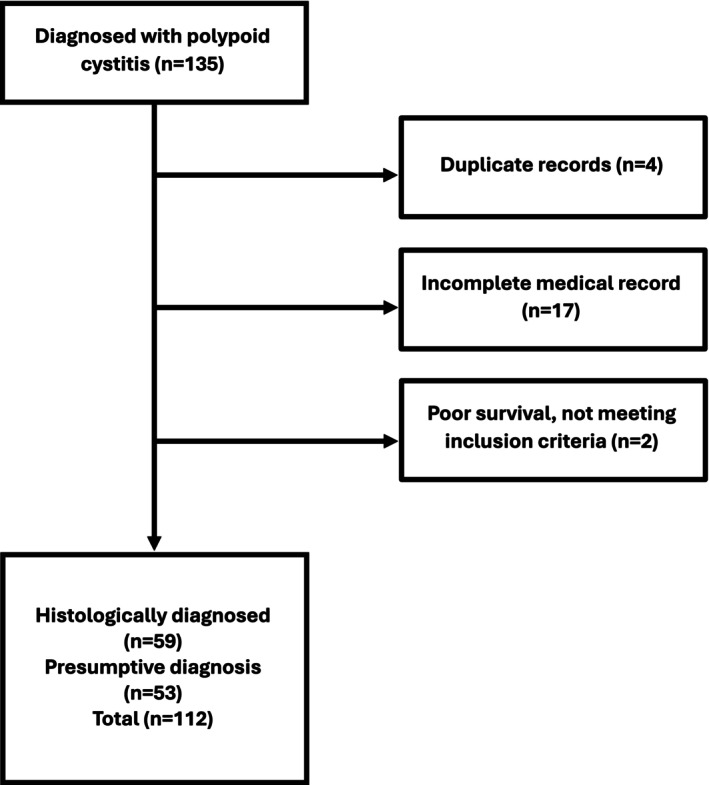
Animals: Dogs with confirmed (n = 59) or presumptive (n = 53) PoC were evaluated between January 2004 and October 2020.
Methods: For this retrospective study, medical records were searched for PoC.
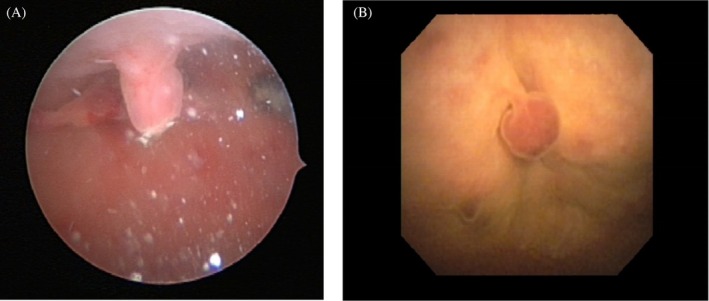
Results: The most common presenting signs of 112 dogs with PoC were hematuria (n = 42; 38%), stranguria (n = 28; 25%), and pollakiuria (n = 25; 22%). Polyps were found incidentally (n = 13; 12%). Urinary tract infection (UTI; n = 61; 54%) or urolithiasis (n = 38; 34%) was a common presumptive cause. Escherichia coli (n = 39; 53%), Enterococcus faecalis (n = 14; 19%) and Staphylococcus pseudintermedius (n = 5; 7%) were isolated from dogs with UTI. Ultrasonographic findings (n = 101) included polypoid structures (n = 44; 44%), broad-based masses (n = 16; 26%), and bladder wall thickening (n = 25; 25%); mostly in the cranioventral bladder apex (n = 56; 80%). Of 41 specimens tested, none had evidence of the BRAF V595E mutation. Urinary tract neoplasia was not reported in any dog during follow-up (range 1 month-8.4 years; median 8 months). Interventions included antibiotic or anti-inflammatory administration, and surgical or cystoscopic ablation. During follow-up, recurrent signs of lower urinary tract disease were reported in 23 (20%) dogs.
Conclusions and clinical importance: History of either UTI or urolithiasis, compatible imaging findings, and absence of detectable BRAF V595E mutation support the presumptive diagnosis of PoC in dogs. Affected dogs have a good prognosis, warranting differentiation from other urinary tract diseases.
Keywords: BRAF V595E mutation; bladder; inflammatory; polyp; urinary tract.
© 2025 The Author(s). Journal of Veterinary Internal Medicine published by Wiley Periodicals LLC on behalf of American College of Veterinary Internal Medicine.
Conflict of interest statement
All BRAF V595E mutation detection was performed at North Carolina State University using testing that was developed there. Shelly L. Vaden serves as Associate Editor for the Journal of Veterinary Internal Medicine. She was not involved in the review of this manuscript. The other authors declare no conflicts of interest.
Figures

References
-
- Johnston S. D., Osborne C. A., and Stevens J. B., “Canine Polypoid Cystitis,” Journal of the American Veterinary Medical Association 166 (1975): 1155–1160. - PubMed
MeSH terms
LinkOut - more resources
Full Text Sources
Research Materials
Miscellaneous
