Association of changes in overall and specific leisure activities with long-term all-cause mortality in older adults: a nationwide cohort study
- PMID: 40377034
- PMCID: PMC12082748
- DOI: 10.7189/jogh.15.04119
Association of changes in overall and specific leisure activities with long-term all-cause mortality in older adults: a nationwide cohort study
Abstract
Background: Leisure activities (LAs) are vital for healthy ageing and are linked to lower mortality risk in older adults. However, most previous longitudinal studies have assessed LAs at only one time point. We aimed to explore the impact of dynamic changes in LAs on subsequent all-cause mortality among older adults.
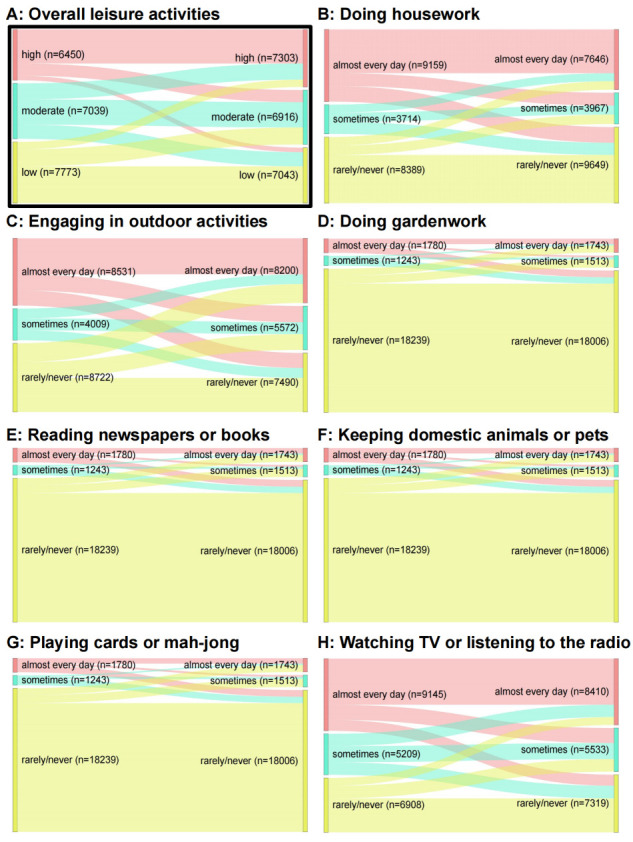
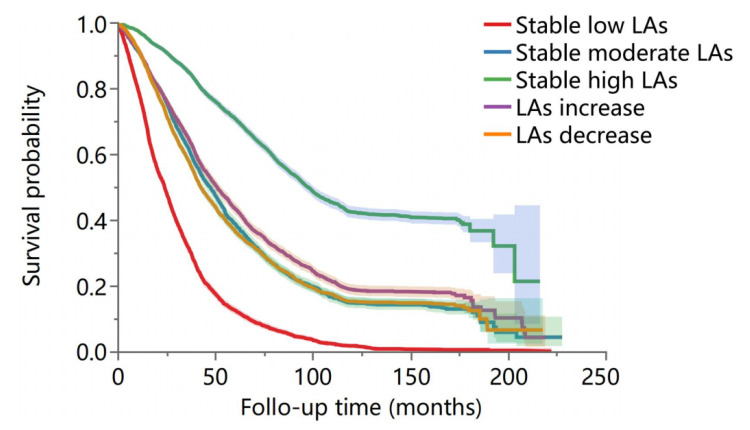
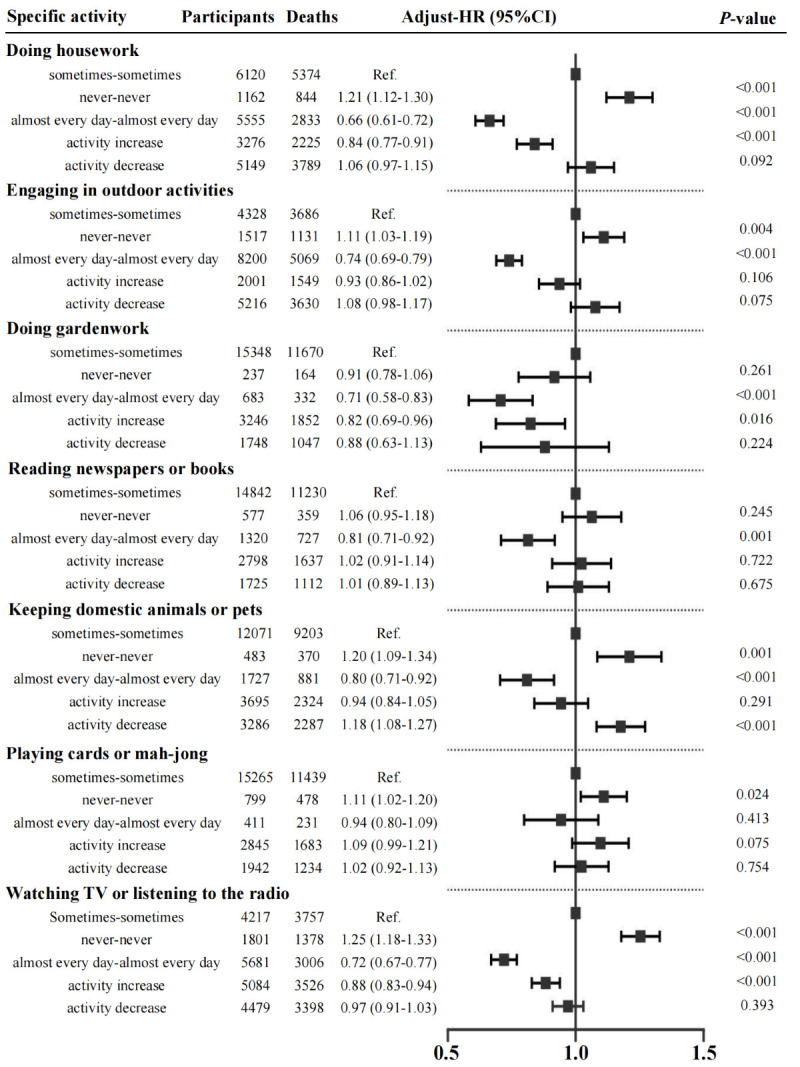
Methods: We enrolled 21 262 older adults who had participated in the six waves of the Chinese Longitudinal Healthy Longevity Survey (CLHLS) in 1998, 2000, 2002, 2005, 2008, and 2011. All participants completed two consecutive assessments of LAs (including seven typical activities) during the first two waves (mean interval = 2.72 years (standard deviation = 0.08)); we further followed them up until 2018, i.e. beyond the 2011 CLHLS. We divided them into five categories according to the change pattern of LAs: stable low (low-low), stable moderate (moderate-moderate), stable high (high-high), LAs increase (low-moderate, low-high, moderate-high), and LAs decrease (high-moderate, high-low, moderate-low). We used a Cox proportional hazard model to test the association between changes in LAs and all-cause mortality, including demographic characteristics, health behaviours, and disease history as covariates.
Results: We documented 15 065 death events during 80 045.39 person-years of follow-up. Compared with the stable moderate group, the adjusted hazard ratios (aHRs) of mortality for the stable low group and stable high group were 1.27 (95% confidence interval (CI) = 1.21-1.35) and 0.66 (95% CI = 0.62-0.71), respectively. An increase in LAs was associated with a lower risk of mortality (aHR = 0.83; 95% CI = 0.78-0.88), while a decrease in LAs was associated with a higher risk of mortality (aHR = 1.05; 95% CI = 1.01-1.09). The protective effect of LAs increase on premature death was more pronounced in men than in women. The main results remained stable in subgroup and sensitivity analyses.
Conclusions: Maintaining and increasing participation in leisure time activities significantly reduced the risk of all-cause mortality in community-dwelling older individuals in our sample.
Copyright © 2025 by the Journal of Global Health. All rights reserved.
Conflict of interest statement
Disclosure of interest: The authors completed the ICMJE Disclosure of Interest Form (available upon request from the corresponding author) and disclose no relevant interests.
Figures
References
MeSH terms
LinkOut - more resources
Full Text Sources