


The differential effect of ambient temperature on age-specific and sex-specific mortality in the 300 largest cities of Russia, 2000-19: a first national time-series study
- PMID: 40381633
- PMCID: PMC12086356
- DOI: 10.1016/S2542-5196(25)00084-1
The differential effect of ambient temperature on age-specific and sex-specific mortality in the 300 largest cities of Russia, 2000-19: a first national time-series study
Abstract
Background: Despite a substantial body of evidence on the association between ambient temperature and mortality worldwide, there has not yet been a comprehensive country-wide assessment of the health effects of temperature in Russia. Moreover, there is no consensus on the effect of non-optimal temperatures on age-specific and sex-specific mortality. Our study aimed to provide the first analysis of temperature-related mortality in a large assembly of cities located in different geographical and socioeconomic zones of Russia.
Methods: We analysed 19 044 538 non-accidental deaths in the 300 most populated cities in Russia between 2000 and 2019. A two-stage analysis strategy was used. First, a quasi-Poisson time-series model with distributed lag non-linear model was fitted to estimate city-specific associations. Second, these associations were pooled with multivariate multilevel meta-regression, from which we also calculated temperature-attributable mortality.
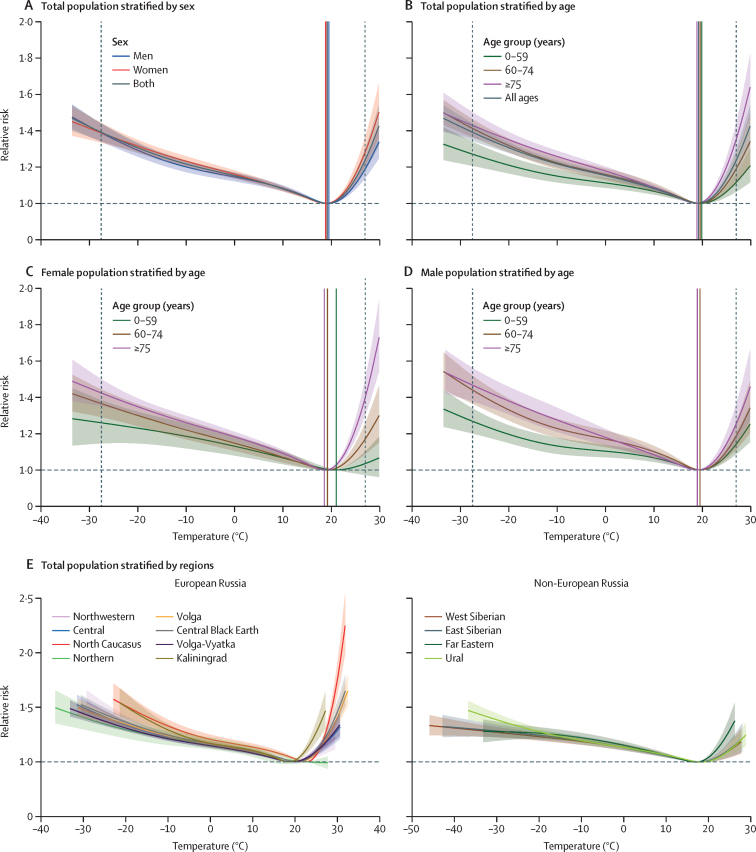
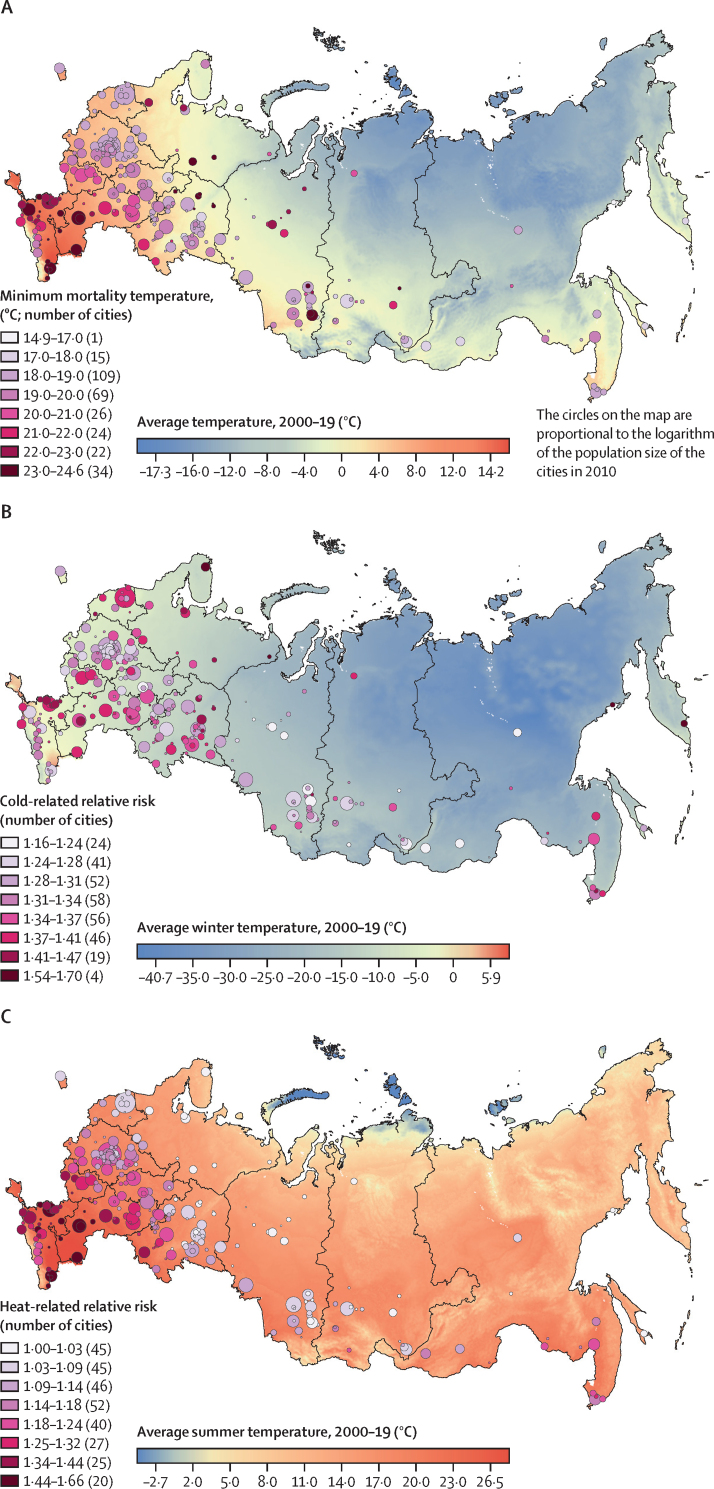
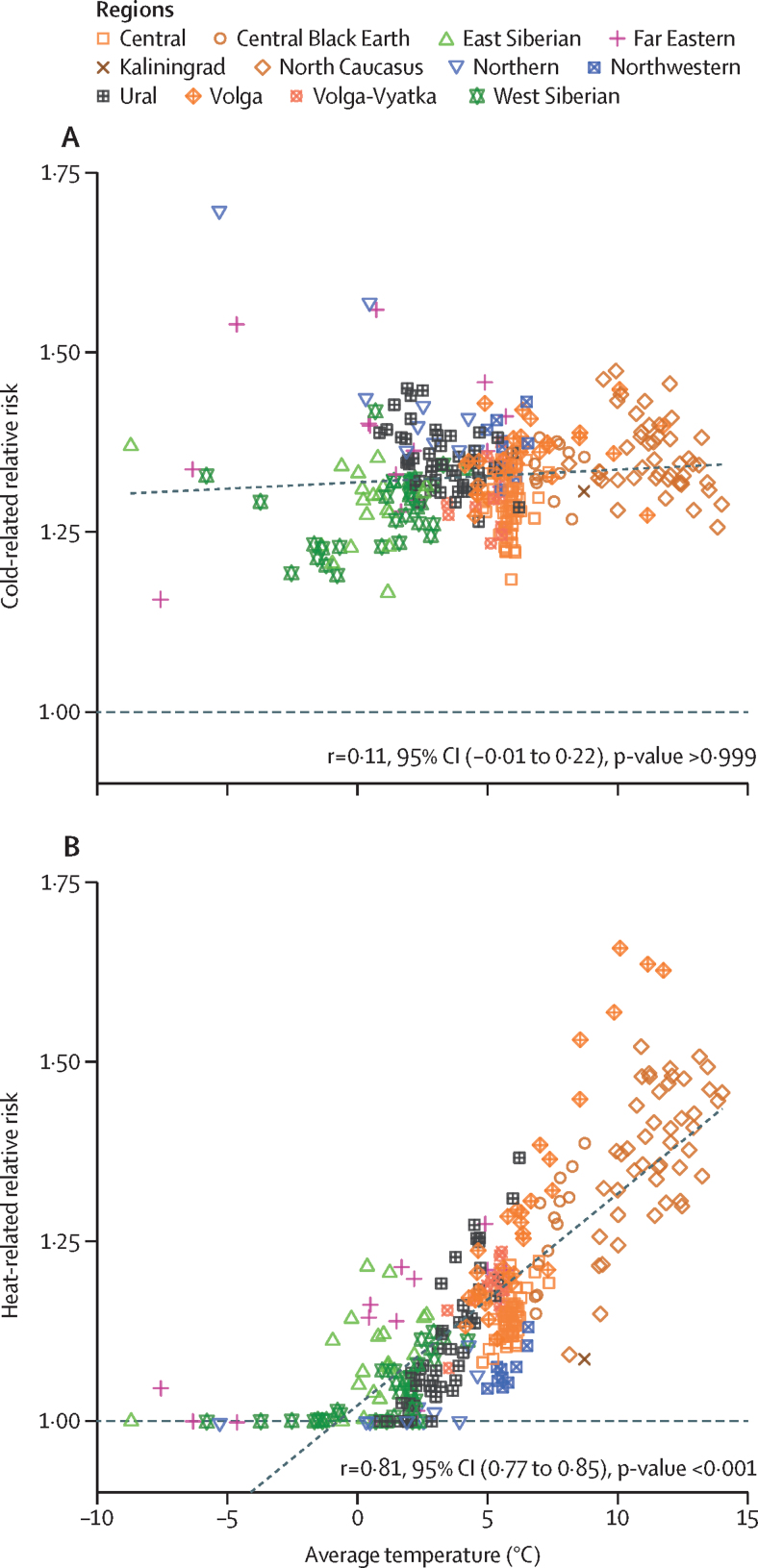
Findings: Relative risks were generally higher for cold than for heat, except for cities in southern European Russia. Cold had a similar effect in both sexes, with a varying age gradient across cities. Although the effect of heat was generally stronger in women than in men, with the relative risk increasing steadily with age in both sexes, men younger than 60 years had a significantly higher risk of dying from heat than women of the same age. With a total of 106 007 (95% empirical CI [eCI]: 88 942-121 318) temperature-attributable deaths, there was a higher mortality attributable fraction for cold (10·74%, 95% eCI 8·80-11·99) than for heat (0·67%, 0·42-0·88).
Interpretation: Russia has a high temperature-related mortality burden, with large differences in risk between cities and subpopulations. This information should be taken into account when planning public health interventions.
Funding: European Research Council, National Health and Medical Research Council, and Australian Research Council.
Copyright © 2025 The Author(s). Published by Elsevier Ltd. This is an Open Access article under the CC BY-NC-ND 4.0 license. Published by Elsevier Ltd.. All rights reserved.
Conflict of interest statement
Declaration of interests We declare no competing interests.
Figures
References
-
- Semenza JC, Rubin CH, Falter KH, et al. Heat-related deaths during the July 1995 heat wave in Chicago. N Engl J Med. 1996;335:84–90. - PubMed
-
- Robine J-M, Cheung SLK, Le Roy S, et al. Death toll exceeded 70,000 in Europe during the summer of 2003. C R Biol. 2008;331:171–178. - PubMed
-
- Maksimenko M, Timonin S, Shartova N, Varentsov M. Urban–rural differences in mortality during the 2010 heatwave in European Russia. Vienna Yearb Pop Res. 2024;22:125–147.
MeSH terms
LinkOut - more resources
Full Text Sources
