Identifying Risk Factors for Myocardial Injury in Elderly Patients with Sepsis
- PMID: 40382677
- PMCID: PMC12101096
- DOI: 10.12659/MSM.947840
Identifying Risk Factors for Myocardial Injury in Elderly Patients with Sepsis
Abstract
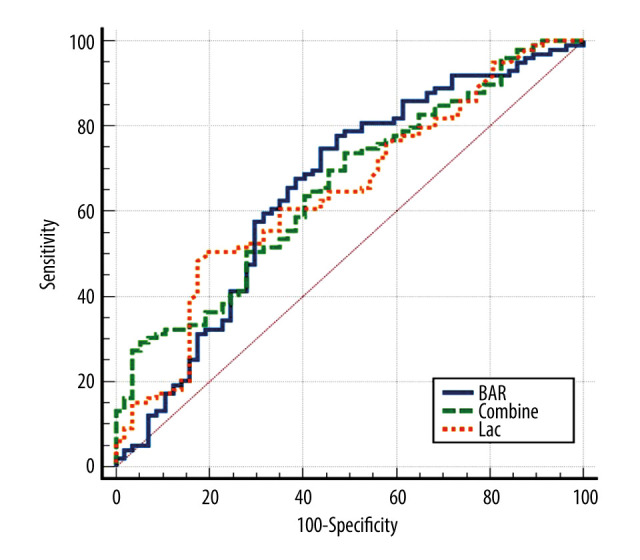
BACKGROUND Myocardial injury is a common complication in elderly patients with sepsis and is associated with poor prognosis. This study aimed to identify clinical characteristics and independent risk factors for myocardial injury in elderly sepsis patients admitted to the Emergency Intensive Care Unit (EICU). MATERIAL AND METHODS A retrospective analysis was conducted on 160 elderly patients with sepsis admitted to the EICU, categorized into myocardial injury and non-myocardial injury groups. Demographic data, inflammatory markers, echocardiographic parameters, and blood urea nitrogen-to-albumin ratio (BAR) values were compared. Logistic regression identified independent risk factors, and ROC curve analysis assessed the predictive value of BAR. RESULTS Of 160 patients, 106 (63.1%) had myocardial injury, with an average age of 77.56±7.49 years. Myocardial injury was associated with lower ejection fraction (EF), and elevated procalcitonin, lactate, and BAR levels (P<0.05). Logistic regression identified septic shock (RR=2.612, P=0.003), elevated BAR (RR=2.272, P=0.035) and lactate levels (RR=1.145, P=0.010) as independent risk factors for myocardial injury. In contrast, increased EF (RR=0.932, P=0.007) was identified as protective against myocardial injury, with lower EF associated with a higher risk. ROC analysis showed that BAR had moderate predictive value (AUC=0.653, P<0.01), with sensitivity of 76.4% and specificity of 53.2% at an optimal cutoff of 0.33. CONCLUSIONS Septic shock, reduced EF, and elevated BAR and lactate levels are independent risk factors for myocardial injury in elderly patients with sepsis. BAR serves as an early marker for myocardial injury, aiding in risk assessment and management in the EICU.
Conflict of interest statement
Figures
References
-
- Reinhart K, Daniels R, Kissoon N, et al. Recognizing sepsis as a global health priority – a WHO resolution. N Engl J Med. 2017;377(5):414–17. - PubMed
-
- Perner A, Cecconi M, Cronhjort M, et al. Expert statement for the management of hypovolemia in sepsis. Intensive Care Med. 2018;44(6):791–98. - PubMed
-
- Prescott HC, Angus DC. Postsepsis morbidity. JAMA. 2018;319(1):91. - PubMed
MeSH terms
Substances
LinkOut - more resources
Full Text Sources
Medical