


Characteristics of research review boards in the context of community-academic settings: A scoping review
- PMID: 40384745
- PMCID: PMC12083201
- DOI: 10.1017/cts.2025.50
Characteristics of research review boards in the context of community-academic settings: A scoping review
Abstract
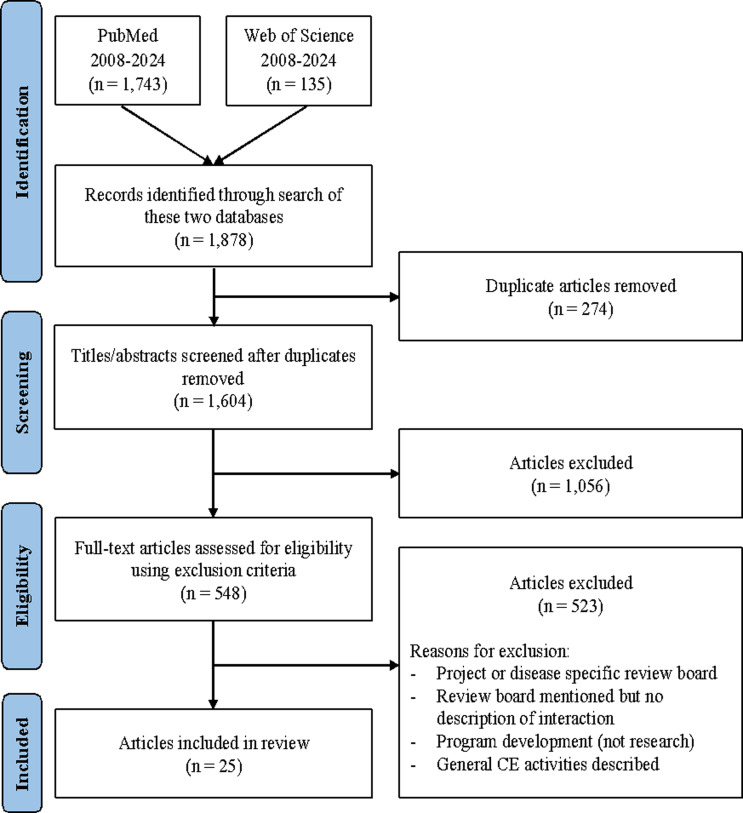
Community advisory boards (CABs) have traditionally been formed in the context of discrete projects and served to support community protections within the confines of the associated investigation(s). However, as funding bodies increasingly prioritize health equity, CABs have shifted - evolving into long-running organizations with broader scope and value. An emerging cornerstone of these project-independent boards (PICABs) has been the formation of "Research Review Boards" (RRBs). While unified in their goal of promoting community protection and representation in health research, it is unknown to what degree RRBs differ on key features including membership, leadership, service reach, and - crucially - impact. A scoping review was conducted according to PRISMA-ScR guidelines to analyze current practices for RRBs. Of screened articles (n= 1878), 25 were included, corresponding to 24 unique RRBs. Findings indicated overlaps in the stated missions, funding structures, and processes of most RRBs. Differences in membership composition, location, service-reach, leadership structures, evaluation procedures, and perceived impact were evident. Where data is available, RRBs receive positive endorsement from both internal members and external users. Standardization of evaluation procedures is needed to fully quantify impact. Additional challenges to sustainability, communication, and conflicts (e.g., of interest, commitment, and power differentials) merit further consideration.
Keywords: Community advisory board; community engagement; equity; research; review.
© The Author(s) 2025.
Conflict of interest statement
The authors have no conflicts of interest to declare that are of relevance to the content of this article.
Figures
References
-
- Bracht N, Tsouros A. Principles and strategies of effective community participation. Health Promot Int. 1990;5(3):199–208. doi: 10.1093/heapro/5.3.199. - DOI
Publication types
LinkOut - more resources
Full Text Sources