


Association Between Body Mass Index and Comorbid Anxiety in First-Episode and Drug Naïve Patients With Major Depressive Disorder
- PMID: 40384809
- PMCID: PMC12085247
- DOI: 10.1155/da/6648190
Association Between Body Mass Index and Comorbid Anxiety in First-Episode and Drug Naïve Patients With Major Depressive Disorder
Abstract
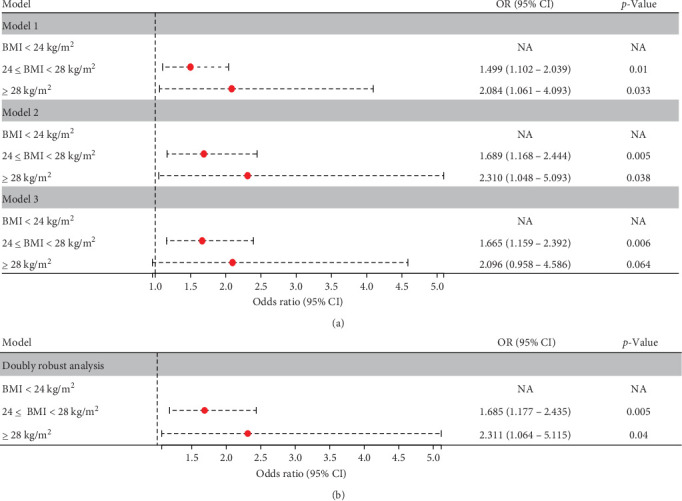
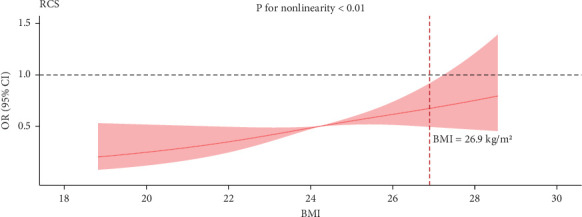
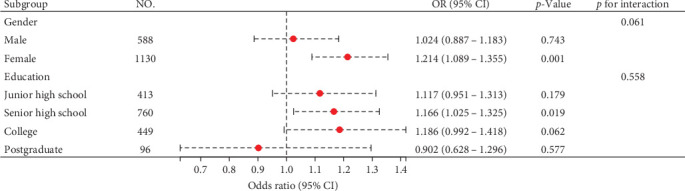
Objective: There is limited evidence regarding the relationship between body mass index (BMI) and anxiety symptoms in individuals with major depressive disorder (MDD), and the findings are controversial. This study aimed to explore the association between BMI and anxiety symptoms in patients with first-episode drug-naïve (FEDN) MDD. Methods: A total of 1718 FEDN MDD patients were included in this study, gathering information on their sociodemographic attributes and physical measurements. BMI was classified into three categories (normal, overweight, and obese) based on the standards of the Working Group on Obesity in China (WGOC). Logistic regression and double robust estimation were used to assess the association between anxiety symptoms and BMI. Additionally, a restricted cubic spline (RCS) analysis was used to examine the relationship between anxiety symptoms and BMI. If nonlinear associations existed, threshold effects were analyzed using a two-piecewise logistic regression model. The subgroup analysis was performed to validate the robustness of the findings. Results: Among 1718 patients, 12.7% (218) exhibited anxiety symptoms. After adjusting for confounding variables, multivariable logistic regression analysis revealed a positive association between BMI and the risk of experiencing anxiety symptoms (OR = 1.13, 95% CI: 1.039-1.229, p=0.004). These findings were further confirmed using a doubly robust estimation. Additionally, RCS analysis revealed a nonlinear correlation between BMI and anxiety symptoms, with a turning point of 26.9 kg/m2. On the left side of the inflection point, a positive association between BMI and anxiety symptoms was detected (OR = 1.167, 95% CI: 1.055-1.296, p=0.003), while no significant association was observed on the right side of the inflection point (OR = 1.01, 95% CI: 0.685-1.341, p=0.972). Subgroup analyses revealed significant variations in the association between gender and education level. Conclusion: This study demonstrated that a higher BMI was associated with an increased risk of experiencing anxiety symptoms in Chinese patients with FEDN MDD, particularly among those with a BMI below 26.9 kg/m2.
Keywords: anxiety symptoms; body mass index; double robust estimation; major depressive disorder; non-linear relationship.
Copyright © 2025 Shilin Liu et al. Depression and Anxiety published by John Wiley & Sons Ltd.
Conflict of interest statement
The authors declare no conflicts of interest.
Figures
References
-
- Cyranowski J. M., Schott L. L., Kravitz H. M., et al. Psychosocial Features Associated With Lifetime Comorbidity of Major Depression and Anxiety Disorders Among a Community Sample of Mid-Life Women: The SWAN Mental Health Study. Depression and Anxiety . 2012;29(12):1050–1057. doi: 10.1002/da.21990. - DOI - PMC - PubMed
MeSH terms
LinkOut - more resources
Full Text Sources
Medical
