


Long-Read Sequencing for the Rapid Response to Infectious Diseases Outbreaks
- PMID: 40384881
- PMCID: PMC12081579
- DOI: 10.1007/s40588-025-00247-y
Long-Read Sequencing for the Rapid Response to Infectious Diseases Outbreaks
Abstract
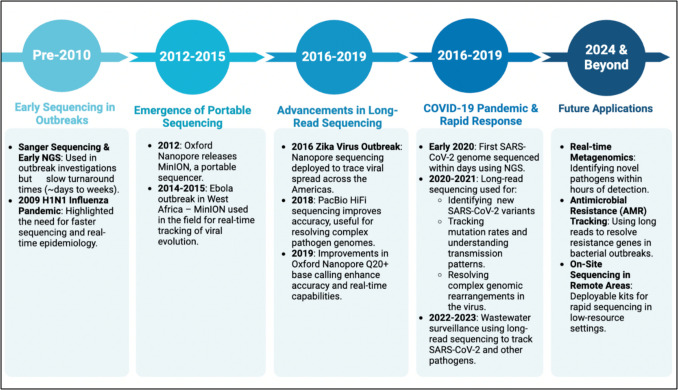
Purpose of review: Long-read sequencing (LRS) has revolutionized pathogen surveillance by enabling real-time, high-fidelity genomic analysis critical for outbreak response. This review synthesizes recent breakthroughs in LRS, evaluating its impact on genomic epidemiology, metagenomics, and public health decision-making while addressing limitations and prospects for integrating LRS into global outbreak surveillance.
Recent findings: Unlike short-read sequencing, LRS-pioneered by Oxford Nanopore Technologies (ONT) and Pacific Biosciences (PacBio)-resolves complex genomic structures, antimicrobial resistance determinants, and transmission dynamics with unprecedented accuracy. The portability of some LRS devices has facilitated rapid pathogen identification in field settings, notably during the Ebola and COVID-19 pandemics. Despite advancements in basecalling algorithms and target enrichment, challenges including sequencing errors, computational bottlenecks, and cost barriers remain.
Summary: By critically evaluating recent findings and discussing future directions, this review highlights the importance of leveraging LRS for outbreak preparedness and response, equipping researchers and public health professionals with the knowledge necessary to navigate the complexities of modern infectious disease challenges.
Keywords: Genomic epidemiology antimicrobial resistance profiling; Metagenomics; Pathogen identification; Real-time surveillance; Third-generation sequencing.
© The Author(s) 2025.
Conflict of interest statement
Conflicts of interestThe authors declare no competing interests.
Figures
References
Publication types
LinkOut - more resources
Full Text Sources
Research Materials