


Case Report: High efficacy of low-dose flecainide as an add-on therapy to a beta-blocker for treating a high burden of idiopathic ventricular arrhythmias in a juvenile athlete
- PMID: 40384969
- PMCID: PMC12081362
- DOI: 10.3389/fcvm.2025.1537078
Case Report: High efficacy of low-dose flecainide as an add-on therapy to a beta-blocker for treating a high burden of idiopathic ventricular arrhythmias in a juvenile athlete
Abstract
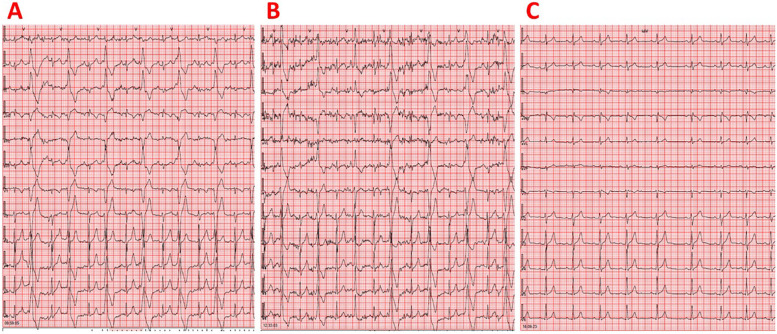
The detection of frequent premature ventricular contractions (PVCs) in an athlete represents one of the most important red flags during pre-participation screening. We report the case of a 6-year-old asymptomatic male athlete practicing basketball and sailing, who was examined for pre-participation screening. His resting electrocardiogram showed very frequent, isolated, monomorphic PVCs. The PVCs exhibited a left bundle branch block morphology with an inferior axis and R/S wave precordial transition in lead V3. The most likely origin of PVCs was considered the left ventricular outflow tract. Resting transthoracic echocardiography revealed reduced left ventricular systolic function, with an ejection fraction of 43%, indicating the possible existence of PVC-induced cardiomyopathy. We detected 43,149 isolated monomorphic PVCs (PVC burden: 40%) on 24-h ambulatory electrocardiographic monitoring. Initiation of treatment with atenolol 12.5 mg twice a day led to inadequate reduction of PVCs, with 29,452 isolated monomorphic PVCs (PVC burden: 29%) still observed on 24-h ambulatory electrocardiographic monitoring. After adding flecainide 25 mg twice daily to atenolol treatment, 24-h ambulatory electrocardiographic monitoring revealed complete resolution of ventricular arrhythmias, with no PVCs detected. Left ventricular systolic function recovered to normal. At 12 years of age, the athlete remained on combination therapy with atenolol and flecainide, continued participating in sports, and remained completely asymptomatic with normal cardiac examinations. The optimization of drug treatment was favored over catheter ablation since the athlete was a child and the probable origin of PVCs was the left ventricular outflow tract. This case report highlights that flecainide at a relatively low dose as an add-on therapy to a beta-blocker was highly effective and safe for treating high-burden PVCs originating from the ventricular outflow tract in a juvenile athlete.
Keywords: athlete; case report; flecainide; sports cardiology; ventricular arrhythmias.
© 2025 Christou, Letsas, Konstandi, Christou, Christou, Kyriakopoulos, Vidalakis, Tigas, Christodoulou and Kiortsis.
Conflict of interest statement
The authors declare that the research was conducted in the absence of any commercial or financial relationships that could be construed as a potential conflict of interest. The author(s) declared that they were an editorial board member of Frontiers at the time of submission. This had no impact on the peer review process and the final decision.
Figures

References
Publication types
LinkOut - more resources
Full Text Sources
