


Effect of early stepwise controlled decompression combined with mild hypothermia therapy on efficacy, cerebral edema volume, and serum biochemical indices in patients with severe hypertensive intracerebral hemorrhage
- PMID: 40385003
- PMCID: PMC12082517
- DOI: 10.62347/TRKY5505
Effect of early stepwise controlled decompression combined with mild hypothermia therapy on efficacy, cerebral edema volume, and serum biochemical indices in patients with severe hypertensive intracerebral hemorrhage
Abstract
Objective: To investigate the effects of early stepwise controlled decompression combined with mild hypothermia therapy (MHT) on clinical outcomes in patients with severe hypertensive intracerebral hemorrhage (sHICH).
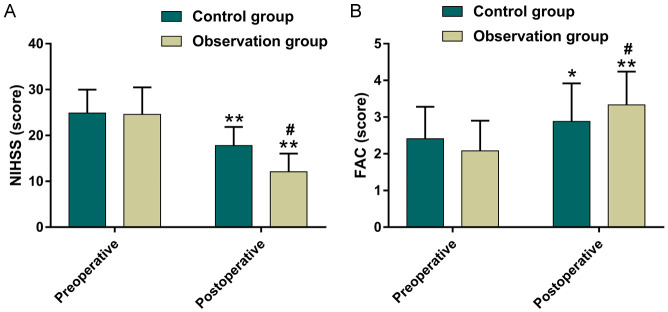
Methods: A total of 80 sHICH patients were included, with 32 cases in the control group receiving conventional craniotomy for hematoma evacuation and MHT, and 48 cases in the observation group undergoing early stepwise controlled decompression plus MHT. The two groups were compared in terms of treatment efficacy, hematoma clearance rate, prognosis, National Institutes of Health Stroke Scale (NIHSS) and Functional Ambulation Category (FAC) scores, complications, cerebral edema volume, and serum biochemical indices.
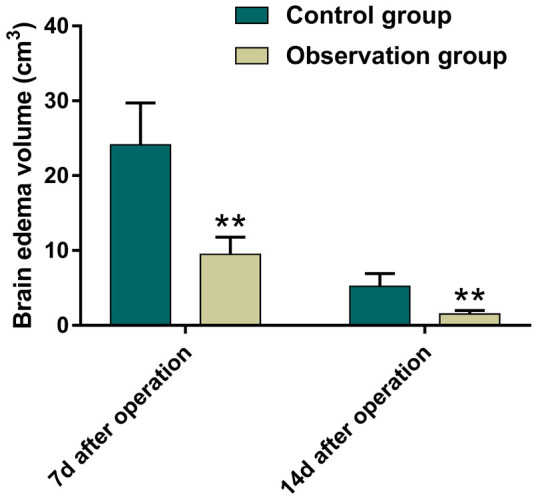
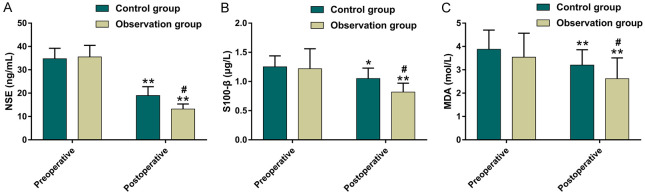
Results: The observation group demonstrated significantly better efficacy, higher hematoma clearance rates, and improved clinical outcomes compared to the control group (all P<0.05). Postoperatively, the observation group had significantly lower NIHSS scores, reduced levels of neuron-specific enolase, central nervous system-specific protein, and malondialdehyde, as well as lower incidences of encephalocele, cerebral infarction, and delayed intracranial hematoma (all P<0.05). Additionally, cerebral edema volume was significantly reduced, while FAC scores were notably higher in the observation group (both P<0.05).
Conclusion: Early stepwise controlled decompression combined with MHT is highly effective in the treatment of sHICH, leading to better neurological recovery, reduced cerebral edema, and improved biochemical profiles.
Keywords: Early stepwise controlled decompression; efficacy; mild hypothermia therapy; severe hypertensive intracerebral hemorrhage.
AJTR Copyright © 2025.
Conflict of interest statement
None.
Figures
Similar articles
-
Effect of Mild Therapeutic Hypothermia Combined with Stereotactic Aspiration on Patients with Severe Cerebral Hemorrhage.Mol Biotechnol. 2024 Oct;66(10):2804-2815. doi: 10.1007/s12033-023-00882-0. Epub 2023 Oct 16. Mol Biotechnol. 2024. PMID: 37843755
-
Effects of mild hypothermia therapy combined with minimally invasive debridement in patients with hypertensive intracranial hemorrhage: a randomized controlled study.Am J Transl Res. 2021 Jul 15;13(7):7997-8003. eCollection 2021. Am J Transl Res. 2021. PMID: 34377281 Free PMC article.
-
Effect of mild hypothermia on expression of inflammatory factors in surrounding tissue after minimally invasive hematoma evacuation in the treatment of hypertensive intracerebral hemorrhage.Exp Ther Med. 2018 Jun;15(6):4906-4910. doi: 10.3892/etm.2018.6014. Epub 2018 Mar 30. Exp Ther Med. 2018. PMID: 29805513 Free PMC article.
-
Therapeutic hypothermia for intracerebral hemorrhage: Systematic review and meta-analysis of the experimental and clinical literature.Int J Stroke. 2022 Jun;17(5):506-516. doi: 10.1177/17474930211044870. Epub 2021 Sep 22. Int J Stroke. 2022. PMID: 34427479
-
[Systematic review and Meta-analysis on efficacy and safety of Naoxueshu Oral Liquid in treatment of hypertensive intracerebral hemorrhage].Zhongguo Zhong Yao Za Zhi. 2021 Jun;46(12):2984-2994. doi: 10.19540/j.cnki.cjcmm.20210324.501. Zhongguo Zhong Yao Za Zhi. 2021. PMID: 34467688 Chinese.
References
-
- Chen Zhou ZH, Salvador Alvarez E, Hilario Barrio A, Cardenas Del Carre AM, Romero Coronado J, Ramos Gonzalez A. Primary and secondary non-traumatic intra-cerebral haemorrhage: MRI findings. Radiologia (Engl Ed) 2023;65:149–164. - PubMed
-
- Puy L, Parry-Jones AR, Sandset EC, Dowlatshahi D, Ziai W, Cordonnier C. Intracerebral haemorrhage. Nat Rev Dis Primers. 2023;9:14. - PubMed
LinkOut - more resources
Full Text Sources