


Myopia Control Efficacy of Spectacle Lenses with Dual-Index Aspherical Lenslets: A 1-Year Randomized Clinical Trial
- PMID: 40385239
- PMCID: PMC12084078
- DOI: 10.1016/j.xops.2025.100766
Myopia Control Efficacy of Spectacle Lenses with Dual-Index Aspherical Lenslets: A 1-Year Randomized Clinical Trial
Abstract
Objective: To examine the myopia control efficacy, in terms of axial elongation, of a new myopia control spectacle lenses with Dual-Index Aspherical Lenslets (DIAL) embedded within the lens, compared with single-vision spectacle lenses (SVLs) over a 1-year period.
Design: A prospective, randomized, double-masked clinical trial.
Participants: Eighty children aged 8 to 13 years with myopia (spherical equivalent refraction [SER] between -0.75 and -4.75 diopters [D]) were recruited.
Intervention: Participants were randomized to either the DIAL or SVL spectacle lenses group (1:1 ratio).
Main outcome measures: Axial length (AL), noncycloplegic subjective refraction, and best-corrected visual acuity (BCVA) were measured at baseline and 6-month intervals. Questionnaires on adaptation and compliance were administered during all visits.
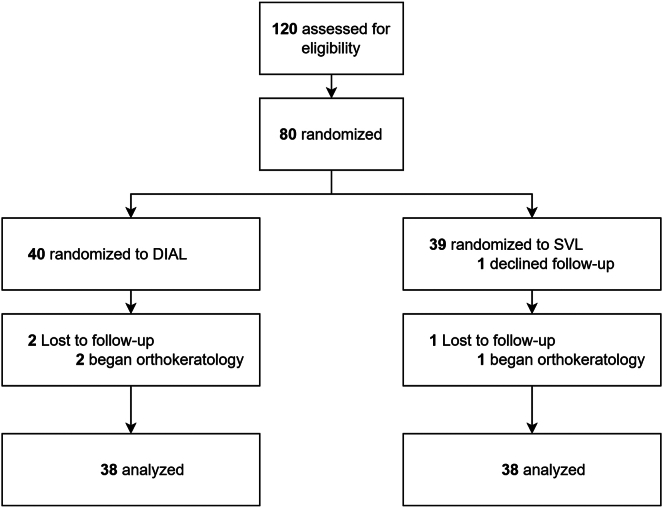
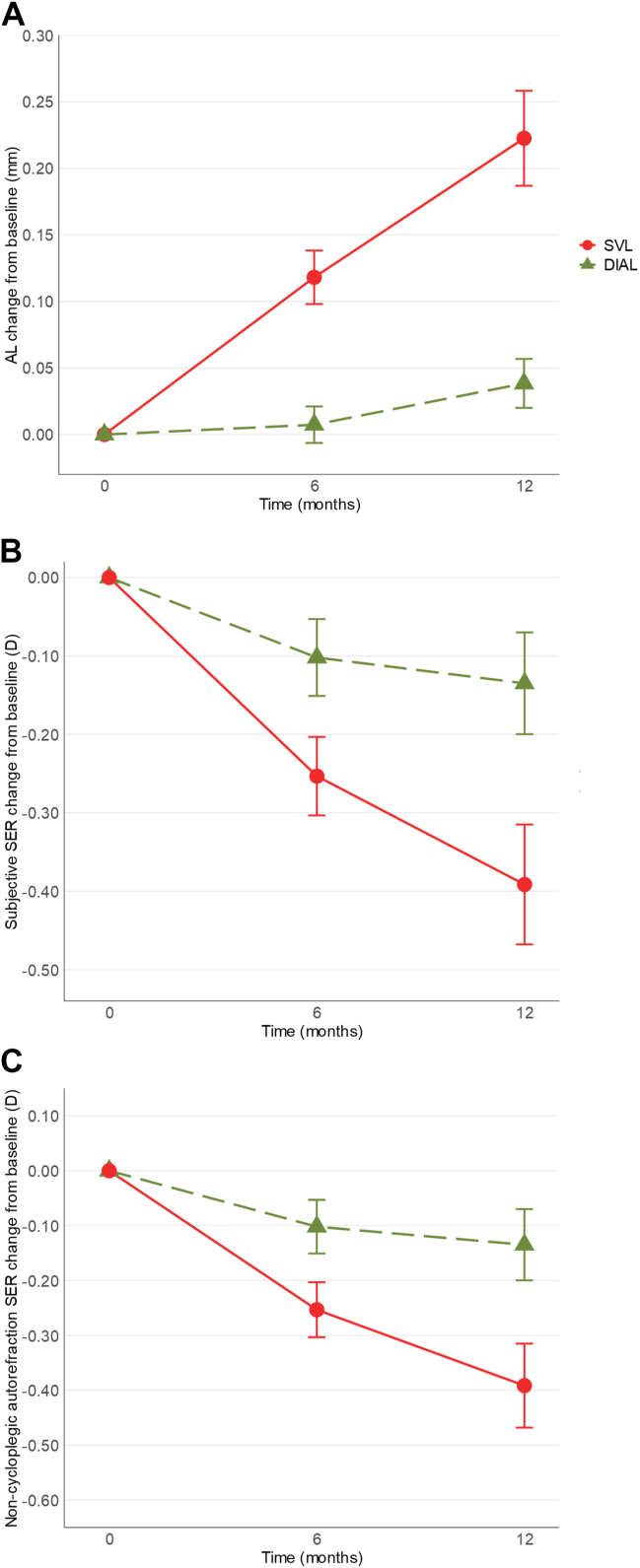
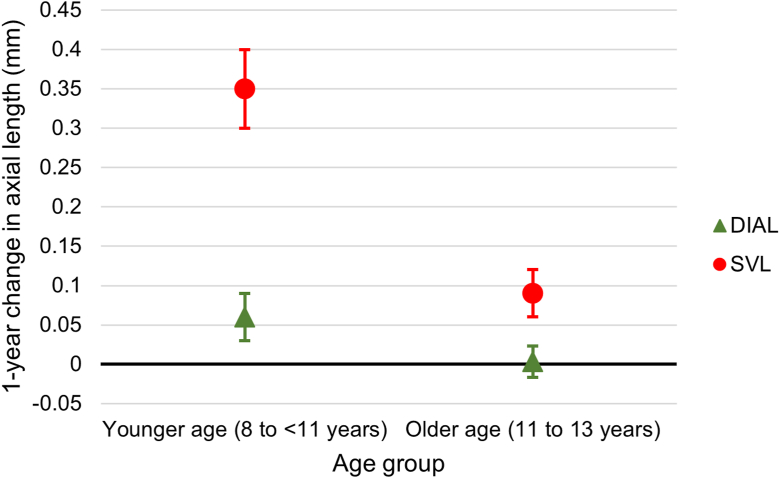
Results: A total of 76 (N = 38 in each group) participants (mean [standard deviation] age, 10.8 [1.6] years) completed the 1-year visit. Mean (± standard error) 1-year AL change in the DIAL and SVL groups was 0.04 ± 0.02 and 0.22 ± 0.04 mm, respectively. A mean difference of -0.18 mm (95% confidence interval [CI], -0.26 to -0.10 mm; P < 0.001) was found. Mean 1-year SER change in the DIAL and SVL groups was -0.13 ± 0.06 and -0.39 ± 0.08 D, respectively, with a mean difference of 0.26 D (95% CI, 0.06-0.46 D; P = 0.01). Compared with SVL, younger children (8 to <11 years) and older children (11-13 years) in the DIAL group had significantly less axial elongation (-0.29 mm less for younger children and -0.09 mm less for older children), with greater myopia control effect of DIAL spectacle lenses among the younger group than among the older group (P = 0.004 for interaction). No significant differences between the lens groups were found for distance BCVA (P = 0.36). All participants adapted within 3 to 4 days regardless of lens group. No significant differences in mean daily wearing time were seen between the DIAL and SVL groups (P = 0.53).
Conclusions: Dual-Index Aspherical Lenslets spectacle lenses showed good myopia control efficacy, in terms of axial elongation, compared with SVL, among children aged 8 to 13 years in Singapore.
Financial disclosures: Proprietary or commercial disclosures may be found in the Footnotes and Disclosures at the end of this article.
Keywords: Aspherical lenslets; Myopia control spectacle lenses; Optical intervention; Randomized trial.
© 2025 by the American Academy of Ophthalmologyé.
Figures
References
-
- Holden B.A., Fricke T.R., Wilson D.A., et al. Global prevalence of myopia and high myopia and temporal trends from 2000 through 2050. Ophthalmology. 2016;123:1036–1042. - PubMed
-
- Matsumura S., Ching-Yu C., Saw S.M. In: Updates on Myopia: A Clinical Perspective. Ang M., Wong T., editors. Springer; Singapore: 2020. Global epidemiology of myopia; pp. 27–51.
-
- Saw S.M., Gazzard G., Shih-Yen E.C., Chua W.H. Myopia and associated pathological complications. Ophthalmic Physiol Opt. 2005;25:381–391. - PubMed
-
- Saw S.M., Matsumura S., Hoang Q.V. Prevention and management of myopia and myopic pathology. Invest Ophthalmol Vis Sci. 2019;60:488–499. - PubMed
LinkOut - more resources
Full Text Sources
