


Drug utilization in geriatric psychiatric patients in the emergency department-a cohort study under real-world conditions
- PMID: 40385248
- PMCID: PMC12084695
- DOI: 10.1177/20451253251339373
Drug utilization in geriatric psychiatric patients in the emergency department-a cohort study under real-world conditions
Abstract
Background: Psychiatric emergencies include agitation, substance-related (e.g., withdrawal) symptoms, and suicidal as well as self-harming behavior and require interdisciplinary management. Drug treatment of geriatric patients in emergency situations may be complicated by adverse drug reactions (ADRs).
Objectives: This study aimed to investigate prescriptions of potentially inappropriate medications (PIMs) and potential drug-drug interactions (DDIs) in the context of geriatric psychiatric emergencies in the emergency department (ED).
Design: Retrospective single-center study.
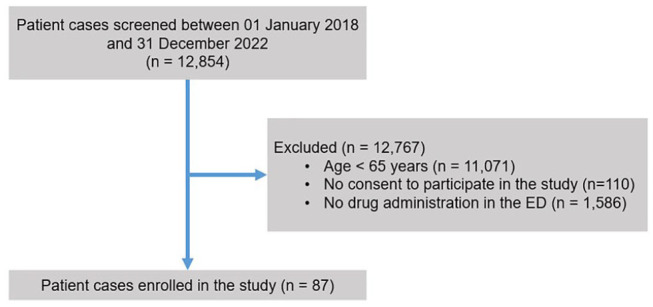
Methods: The medication lists of 87 consecutively acquired geriatric patient cases receiving pharmacological treatment between January 2018 and December 2022 in a psychiatric emergency department were analyzed. Herein, utilizing the PRISCUS 2.0 list and the Fit fOR The Aged (FORTA) classification, prescriptions of PIMs were assessed, and DDIs were classified with the aid of the drug interaction program AiDKlinik® (Arzneimittel-Informations-Dienste, Dosing GmbH, Heidelberg, Germany).
Results: A total of 94 drugs were administered during treatment in the ED. The total number of drugs per patient was on average 5.9 1 (median: 5; interquartile range: 4) hereafter. 77.7% of the newly prescribed drugs were PIMs according to the PRISCUS 2.0 list, while 18.1% were designated as therapeutic alternatives to PIMs. 70.2% and 22.3% of the newly recommended drugs were FORTA category C and D drugs, respectively. An average of 0.8 (median: 0; interquartile range: 1) potential DDIs existed before psychiatric ED treatment, and 0.9 (median: 0; interquartile range: 2) potential DDIs thereafter (p = 0.002). Coercive measures-such as administration of medication against the patient's will-were rarely required in the study population.
Conclusion: The majority of all drug prescriptions for the treatment of geriatric psychiatric emergencies were categorized as PIMs according to the PRISCUS 2.0 list and the FORTA classification. However, it should be noted that these PIM classification systems were not specifically designed for geriatric psychiatric settings. The number of potential DDIs was significantly higher after drug administration in the ED than before, which should prompt the monitoring of certain clinical parameters in the further course of treatment.
Keywords: FORTA; PRISCUS; drug safety; emergency department; geriatric psychiatry; potentially inappropriate medications.
© The Author(s), 2025.
Figures
References
-
- Schuller J, Cavenaile JC, Briganti G. Somatic management of psychiatric patients in the emergency department. Psychiatria Danubina 2023; 35(Suppl 2): 341–346. - PubMed
-
- Eseaton PO, Oladunjoye AF, Anugwom G, et al.. Most common reasons for emergency department presentation among patients with psychiatric disorders: a United States nationwide analysis. J Affective Disorders 2023; 331: 145–148. - PubMed
LinkOut - more resources
Full Text Sources
