Assessment of left ventricular systolic function using pressure-strain loops in offspring of women with gestational diabetes mellitus: a prospective cohort study
- PMID: 40385277
- PMCID: PMC12082216
- DOI: 10.21037/cdt-24-450
Assessment of left ventricular systolic function using pressure-strain loops in offspring of women with gestational diabetes mellitus: a prospective cohort study
Abstract
Background: Gestational diabetes mellitus (GDM) increases the risk of cardiovascular abnormalities in offspring. The objective of this study is to assess changes in left ventricular myocardial work using the left ventricular pressure-strain loop (LVPSL) method in neonates born to mothers with GDM. The aim of the research is to examine early impairments in neonatal left ventricular systolic function and to investigate whether these impairments persist over time.
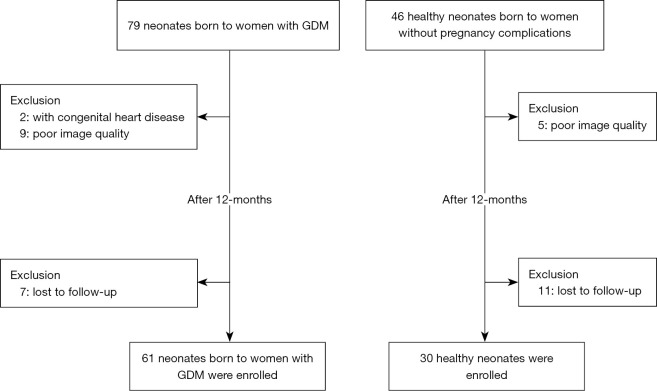
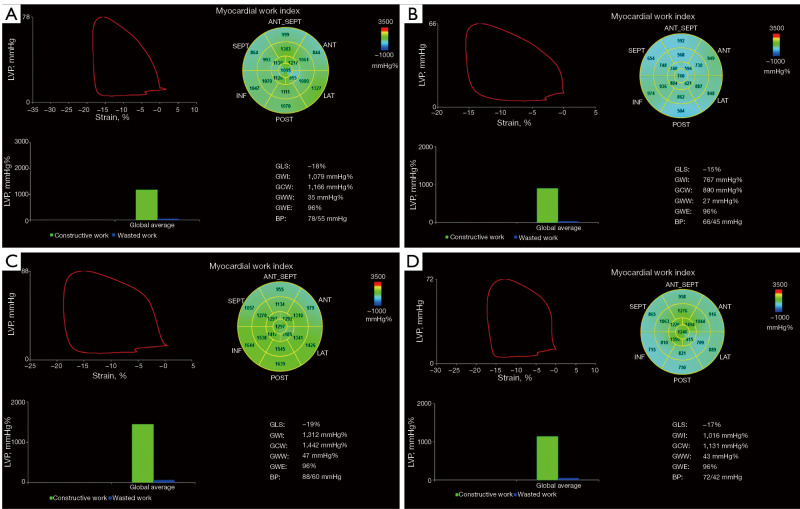
Methods: In a prospective cohort study, we enrolled 61 neonates born to mothers with GDM and 30 healthy neonates born to mothers without pregnancy complications between August 2021 and March 2023 using a random method. The GDM group was further subdivided based on maternal hemoglobin A1c (HbA1c) levels into those with HbA1c ≤6.5% and those with HbA1c >6.5%. Echocardiographic assessments and left ventricular myocardial work parameters were measured and compared across the three groups using one-way analysis of variance (ANOVA) with multiple comparisons conducted using the Least Significant Difference t (LSD-T) test and multiple correction using the Bonferroni method in terms of data of normal distribution and homoscedasticity. Non-normally distributed data were presented as median (first quartile, third quartile) [M (Q1, Q3)] and compared using the Kruskal-Wallis H test. The correlation between myocardial work parameters in neonates born to mothers with GDM and the maternal HbA1c levels was also analyzed using Pearson correlation analysis or Spearman's rank correlation.
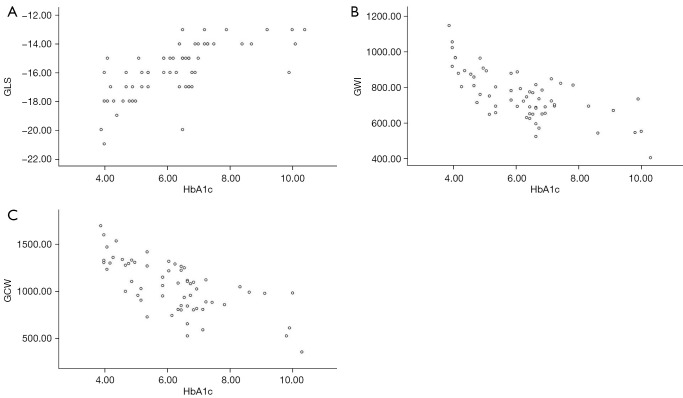
Results: The enrolled 61 neonates born to women with GDM comprised 34 male and 27 female neonates, with a gestational age (GA) of 38.9±1.7 weeks. The control group 30 healthy neonates comprised 17 males and 13 females, with a GA of 39.1±1.8 weeks. Neonates in the HbA1c ≤6.5% and HbA1c >6.5% groups demonstrated increased interventricular septal thickness (IVSD) (P<0.05) compared to the control group. However, no significant differences in IVSD were observed among the groups after a 12-month follow-up (P>0.05). At birth and during the 12-month follow-up, global longitudinal strain (GLS), global work index (GWI), and global constructive work (GCW) values were lower in both HbA1c groups compared to the control group, with the HbA1c >6.5% group revealing significantly reduced GLS, GWI, and GCW (P<0.05). Neonatal GLS exhibited a positive correlation with maternal HbA1c, whereas GWI and GCW revealed negative correlations (r=0.683, r=-0.709, r=-0.688, P<0.001).
Conclusions: The LVPSL method can examine early impairments in left ventricular systolic function in neonates born to mothers with GDM. More severe impairments are associated with poorer glycemic control during pregnancy, as indicated by higher maternal HbA1c levels. These functional impairments persist in the offspring 12 months postpartum.
Keywords: Gestational diabetes mellitus (GDM); glycosylated hemoglobin; left ventricular systolic function; offspring; pressure-strain loop (PSL).
Copyright © 2025 AME Publishing Company. All rights reserved.
Conflict of interest statement
Conflicts of Interest: All authors have completed the ICMJE uniform disclosure form (available at https://cdt.amegroups.com/article/view/10.21037/cdt-24-450/coif). The authors have no conflicts of interest to declare.
Figures
References
-
- Akbariasbagh P, Shariat M, Akbariasbagh N, et al. Cardiovascular Malformations in Infants of Diabetic Mothers: A Retrospective Case-Control Study. Acta Med Iran 2017;55:103-8. - PubMed
LinkOut - more resources
Full Text Sources
Miscellaneous