


The contribution of social determinants of health to long-term outcomes following traumatic brain injury
- PMID: 40386445
- PMCID: PMC12084076
- DOI: 10.1016/j.ssmph.2025.101795
The contribution of social determinants of health to long-term outcomes following traumatic brain injury
Abstract
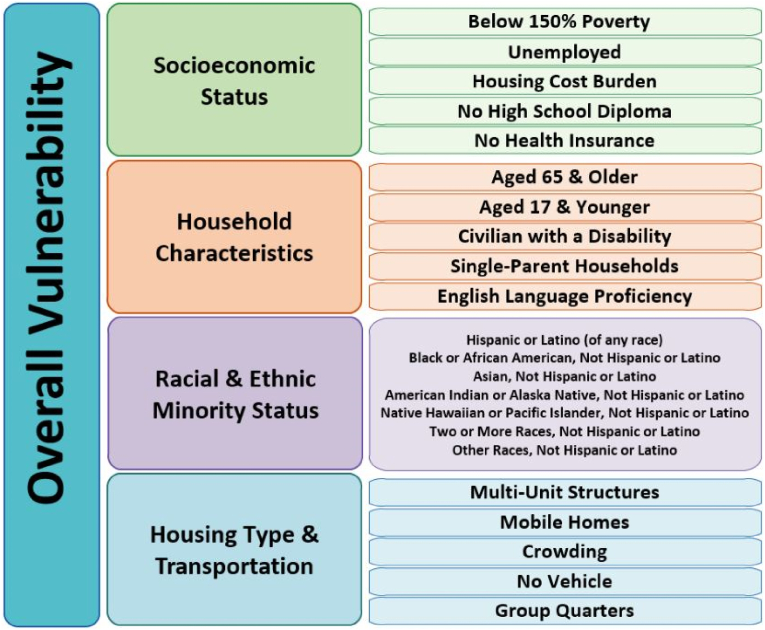
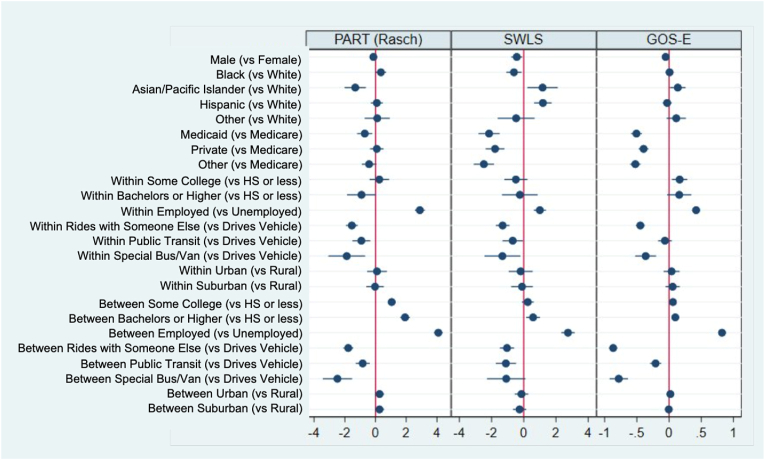
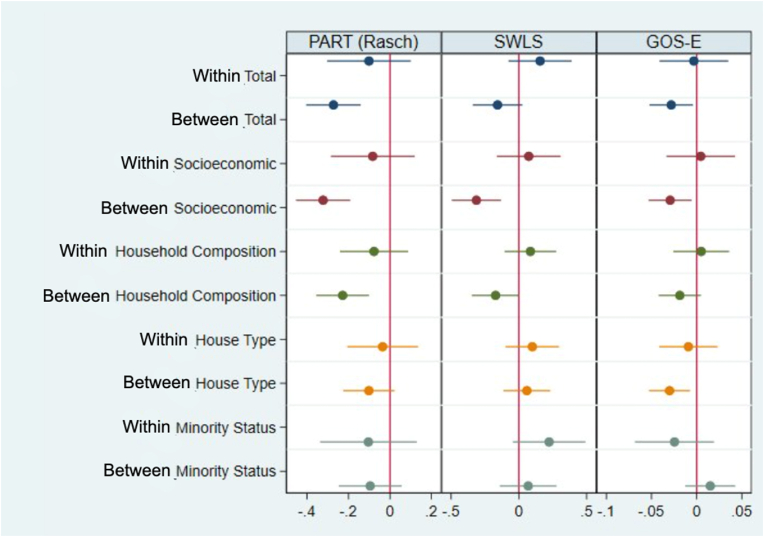
Social Determinants of Health (SDoH) are a significant factor in health outcomes for both acute and chronic health conditions, but systematic research related to outcomes from traumatic brain injury (TBI) has been limited. This study explores the relationship between individual and neighborhood-level SDoH and TBI outcomes to understand the extent of their influence on long-term recovery. Hybrid panel models that decompose time-varying predictors into between- and within-person effects were used to examine the relationships between SDoH and participation in the community, life satisfaction, and global functioning for persons with moderate to severe TBI one to 30 years post-injury. Participants were 9263 persons, distributed nationally, who received inpatient rehabilitation for TBI and enrolled in the TBI Model Systems longitudinal study. Individual-level SDoH included sex, race/ethnicity, education, employment, insurance, primary means of transportation, and rurality. The Social Vulnerability Index (SVI) was used as an indicator of neighborhood disadvantage. Results indicated that neighborhood-level SDoH accounted for differences in outcomes between individuals but not due to change in a given individual's neighborhood. These findings were robust to the inclusion of numerous individual-level SDoH, which were also associated with the outcomes. Individual-level SDoH accounted for differences in outcomes both between individuals and with change in a given individual's status. Among four thematic subscales constituting the SVI, the socio-economic status subscale was consistently associated with all three outcomes.
Keywords: Neighborhood disadvantage; Social determinants of health; Traumatic brain injury.
© 2025 The Authors.
Conflict of interest statement
None of the authors have financial or personal relationships with other people or organizations that could inappropriately influence or bias this work and thus have nothing to declare.
Figures
References
-
- Arango-Lasprilla J.C., Ketchum J.M., Lewis A.N., Krch D., Gary K.W., Dodd B.A. Racial and ethnic disparities in employment outcomes for persons with traumatic brain injury: A longitudinal investigation 1-5 years after injury. PM & R: The Journal of Injury, Function, and Rehabilitation. 2011;3(12):1083–1091. doi: 10.1016/j.pmrj.2011.05.023. - DOI - PubMed
-
- Arango-Lasprilla J.C., Ketchum J.M., Williams K., Kreutzer J.S., Marquez de la Plata C.D., O'Neil-Pirozzi T.M., et al. Racial differences in employment outcomes after traumatic brain injury. Archives of Physical Medicine and Rehabilitation. 2008;89(5):988–995. doi: 10.1016/j.apmr.2008.02.012. - DOI - PubMed
LinkOut - more resources
Full Text Sources
