


The Evolution of Medical Student Competencies and Attitudes in Digital Health Between 2016 and 2022: Comparative Cross-Sectional Study
- PMID: 40743520
- PMCID: PMC12313084
- DOI: 10.2196/67423
The Evolution of Medical Student Competencies and Attitudes in Digital Health Between 2016 and 2022: Comparative Cross-Sectional Study
Abstract
Background: Modern health care systems worldwide are facing challenges, and digitalization is viewed as a way to strengthen health care globally. As health care systems become more digital, it is essential to assess health care professionals' competencies and skills to ensure they can adapt to new practices, policies, and workflows effectively.
Objective: The aim of this study was to analyze how the attitudes, skills, and knowledge of medical students concerning digital health have shifted from 2016 to 2022 in connection with the development of the national health care information system architecture using the clinical adoption meta-model framework.
Methods: The study population consisted of 5th-year medical students from the University of Oulu in Finland during 2016, 2021, and 2022. A survey questionnaire was administered comprising 7 background questions and 16 statements rated on a 5-point Likert scale assessing students' attitudes toward digital health and their self-perceived digital capabilities. The results were recategorized into a dichotomous scale. The statistical analysis used Pearson χ2 test. The Benjamini-Hochberg procedure was used for multiple variable correction.
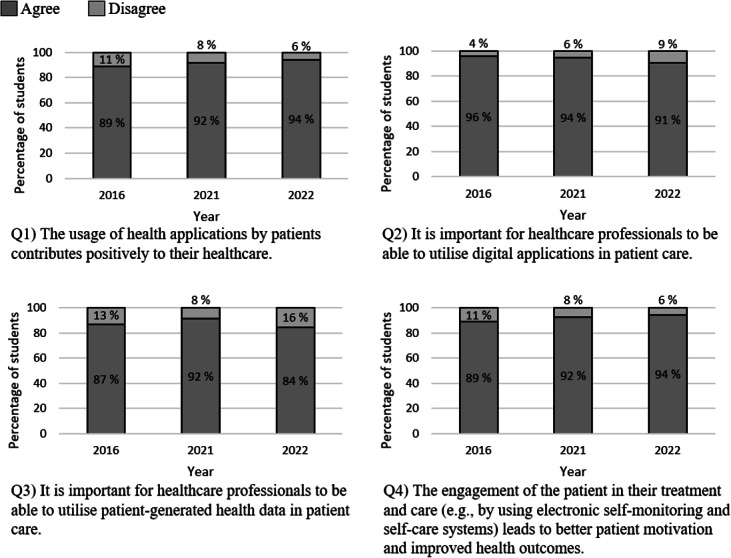
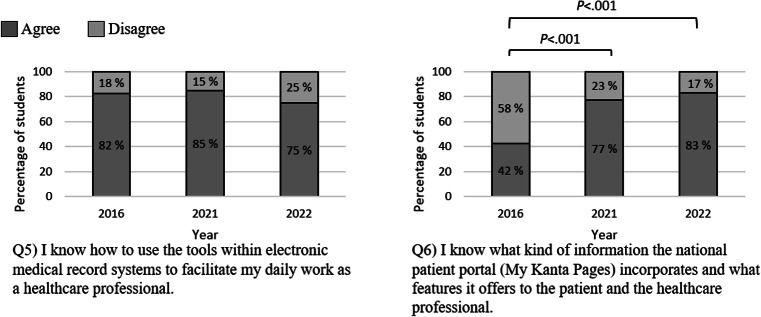
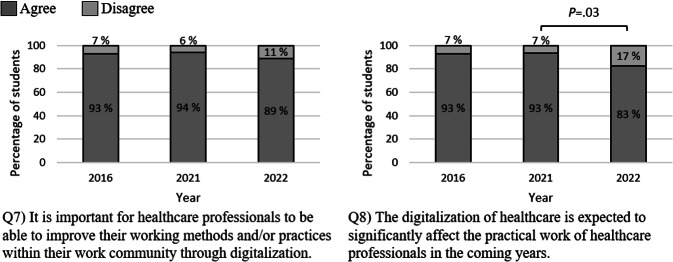
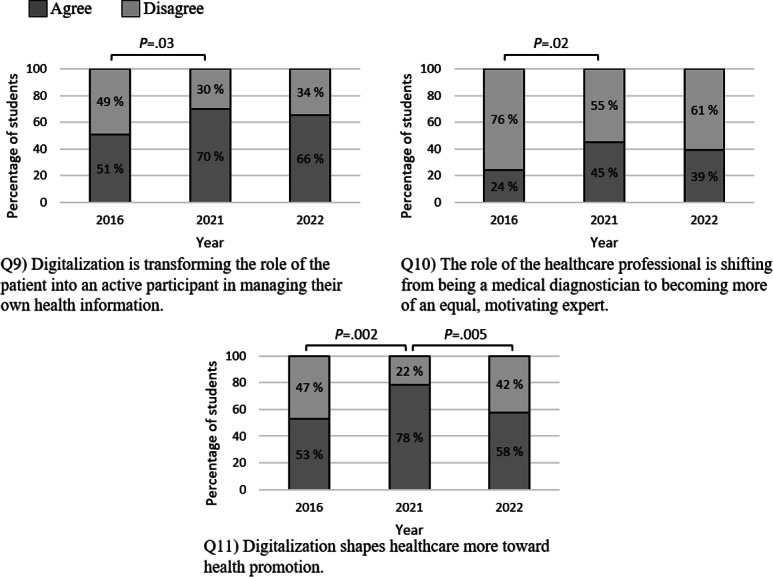
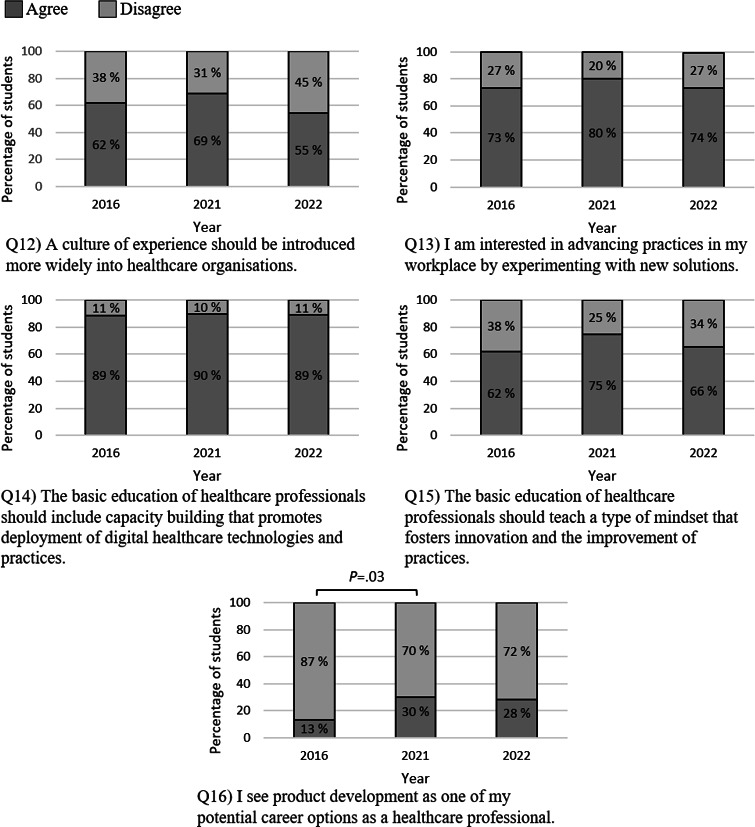
Results: The study included 215 medical students (n=45 in 2016, n=106 in 2021, and n=64 in 2022) with an overall response rate of 53% (43% in 2016, 74% in 2021, and 42% in 2022). Throughout 2016, 2021, and 2022, medical students maintained positive attitudes toward using patient-generated information and digital applications in patient care. Their self-perceived knowledge of the national patient portal significantly improved, with agreement increasing by 35 percentage points from 2016 to 2021 (P<.001) and this trend continued in 2022 (P<.001). However, their perceived skills in using electronic medical records did not show significant changes. Additionally, students' perceptions of the impact of digitalization on health promotion improved markedly from 2016 to 2021 (with agreement rising from 53% to 78%, P=.002) but declined notably again by 2022.
Conclusions: Medical students' attitudes and self-perceived competencies have shifted over the years, potentially influenced by the national health information system architecture developments. However, these positive changes have not followed a completely linear trajectory. To address these gaps, educational institutions and policy makers should integrate more digital health topics into medical curricula and provide practical experience with digital technologies to keep professionals up-to-date with the evolving health care environment.
Keywords: digital health; cross-sectional study; digital; digital competence; digital health; digitalization; eHealth; health care; health care information system; health care professional; health care systems; healthcare digitalization; innovation; medical education; medical informatics; medical student; professional competence; questionnaire; survey; technology; telemedicine.
© Paula Veikkolainen, Timo Tuovinen, Petri Kulmala, Erika Jarva, Jonna Juntunen, Anna-Maria Tuomikoski, Merja Männistö, Teemu Pihlajasalo, Jarmo Reponen. Originally published in JMIR Medical Education (https://mededu.jmir.org).
Conflict of interest statement
Figures
References
-
- Communication from the Commission to the European Parliament, the Council, the European Economic and Social Committee and the Committee of the Regions on enabling the digital transformation of health and care in the Digital Single Market; empowering citizens and building a healthier society. European Commission; 2018. https://digital-strategy.ec.europa.eu/en/library/staff-working-document-... URL.
-
- Recommendations on Digital Interventions for Health System Strengthening - WHO Guideline. World Health Organization; 2019. [06-04-2025]. https://www.who.int/publications/i/item/9789241550505 URL. Accessed. ISBN.978- 92-4-155050-5 - PubMed
Publication types
MeSH terms
LinkOut - more resources
Full Text Sources
Research Materials
