


Asymmetry in Limb Stiffness, Joint Power, and Joint Work During Landing in Anterior Cruciate Ligament Reconstruction Patients
- PMID: 40387877
- PMCID: PMC12089123
- DOI: 10.1177/19417381251338218
Asymmetry in Limb Stiffness, Joint Power, and Joint Work During Landing in Anterior Cruciate Ligament Reconstruction Patients
Abstract
Background: Kinetic and kinematic side-to-side limb asymmetries can increase after anterior cruciate ligament reconstruction (ACLR). Limb stiffness asymmetry has not been previously explored.
Hypothesis: Athletes with ACLR will exhibit greater asymmetry in limb stiffness, peak eccentric joint power, and eccentric joint work compared with asymptomatic controls during landing.
Study design: Case-control study.
Level of evidence: Level 4.
Methods: Forty athletes with 5.9 ± 1.4 months removed from ACLR and 40 asymptomatic athletes completed 7 stop-jumps (SJs) during a single session. Three-dimensional motion capture and ground-reaction force data were collected during landing. Normalized symmetry index values for limb stiffness, peak eccentric joint power, and eccentric joint work of athletes with bone-patellar tendon-bone (BPTB) grafts, athletes with hamstring grafts, and control athletes were compared.
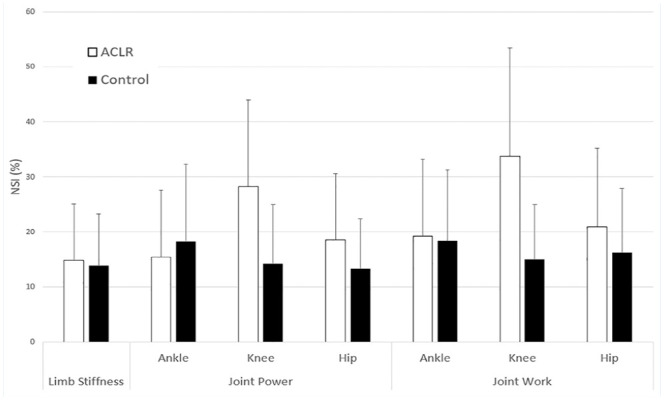
Results: Athletes with ACLR had greater knee power Athletes with ACLR had greater knee power (BPTB, 29.1 ± 17.6; hamstring, 27.3 ± 14.1; Control, 14.2 ± 10.7; P < 0.01) and knee work (BPTB, 35.2 ± 21.5; hamstring, 32.1 ± 18.4; Control, 14.9 ± 10.1; P < 0.01) asymmetries than control athletes. Athletes with BPTB grafts and hamstring grafts both displayed larger knee power and work asymmetries compared with control athletes (P < 0.01 for each comparison), with no differences between graft types (P = 0.90 and P = 0.80, respectively). No between-group differences were found in limb stiffness (BPTB, 16.2 ± 10.8; hamstring, 13.5 ± 9.83; Control, 13.9 ± 9.33; P = 0.63), ankle power (BPTB, 16.5 ± 11.4; hamstring, 14.4 ± 13.0; Control, 18.3 ± 14.0; P = 0.55), ankle work (BPTB, 20.9 ± 13.0; hamstring, 17.4 ± 14.9; Control, 18.4 ± 12.8; P = 0.69), hip power (BPTB, 17.6 ± 12.8; hamstring, 19.5 ± 11.3; Control, 13.3 ± 9.08; P = 0.09), or hip work (BPTB, 17.2 ± 13.9; hamstring, 24.6 ± 14.1; Control, 16.2 ± 11.7; P = 0.06) asymmetries.
Conclusion: Athletes with ACLR use asymmetric landing strategies that favor their nonsurgical limb, resulting in greater knee power and knee work asymmetries compared with controls. No between-group asymmetry differences in limb stiffness, ankle power and work, and hip power and work were found.
Clinical relevance: After 5.9 ± 1.4 months removed from ACLR surgery, athletes favor their nonsurgical limb at the knee, risking further injury. While limb stiffness asymmetry was not different between groups, the groups appeared to modulate limb stiffness differently between limbs to produce similar asymmetry values.
Keywords: ACL; asymmetry; biomechanics; injury prevention; landing; motion analysis; stiffness.
Conflict of interest statement
The authors report no potential conflicts in the development and publication of this article.
Figures




References
-
- Arampatzis A, Brüggemann GP, Klapsing GM. Leg stiffness and mechanical energetic processes during jumping on a sprung surface. Med Sci Sports Exerc. 2001;33(6):923-931. - PubMed
-
- Arampatzis A, Schade F, Walsh M, Brüggemann GP. Influence of leg stiffness and its effect on myodynamic jumping performance. J Electromyogr Kinesiol. 2001;11(5):355-364. - PubMed
-
- Arna Risberg M, Lewek M, Snyder-Mackler L. A systematic review of evidence for anterior cruciate ligament rehabilitation: how much and what type? Phys Ther Sport. 2004;5(3):125-145.
-
- Bell AL, Brand RA, Pedersen DR. Prediction of hip joint centre location from external landmarks. Hum Mov Sci. 1989;8(1):3-16.
-
- Boden BP, Dean GS, Feagin JA, Jr, Garrett WE., Jr. Mechanisms of anterior cruciate ligament injury. Orthopedics. 2000;23(6):573-578. - PubMed
MeSH terms
Grants and funding
LinkOut - more resources
Full Text Sources
Medical
Research Materials
