


Inducible nitric oxide synthase (iNOS): More than an inducible enzyme? Rethinking the classification of NOS isoforms
- PMID: 40389042
- PMCID: PMC12161154
- DOI: 10.1016/j.phrs.2025.107781
Inducible nitric oxide synthase (iNOS): More than an inducible enzyme? Rethinking the classification of NOS isoforms
Abstract
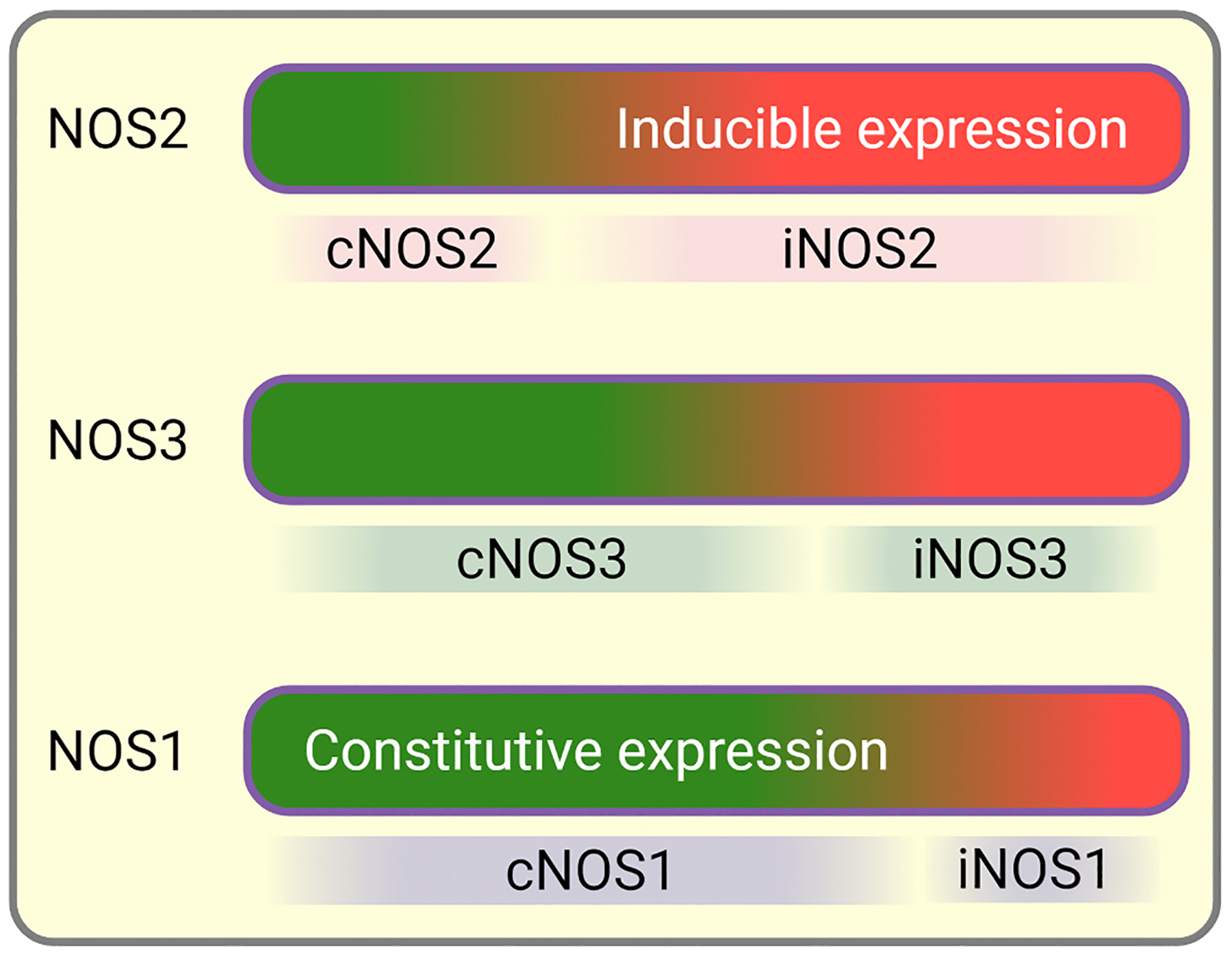
Nitric oxide (NO) is a critical signaling molecule synthesized from L-arginine by nitric oxide synthase (NOS). The three NOS isoforms-neuronal NOS (nNOS; NOS1), inducible NOS (iNOS; NOS2), and endothelial NOS (eNOS; NOS3)-have traditionally been classified as either constitutive (nNOS and eNOS) or inducible (iNOS). However, this binary classification oversimplifies their functions, particularly by neglecting the physiological roles of iNOS and misrepresenting its involvement in pathological processes. Increasing evidence demonstrates that all three isoforms can exhibit both constitutive and inducible expression. Notably, iNOS is constitutively expressed at low levels in several tissues, including blood, heart, bone marrow, lung, brain, spinal cord, retina, colonic mucosa, liver, ileum, skeletal muscle, epidermis, adipose tissue, endometrium, ovary, and kidney under normal physiological conditions, a form we refer to as constitutive iNOS (ciNOS). This basal expression contributes to essential functions such as heart rate regulation, respiratory exchange, and microbiome balance in the gut. Moreover, in certain pathological contexts, iNOS may exert protective rather than harmful effects, challenging the prevailing view that it is solely a pro-inflammatory mediator. Current drug development strategies targeting NOS are largely based on the outdated dichotomy of constitutive "physiologic" versus inducible "pathologic" isoforms, focusing primarily on iNOS inhibition. The failure of iNOS inhibitors in most clinical trials highlights the limitations of this approach. To address these gaps, we propose a revised nomenclature that incorporates both gene expression mode (constitutive vs. inducible) and discovery order, offering a more nuanced framework for understanding NOS isoforms in both health and disease.
Keywords: Constitutive inducible nitric oxide synthase; Constitutivity; Inducibility; Nitric oxide.
Copyright © 2025 The Authors. Published by Elsevier Ltd.. All rights reserved.
Conflict of interest statement
Declaration of Competing Interest The authors declare no conflict of interest.
Figures

References
-
- Persson PB, Bondke Persson A, Nitric oxide: a classic revisited, Acta Physiol. 207 (3) (2013) 427–429. - PubMed
-
- Gow AJ, Ischiropoulos H, Nitric oxide chemistry and cellular signaling, J. Cell Physiol 187 (3) (2001) 277–282. - PubMed
-
- Knowles RG, Moncada S, Nitric oxide as a signal in blood vessels, Trends Biochem Sci. 17 (10) (1992) 399–402. - PubMed
-
- Dawson TM, Dawson VL, Nitric oxide synthase: role as a transmitter/mediator in the brain and endocrine system, Annu Rev. Med 47 (1996) 219–227. - PubMed
-
- Ghasemi A, Jeddi S, Kashfi K, Brain glucose metabolism: role of nitric oxide, Biochem. Pharmacol 232 (2025) 116728. - PubMed
Publication types
MeSH terms
Substances
Grants and funding
LinkOut - more resources
Full Text Sources
