


Effect of sweet and caloric drinks on cardiac reactivity to slow-paced breathing in healthy adults
- PMID: 40389457
- PMCID: PMC12089329
- DOI: 10.1038/s41598-025-00980-w
Effect of sweet and caloric drinks on cardiac reactivity to slow-paced breathing in healthy adults
Abstract
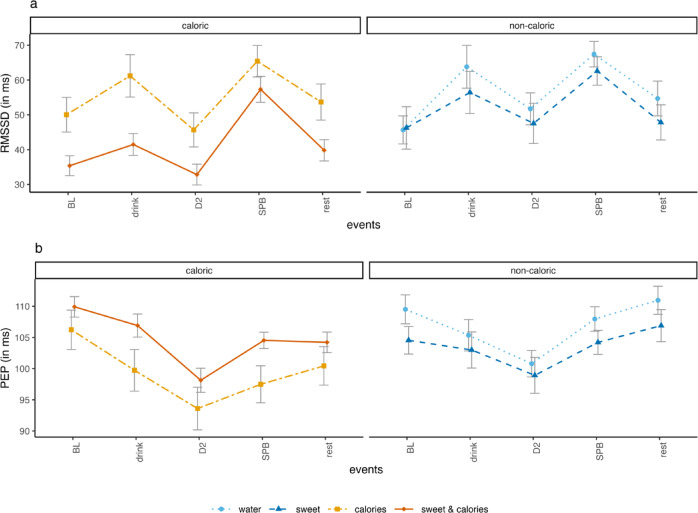
Cardiac reactivity is proposed to be a central indicator of autonomic functioning. While hyperglycemia plays a limited role in cardiac stress reactivity, it is unclear whether it may modulate cardiac reactivity in non-stressful situations. We investigated the effect of glucose on cardiac reactivity to a relaxing exercise, namely, slow-paced breathing (SPB). A total of 115 adults (age mean = 23.28 years, SD = 6.88; 76% female) either consumed a sweet & caloric, a sweet, a caloric drink, or pure water after baseline. Later, they performed a sustained attention test and SPB. Electrocardiography and impedance cardiography was obtained, and blood glucose and subjective relaxation were measured repeatedly. We analyzed changes in parasympathetic (root mean square of successive differences [RMSSD]) and sympathetic (pre-ejection period [PEP]) cardiac activity and subjective relaxation using growth curve models and performed correlational analyses. Hyperglycemia triggered cardiac PNS withdrawal and SNS activation. Despite this, SPB increased cardiac PNS activity and subjective relaxation and decreased cardiac SNS activity in all groups. Our results align with the autonomic space model and highlight the tight link between autonomic regulation and blood glucose homeostasis. Hyperglycemia might play a limited modulating role in cardiac reactivity to slow-paced breathing.
Keywords: Blood glucose; Heart rate variability; Pre-ejection period; Slow-paced breathing; Vagal activity.
© 2025. The Author(s).
Conflict of interest statement
Declarations. Competing interests: The authors declare no competing interests.
Figures



References
-
- Thayer, J. F. & Brosschot, J. F. Psychosomatics and psychopathology: Looking up and down from the brain. Psychoneuroendocrinology30, 1050–1058 10.1016/j.psyneuen.2005.04.014 (2005). - PubMed
-
- Sherwood, A. et al. Methodological guidelines for impedance cardiography. Psychophysiology27(1), 1–23 10.1111/j.1469-8986.1990.tb02171.x (1990). - PubMed
MeSH terms
Substances
Grants and funding
LinkOut - more resources
Full Text Sources
Miscellaneous
