. 2025 May 19;15(1):17284.
doi: 10.1038/s41598-025-01657-0.

Highly specific Immunoproteasome inhibitor M3258 induces proteotoxic stress and apoptosis in KMT2A::AFF1 driven acute lymphoblastic leukemia

Affiliations

Highly specific Immunoproteasome inhibitor M3258 induces proteotoxic stress and apoptosis in KMT2A::AFF1 driven acute lymphoblastic leukemia

Tyler W Jenkins et al. Sci Rep. .

Abstract

Proteasome inhibitors (PIs) bortezomib, carfilzomib and ixazomib are approved for the treatment of multiple myeloma and mantle cell lymphoma and have clinical activity in acute lymphoblastic leukemia (ALL). The predominant form of proteasome in these hematologic malignancies is the lymphoid tissue-specific immunoproteasome. FDA-approved PIs inhibit immunoproteasomes and ubiquitously expressed constitutive proteasomes causing on-target toxicities in non-hematological tissues. Replacing PIs with selective immunoproteasome inhibitors (IPIs) should reduce these toxicities. We have previously shown that IPI ONX-0914 causes apoptosis of ALL cells expressing the KMT2A::AFF1 (MLL-AF4) fusion protein but did not elucidate the mechanism. Here we show that a novel, highly specific IPI M3258 induces rapid apoptosis in ALL cells in vitro and is comparable to bortezomib in its ability to reduce tumor growth and to cause tumor regression when combined with chemotherapy in vivo. Treatment of KMT2A::AFF1 ALL cells with M3258, ONX-0914, and bortezomib induced proteotoxic stress that was prevented by the protein synthesis inhibitor cycloheximide, which dramatically desensitized cells to PI-induced apoptosis. Thus, similar to multiple myeloma, ALL cells are sensitive to PIs and IPIs due to increased proteotoxic stress caused by elevated rates of protein synthesis.

Keywords: Heat shock response; Proteasome; Proteasome inhibitor; Proteostasis; Ubiquitin; Unfolded protein response.


Conflict of interest statement

Declarations. Competing interests: Alexei F. Kisselev is the Founder and Chief Scientific Officer of InhiProt, LLC; other authors do not report any conflicts.

Figures

Fig. 1
Fig. 1
M3258, a highly specific inhibitor of β5i sites, induces apoptosis in ALL cells. (a) Inhibition of proteasome active sites was measured in extracts of RS4;11 and HeLa cells, and in the purified constitutive 26 S proteasomes; n = 2. (b, c) Cells were treated with Btz (b) or M3258 (c) for 48 h, and the viability was assessed by Alamar Blue; n = 2–4. (d) RS4;11 cells were treated with 75 nM and 300 nM M3258 for indicated times, and percentage of apoptotic cells was determined by flow cytometry; n = 2. (e) Cells were treated with M3258 for 12 h, and apoptosis was determined by flow cytometry. In a parallel experiment, RS4;11 cells were treated with M3258 for 4 h, and the chymotrypsin-like (β5) activity was measured by the Proteasome-Glo assay; n = 2. (f) The chymotrypsin-like (β5) activity of the proteasomes in cells treated with M3258 for times indicated was determined by the Proteasome-Glo assay; n = 2. (g) MM1.S cells were pre-treated with IFNγ for three days and then treated with M3258 for 48 h. Viability was measured with Alamar Blue; n = 2. Data on all panels are averages of n biological replicates, and the error bars indicate standard error of the mean.
Fig. 2
Fig. 2
In vivo activity of M3258 in ALL models. (a) NSG mice bearing orthotopic tumors of luciferase expressing SEM cells were dosed daily by oral gavage for four weeks with either M3258 (10 mg/kg) or vehicle control, and tumor growth was assessed by bioluminescent imaging. Statistical analysis of growth data was conducted by a t-test; n = 6 (control); n = 7 (M3258-treated). Survival data here and in all subsequent panels was analyzed by the log-rank test. (b) NRG mice bearing the same tumors were treated as indicated and tumor growth was assessed by bioluminescent imaging. Left and right graphs present results of the same experiment. Slopes of log10(tumor growth) curves were estimated using linear mixed model with a random intercept for each mouse (Supplementary Table S2), and growth rates were compared using Bonferoni correction; n = 8. (c) NRG mice engrafted with MLL-86 cells were treated with Btz, M3258, and the same combination chemotherapy at the same schedule and doses as in panel b; n = 8. Left panel, survival of animals. Right panel, contribution of β5i to the chymotrypsin-like activity of proteasomes in 85–95% pure MLL-86 cells isolated from animals’ spleens.
Fig. 3
Fig. 3
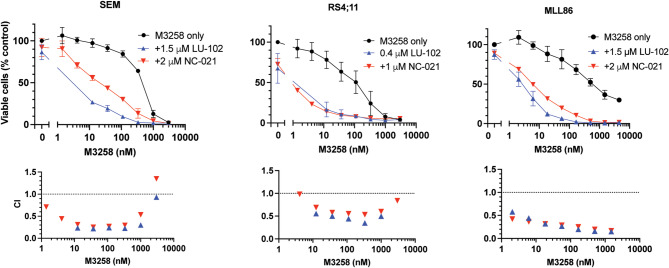
Specific inhibitors of the proteasome trypsin-like and the caspase-like sites enhance M3258 cytotoxicity. RS4;11 and SEM cells were treated with M3258 and indicated concentrations of the trypsin-like sites inhibitor LU-102 or the caspase-like sites inhibitor NC-021 for 48 h, and cell viability were measured with Alamar Blue. MLL-86 cells were treated ex vivo for 24 h, and cell viability was measured by the CellTiter Glo assay. All data are averages of two biological replicates. Error bars indicate the standard error. Single agent activity of NC-021 and LU-102 is presented on Supplementary Fig. S3 and in Fig. 3d in. Bottom graph shows combination indexes determined by the CalcuSyn software.
Fig. 4
Fig. 4
Treatment with PIs induces proteotoxic stress. (a) Effect of PIs on gene expression in SEM cells. Cells treated with 20 nM Btz, 1 µM M3258, and 0.8 µM ONX-0914 and harvested for RNA isolation 1 h before detectable increase in the caspase-like activity. (b) Analysis of RNA sequencing data from (a) by the Ingenuity Pathway Analysis (IPA). BAG2 SP, BAG2 signaling pathway. (c) IPA of RNA sequencing data of Btz-treated primary ALL cells from. (d) Gene-set enrichment analysis (GSEA) of data from (a). (e) Analysis of published proteomic data from Btz-treated SEM cells.
Fig. 5
Fig. 5
Blocking protein synthesis inhibits PI and IPI-induce apoptosis. (a) Cells were treated with M3258 for 12 h or Btz for 6 h in the presence or absence of cycloheximide (CHX), and apoptosis was measured by flow-cytometry with a caspase-3/7 probe; n = 2. Error bars indicate standard error. (b) RS4;11 cells were treated with 10 nM Btz for times indicated or with 1 µM M3258 for 6 h, in the presence or absence of 100 µg/ml CHX and analyzed by western blot. The left membrane was first incubated with K48-polyubiquitin antibody, and then with GAPDH antibody. The membrane on the right was cut horizontally and the top portion was incubated with K48-polyubiquitin antibody, and the bottom with β-actin antibody. (c) Cells were treated with either 10 nM Btz for 4 h or 1 µM M3258 for 6 h, in the presence or absence of 100 ng/ml CHX. RNA was isolated and analyzed by RT-Q-PCR; n = 2(RS4;11) or 3(SEM). Error bars indicate standard error. (d) Cells were treated with Btz, ONX-0914 and M3258 for times indicated, and isolated histones and cell extracts were analyzed by western blots. Histone blots (top two panels) were simultaneously probed with mouse H2B and rabbit H2B-Ub antibodies, then with fluorescently labeled secondary antibodies, and imaged on different channels. Other blots were cut horizontally, the top sections were first probed with cleaved PARP antibody, and then with K48-polyubiquitin antibody. The middle sections were probed with the loading control antibodies, The bottom section of the RS4;11 membrane was probed with NOXA antibodies. SEM samples probed with NOXA antibodies were run on a separate gel.

References

    1. Messinger, Y. H. et al. Bortezomib with chemotherapy is highly active in advanced B-precursor acute lymphoblastic leukemia: therapeutic advances in childhood leukemia & lymphoma (TACL) study. Blood120, 285–290. 10.1182/blood-2012-04-418640 (2012). - PubMed
    1. Kuhlen, M., Klusmann, J. H. & Hoell, J. I. Molecular approaches to treating pediatric leukemias. Front. Pediatr.7, 368. 10.3389/fped.2019.00368 (2019). - PMC - PubMed
    1. Bertaina, A. et al. The combination of bortezomib with chemotherapy to treat relapsed/refractory acute lymphoblastic leukaemia of childhood. Br. J. Haematol.176, 629–636. 10.1111/bjh.14505 (2017). - PubMed
    1. Wartman, L. D. et al. A phase I study of Carfilzomib for relapsed or refractory acute myeloid and acute lymphoblastic leukemia. Leuk. Lymphoma. 57, 728–730. 10.3109/10428194.2015.1076930 (2016). - PMC - PubMed
    1. Jonas, B. A. et al. Phase I study of escalating doses of Carfilzomib with hypercvad in patients with newly diagnosed acute lymphoblastic leukemia. Am. J. Hematol.96, E114–E117. 10.1002/ajh.26105 (2021). - PubMed

MeSH terms

LinkOut - more resources