


Association between postpartum anxiety and depression and exclusive and continued breastfeeding practices: a cross-sectional study in Nevada, USA
- PMID: 40390039
- PMCID: PMC12090565
- DOI: 10.1186/s13006-025-00734-4
Association between postpartum anxiety and depression and exclusive and continued breastfeeding practices: a cross-sectional study in Nevada, USA
Abstract
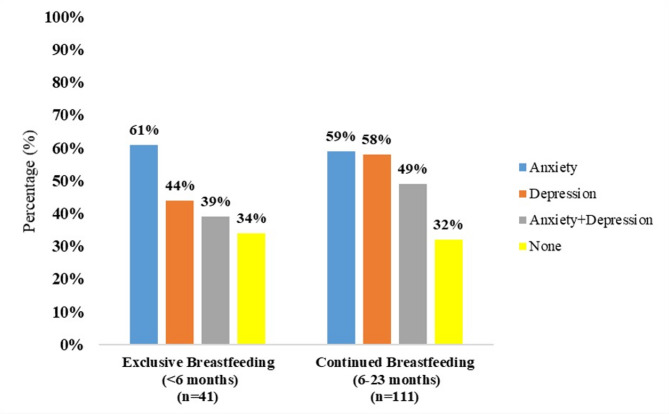
Background: Exclusive (EBF) and continued breastfeeding (CBF) as defined by the World Health Organization are the optimal feeding practices. Perinatal Mental Health Conditions (PMHCs) such as anxiety and depression may influence breastfeeding practices. We aimed to examine if maternal postpartum anxiety and depression symptoms, individually and combined (comorbid), influence EBF and CBF practices.
Methods: A cross-sectional survey was conducted between November 2022 and March 2023 with 326 mothers of children 0-23 months old, all residing in Clark County, Nevada, USA. Descriptive, bivariate, and multivariable logistic regression analyses were conducted to examine the association between self-reported postpartum anxiety and depression symptoms and EBF and CBF in the 24 h prior to the survey.
Results: The prevalence of EBF among infants under 6 months old and CBF among children 6-23 months old was 36.3% (n = 41) and 52.1% (n = 111), respectively. After adjusting for maternal socio-demographic, perinatal, and infant/child characteristics, decreased odds of EBF were associated with the presence of postpartum depressive symptoms (AOR 0.13; 95% CI 0.03,0.55) and the comorbid presence of postpartum anxiety and depression symptoms (AOR 0.16; 95% CI 0.04,0.66). Similarly, decreased odds of CBF were associated with the presence of postpartum anxiety symptoms (AOR 0.36; 95% CI 0.16,0.82).
Conclusion: Postpartum anxiety and depression symptoms decreased the odds of breastfeeding practices among mothers of children under two years old in Clark County, Nevada. However, the relationship may be bidirectional or inverse, requiring further research to clarify. Culturally appropriate interventions to reduce postpartum anxiety and depression are essential to improve breastfeeding practices.
Keywords: Breastfeeding; Continued breastfeeding; Exclusive breastfeeding; Maternal mental health; Mothers; Postpartum anxiety; Postpartum depression.
© 2025. The Author(s).
Conflict of interest statement
Declarations. Ethical approval and consent to participate: Ethical approval was granted by the Institutional Review Board (Protocol UNLV-2022-372) of the University of Nevada, Las Vegas. Informed consent was received prior to the beginning of the survey. Consent for publication: Not applicable. Competing interests: The authors declare no competing interests.
Figures
References
-
- World Health Organization. Indicators for assessing infant and young child feeding practices: definitions and measurement methods. Available: https://www.who.int/publications-detail-redirect/9789240018389. Accessed 23 Apr 2024.
-
- Centers for Disease Control and Prevention. Breastfeeding data. Available: https://www.cdc.gov/breastfeeding-data/survey/results.html. Accessed 3 Apr 2025.
-
- Mental Health Technology Transfer Center (MHTTC). Network. Perinatal mental health. Available: https://mhttcnetwork.org/perinatal-mental-health/#:~:text=Perinatal%20Me.... Accessed 5 Aug 2024.
MeSH terms
Grants and funding
LinkOut - more resources
Full Text Sources
Medical
