


No socioeconomic disparities in the availability of personal care assistance: a population-based cohort analysis of children living with respiratory support
- PMID: 40390045
- PMCID: PMC12090546
- DOI: 10.1186/s12939-025-02511-5
No socioeconomic disparities in the availability of personal care assistance: a population-based cohort analysis of children living with respiratory support
Abstract
Background: Children aged 0-18 years who need long-term respiratory support rely on medical technology and comprehensive medical care. For this care to be provided at home, access to medical and social support and care is essential. In Sweden, the most notable form is personal care assistance (PCA), which is granted based on legislation and individual authority decisions. We aim to explore the impact of socioeconomic factors on the availability of PCAs in children on long-term respiratory support.
Methods: This was a retrospective, population-based cohort analysis of children living with respiratory support in the Swedish Quality Registry for Respiratory Failure (Swedevox) between 2015 and 2021, with crosslinked national registry data on socioeconomic factors and PCA. Associations between socioeconomic factors (country of origin, disposable household income, parents' educational level and marital status) and having been granted PCA were analysed using multivariable regression models.
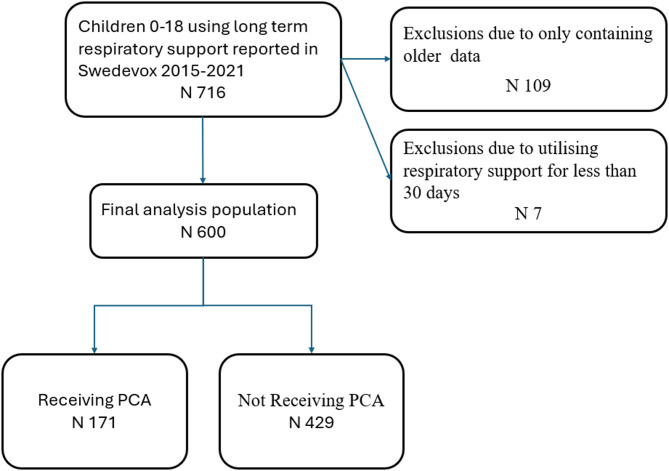
Results: Of the 600 included children (mean age 5.4 ± 5.1 years), 171 (29%) were granted PCA for a median 235 h/month (interquartile range 56-453). No associations were found between socioeconomic factors and the likelihood of children receiving PCA. Specifically, family income (tertile 2: OR 1.02, 95% CI 0.6-1.7; tertile 3: OR 0.89, 95% CI 0.5-1.5), parental education level (OR 1.08, 95% CI 0.7-1.6), parents' marital status (OR 0.91, 95% CI 0.5-1.6), and country of origin (OR 1.33, 95% CI 0.9-2.0) were not associated with PCA receipt.
Conclusion: Among children on long-term respiratory support, 29% were granted PCA, which was not associated with their socioeconomic status. While this suggests that care is provided based on need, the low proportion of children granted PCA raises concerns about whether those judged ineligible receive adequate and equitable support.
Keywords: CPAP; Chronic disease; HMV; NIV; Respiratory insufficiency; Social inequalities.
© 2025. The Author(s).
Conflict of interest statement
Declarations. Ethics approval and consent to participate: The study was conducted in accordance with the Declaration of Helsinki [55] and was approved by the Swedish Ethical Review Authority (Dnr 2021–03426). Consent for publication: In Sweden, reporting to a National Quality Registry requires that participants be provided with detailed information and give verbal consent, but written informed consent is not necessary. Competing interests: None of the authors declares any conflicts of interest related to this work. Unrelated to this work, ME has received a research grant from ResMed and personal fees from AstraZeneca, Boehringer Ingelheim, Novartis, and Roche. AM and AP have received a grant from ResMed related to lectures.
References
-
- Falkson S, Knecht C, Hellmers C, Metzing S. The perspective of families with a Ventilator-Dependent child at home. A literature review. J Pediatr Nurs. 2017;36:213–24. - PubMed
-
- Graham RJ, McManus ML, Rodday AM, et al. Chronic respiratory failure: utilization of a pediatric specialty integrated care program. Healthcare. 2017;5(1):23–8. - PubMed
-
- Popejoy E, Marufu TC, Thomas DA, et al. A regional evaluation of the health care utilization and outcomes of children and young people with long-term ventilation needs. Child Care Health Dev. 2021;47(1):70–6. - PubMed
MeSH terms
LinkOut - more resources
Full Text Sources
Medical
