. 2025 Apr 25:20:101051.
doi: 10.1016/j.onehlt.2025.101051. eCollection 2025 Jun.

Coinheritance of polymorphic alleles of PIEZO1, G6PD and HBB enhances protection against malaria

Affiliations

Coinheritance of polymorphic alleles of PIEZO1, G6PD and HBB enhances protection against malaria

Paloma Abad et al. One Health. .

Abstract

Malaria has exerted potent selective pressure on the human genome over millennia and has been a significant force in shaping human evolution. We have determined in 424 individuals living in malaria-hyperendemic areas in Ghana and in the Democratic Republic of Congo, the genotypes at the loci PIEZO1, G6PD, HBB, and PKLR. By qPCR we have also estimated P. falciparum parasitemia in all these subjects. We found that 41% of individuals tested had one protective variant, 20.5% two variants, 6.4% three variants, and 0.7% four variants. We have confirmed that Pz_E756del, G6pd A-, and HbS are associated with lower parasite density. The highest allele frequency was that of Pz_E756del, approaching 0.2, and we found that it is in linkage disequilibrium with Pz_E750Q. While overall malaria prevalence did not differ significantly among the groups, non-pregnant individuals with multiple protective alleles had lower rates of high-density parasitaemia, suggesting an additive effect of these variants against severe malaria infection, while pregnancy showed different allele protection profile. The high frequency of individuals carrying two or more protective polymorphisms might have implications for malaria transmission and parasite reservoir maintenance. Thus, the significance of additive or possibly synergistic effects of multiple protective genes co-existing in the same person deserves further investigation.

Keywords: G6PD; Hemoglobin; Malaria; PKLR; Piezo1; Polymorphism; Protection; Resistance; Sickle cell; Tolerance.


Conflict of interest statement

We declare no conflict of interest.

Figures

Fig. 1
Fig. 1
Malaria infection status according to the presence of genetic variants. The percentage of individuals classified as non-infected (green), with submicroscopic malaria (orange), or with microscopic malaria (purple) is shown for each genotype group. Only variants observed in at least 10 individuals are included. The total number of individuals (n) analyzed within each genotype group and the corresponding percentages of microscopic malaria over all infections (MM / MM+SM) and total malaria infection (any parasitaemia) are indicated below the bars. (A) All study participants. (B) Non-pregnant individuals only. (C) Pregnant women only.
Fig. 2
Fig. 2
Parasitaemia level according to the presence or absence of polymorphic variants conferring malaria protection by age group and pregnancy. Parasitaemia level was compared between individuals carrying any of the variants conferring malaria protection and those carrying none of these variants (label as “Normal”). Parasitaemia according to variant: A, Pz_E756del; B, G6pd A-; C, HbS; D, HbC. Significant differences obtained by Wilcoxon test are indicated by asterisks (*). *, p-value ≤ 0.05; **, p-value ≤ 0.01. Differences by age or pregnancy group (PG) are indicated at the top and differences between mutants and non-mutants are indicated at the bottom of the graph. Each box plot shows the distribution of parasitaemia level for each group (the central bar indicates the median, the edges of the boxes Q1 and Q3 and the whiskers extend to the minimum and maximum values not exceeding Q1/Q3 ± 1.5 x IQR).
Fig. 3
Fig. 3
Parasitaemia level according to the presence or absence of polymorphic variants conferring malaria protection in pregnancy. Parasitaemia level was compared between individuals carrying any of the variants conferring malaria protection and those carrying none of these variants (label as “Normal”). Parasitaemia according to variant: A, Pz_E756del; B, G6pd A-; C, HbS; D, HbC. Significant differences obtained by Wilcoxon test are indicated by asterisks (*). *, p-value ≤ 0.05; **, p-value ≤ 0.01. Differences by pregnancy group (non-pregnant vs. pregnant) are indicated at the top and differences between mutants and non-mutants are indicated at the bottom of the graph. Each box plot shows the distribution of parasitaemia level for each group (the central bar indicates the median, the edges of the boxes Q1 and Q3 and the whiskers extend to the minimum and maximum values not exceeding Q1/Q3 ± 1.5 x IQR).
Fig. 4
Fig. 4
Type of malaria infection according to the number of potentially protective variants. Malaria infection status vs. number of accumulated variants in the individuals sharing such status. Significant differences obtained by Student’s t-test are indicated by asterisk (*), p-value ≤ 0.05. NI, non-infected; SM, submicroscopic malaria; MM, microscopic malaria. (A) All study participants. (B) Non-pregnant individuals only. (C) Pregnant women only.
Fig. 5
Fig. 5
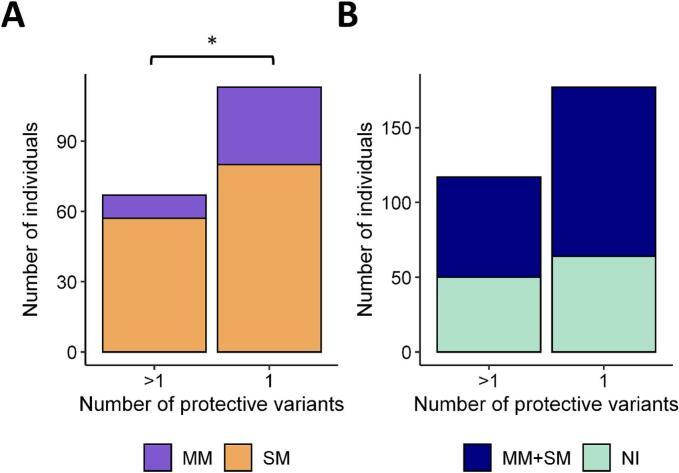
Prevalence of malaria infection according to the number of potentially protective variants. A and B, carriers of one or more than one variant vs. proportion of malaria infection status. Significant differences obtained by Fisher’s test are indicated by asterisk (*), p-value ≤ 0.05. NI, non-infected; SM, submicroscopic malaria; MM, microscopic malaria.

References

    1. Whitfield J. Portrait of a serial killer. Nature. 2002 doi: 10.1038/news021001-6. - DOI
    1. Kwiatkowski D.P. How malaria has affected the human genome and what human genetics can teach us about malaria. Am J Hum Genet. 2005;77:171–192. - PMC - PubMed
    1. Akide-Ndunge O.B., Ayi K., Arese P. The Haldane malaria hypothesis: facts, artifacts, and a prophecy. Redox Rep. 2003;8:311–316. - PubMed
    1. Kariuki S.N., Williams T.N. Human genetics and malaria resistance. Hum Genet. 2020;139:801–811. - PMC - PubMed
    1. Luzzatto L. Genetics of red cells and susceptibility to malaria. Blood. 1979;54:961–976. - PubMed

LinkOut - more resources