


Back to normal? A retrospective study on stimulation test and endocrinological diagnosis before, during and after COVID-19 pandemics
- PMID: 40391009
- PMCID: PMC12086081
- DOI: 10.3389/fendo.2025.1571685
Back to normal? A retrospective study on stimulation test and endocrinological diagnosis before, during and after COVID-19 pandemics
Abstract
Introduction: The COVID-19 pandemic disrupted healthcare systems, affecting consultations and diagnostics. In pediatric endocrinology, referral patterns shifted, with increased central precocious puberty (CPP) diagnoses and decreased growth hormone deficiency (GHD) evaluations. This study examines trends in stimulation tests, referrals, and diagnoses from 2019 to 2023 to assess the pandemic's impact on pediatric endocrinology.
Methods: This retrospective study analyzed stimulation tests performed at the Institute for Maternal and Child Health IRCCS "Burlo Garofolo," Trieste, Italy, from 2019 to 2023, divided into pre-pandemic (2019-March 2020), pandemic (March 2020-January 2022), and post-pandemic (February 2022-December 2023) phases.
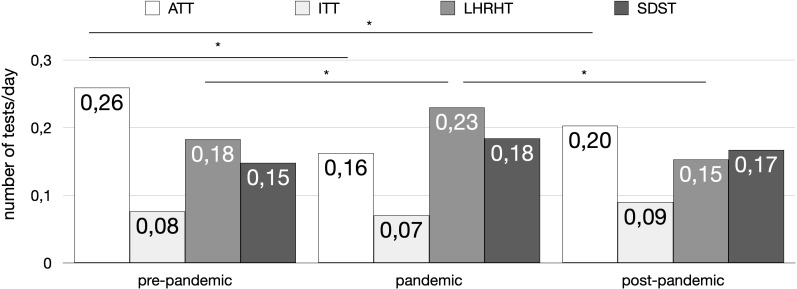
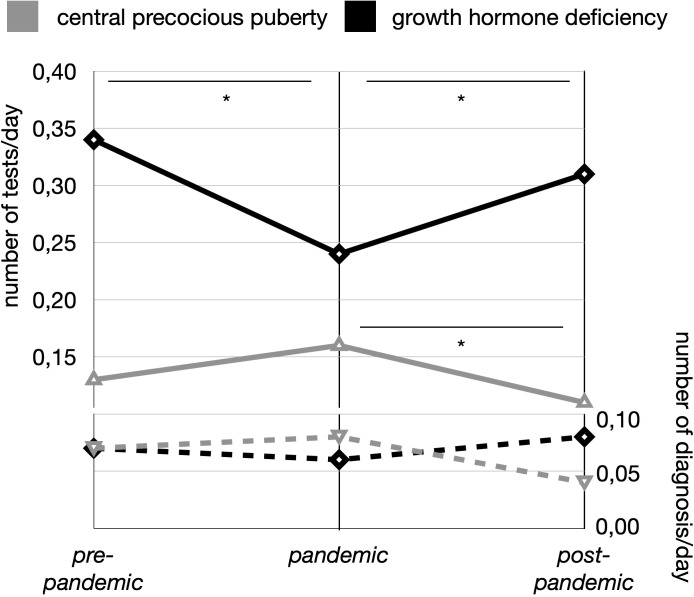
Results: A total of 1,526 tests were conducted on 1,042 patients. Tests per day remained stable (pre-pandemic: 0.84; pandemic: 0.82; post-pandemic: 0.85). The Arginine Stimulation Test (ATT), the most frequent test pre-pandemic (31%), decreased during the pandemic (20%, p<0.001), while the LHRH Test (LHRHT) increased from 22% to 28% (p<0.001), becoming the most requested test. Diagnosis rates for GHD and CPP remained stable, but the proportion of females diagnosed with CPP increased significantly during the pandemic (91% vs. 69%, p=0.022). CPP testing declined (p=0.018) post-pandemic, while GHD testing returned to pre-pandemic levels.
Conclusion: The pandemic altered diagnostic patterns, with reduced GHD evaluations reflecting limited healthcare access. Post-pandemic recovery suggests a resolution of diagnostic delays. The temporary surge in CPP cases, likely influenced by pandemic-related lifestyle changes, subsided post-pandemic, aligning with pre-pandemic trends. To date, no other studies have reported similar variations in GHD incidence during the pandemic.
Keywords: COVID-19; central precocious puberty (CPP); growth hormone deficiency; precocious puberty; stimulation tests.
Copyright © 2025 Peinkhofer, Passarella, Dalena, Tamaro, Vidonis, Vittori, Slama, Faleschini, Barbi and Tornese.
Conflict of interest statement
The authors declare that the research was conducted in the absence of any commercial or financial relationships that could be construed as a potential conflict of interest. The author(s) declared that they were an editorial board member of Frontiers, at the time of submission. This had no impact on the peer review process and the final decision.
Figures
References
-
- Indolfi G, Stivala M, Lenge M, Diaz Naderi R, McIntosh J, Llandrich RC, et al. Impact of SARS-CoV-2 pandemic and strategies for resumption of activities during the second wave of the pandemic: A report from eight paediatric hospitals from the ECHO network. Front Public Health. (2021) 9:630168. doi: 10.3389/fpubh.2021.630168 - DOI - PMC - PubMed
MeSH terms
LinkOut - more resources
Full Text Sources
Medical
