


Effectiveness of preventive interventions on adolescents' depression and suicidal tendency: a systematic review of randomized controlled trials
- PMID: 40391107
- PMCID: PMC12087179
- DOI: 10.3389/fpsyg.2025.1356816
Effectiveness of preventive interventions on adolescents' depression and suicidal tendency: a systematic review of randomized controlled trials
Abstract
Introduction: This study was conducted to review the effectiveness of preventive mental health interventions for adolescents (aged 11-19 years) in reducing depression and suicidal tendencies.
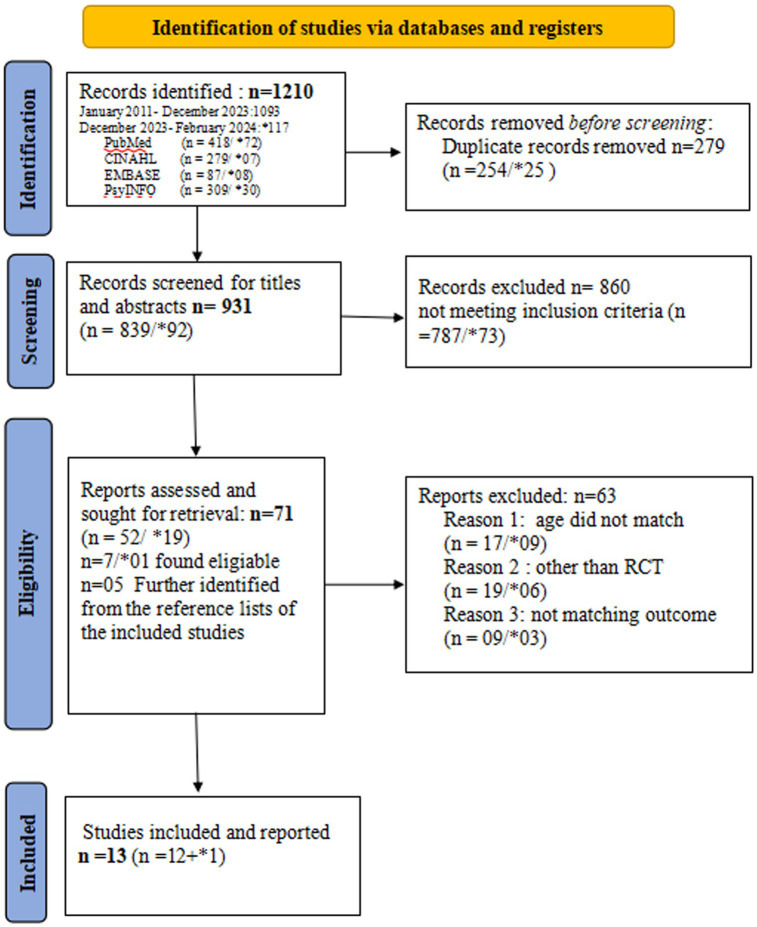
Methods: A systematic search was conducted to identify randomized controlled trials (RCTs) from the databases PubMed, CINAHL, EMBASE, and APA PsycINFO for the period 2011-2024. Studies were included based on strict inclusion/exclusion criteria, selecting those that reported preventive interventions addressing depression and suicidal tendencies among adolescents. The systematic review registration number is CRD42023384321.
Results: Out of 1,210 studies, 13 RCTs were incorporated. The interventions yielded varied outcomes, with approximately half of the RCTs demonstrating reductions in depression and suicidal tendencies, comparable to the control group. Post-intervention, the majority of interventions exhibited mild to moderate effect sizes; however, further research is warranted to assess their long-term efficacy. Cognitive-behavioral therapy (CBT)-based psychoeducation interventions served as the primary approach, often implemented in school settings. However, these interventions were primarily delivered by specialists rather than teachers. Parental involvement in treatment emerged as a potential factor that could enhance the effectiveness of preventive interventions.
Discussion and conclusion: While numerous interventions in this review showed effects comparable to control groups, the diversity in methodology, intervention types, and outcome measures poses challenges in drawing definitive conclusions. Therefore, future research should prioritize addressing these methodological discrepancies within their respective contexts.
Keywords: adolescents; children; depression; prevention; promotion; suicide.
Copyright © 2025 Ghazal, Cui, Fenglin, Froelicher and Shimbrer.
Conflict of interest statement
The authors declare that the research was conducted in the absence of any commercial or financial relationships that could be construed as a potential conflict of interest.
Figures
References
-
- Ajzen I. (1991). The theory of planned behavior. Organ. Behav. Hum. Decis. Process. 50, 179–211. doi: 10.1016/0749-5978(91)90020-T - DOI
-
- Arora P. G., Collins T. A., Dart E. H., Hernández S., Fetterman H., Doll B. (2019). Multi-tiered systems of support for school-based mental health: a systematic review of depression interventions. School Mental Health 11, 240–264. doi: 10.1007/s12310-019-09314-4 - DOI
-
- Bandura A. (1977). Social learning theory. Oxford: England, Prentice-Hall.
-
- Bernal G., Rivera-Medina C. L., Cumba-Avilés E., Reyes-Rodríguez M. L., Sáez-Santiago E., Duarté-Vélez Y., et al. . (2019). Can cognitive-behavioral therapy be optimized with parent psychoeducation? A randomized effectiveness trial of adolescents with major depression in Puerto Rico. Fam. Process 58, 832–854. doi: 10.1111/famp.12455, PMID: - DOI - PubMed
Publication types
LinkOut - more resources
Full Text Sources
