


How do study participants want to be informed about study results: Findings from a malaria trial in Cambodia, Ethiopia, Pakistan, and Indonesia
- PMID: 40391130
- PMCID: PMC12086731
- DOI: 10.1017/cts.2025.56
How do study participants want to be informed about study results: Findings from a malaria trial in Cambodia, Ethiopia, Pakistan, and Indonesia
Abstract
Background: Researchers acknowledge the need to share study results with the patients and their communities, but this is not done consistently due to a plethora of barriers, including a paucity of data to guide best practice approaches in different populations.
Methods: This study was nested within a large multi-center randomized controlled trial of antimalaria treatment. Data on dissemination preferences were collected at the third-month follow-up visit using a short questionnaire. Data were analyzed using descriptive statistics and subsequently fed into an iterative process with key stakeholders, to develop suitable strategies for result dissemination.
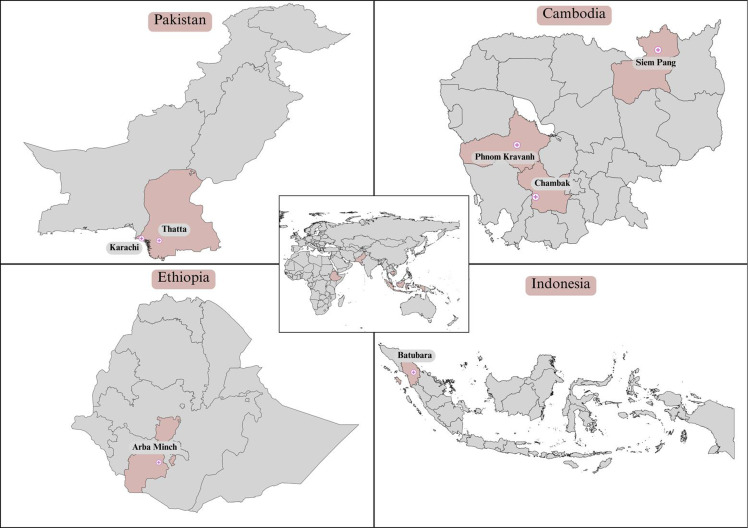
Results: A total of 960 patients were enrolled in the trial, of whom 84.0% participated in the nested survey. A total of 601 (74.6%) participants indicated interest in receiving trial results. There was significant heterogeneity by study country, with 33.3% (58/174) of patients indicating being interested in Cambodia, 100% (334/334) in Ethiopia, 97.7% (209/214) in Pakistan, but none (0/85) in Indonesia. The preferred method of dissemination varied by site, with community meetings, favored in Ethiopia (79.0%, 264/334) and individualized communication such as a letter (27.6%, 16/58) or phone calls (37.9%, 22/58) in Cambodia. Dissemination strategies were designed with key stakeholders and based on patient preferences but required adaptation to accommodate local logistical challenges.
Conclusion: The varying preferences observed across different sites underscore that a one-size-fits-all approach is inadequate. Strategies can be tailored to patient preference but require adaptation to accommodate logistical challenges.
Keywords: Results dissemination; clinical trial; community engagement; malaria; research participants.
© The Author(s) 2025.
Conflict of interest statement
The authors declare none.
Figures
Similar articles
-
Evidence Brief: Comparative Effectiveness of Appointment Recall Reminder Procedures for Follow-up Appointments [Internet].Washington (DC): Department of Veterans Affairs (US); 2015 Jul. Washington (DC): Department of Veterans Affairs (US); 2015 Jul. PMID: 27606388 Free Books & Documents. Review.
-
The future of Cochrane Neonatal.Early Hum Dev. 2020 Nov;150:105191. doi: 10.1016/j.earlhumdev.2020.105191. Epub 2020 Sep 12. Early Hum Dev. 2020. PMID: 33036834
-
Comparing Three Ways to Help Cancer Survivors Plan for Follow-Up Care [Internet].Washington (DC): Patient-Centered Outcomes Research Institute (PCORI); 2022 May. Washington (DC): Patient-Centered Outcomes Research Institute (PCORI); 2022 May. PMID: 39666842 Free Books & Documents. Review.
-
Sharing results with participants (and community) in malaria related research: Perspectives and experience from researchers.PLOS Glob Public Health. 2023 Sep 5;3(9):e0002062. doi: 10.1371/journal.pgph.0002062. eCollection 2023. PLOS Glob Public Health. 2023. PMID: 37669255 Free PMC article.
-
Multi-country collaborative citizen science projects to co-design cardiovascular disease prevention strategies and advocacy: findings from Ethiopia, Malawi, Rwanda, and South Africa.BMC Public Health. 2023 Dec 12;23(1):2484. doi: 10.1186/s12889-023-17393-x. BMC Public Health. 2023. PMID: 38087240 Free PMC article.
Cited by
-
Current global practice and implications for future research on disseminating health research results to study participants: A systematic review.PLoS Med. 2025 Aug 14;22(8):e1004569. doi: 10.1371/journal.pmed.1004569. eCollection 2025 Aug. PLoS Med. 2025. PMID: 40811427 Free PMC article.
References
-
- Reynolds L, Sariola S. The ethics and politics of community engagement in global health research, 2018.
-
- NHMRC. National statement on ethical conduct in human research, 2007 - updated 2018, 2018.
LinkOut - more resources
Full Text Sources