


Speciation in the Peninsular Indian Flying Lizard (Draco dussumieri) Follows Climatic Transition and Not Physical Barriers
- PMID: 40391543
- PMCID: PMC12143371
- DOI: 10.1111/mec.17800
Speciation in the Peninsular Indian Flying Lizard (Draco dussumieri) Follows Climatic Transition and Not Physical Barriers
Abstract
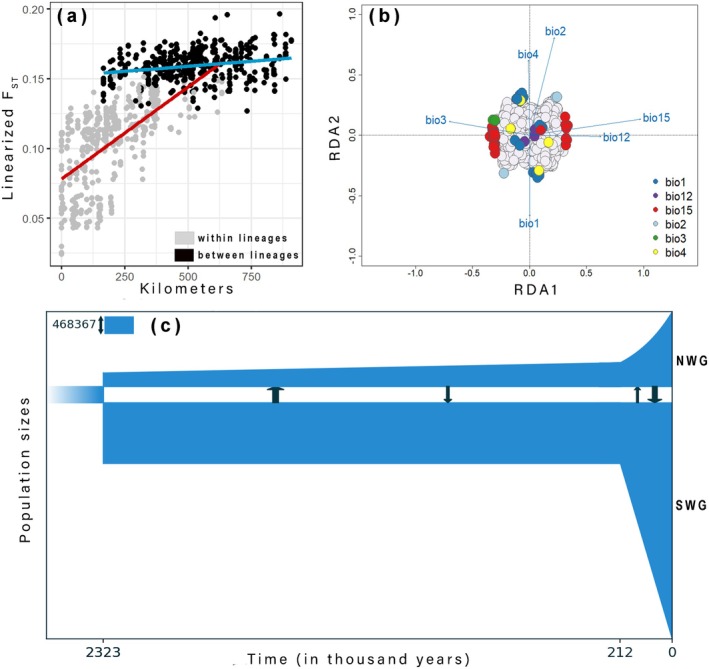
Marked with high levels of endemism and in situ radiations, the Western Ghats mountains make for a compelling backdrop to examine processes that lead to the formation and maintenance of species. Regional geographic barriers and paleoclimatic fluctuations have been implicated as drivers of speciation, but their roles have not been explicitly tested in a phylogenomic framework. We integrated mitochondrial DNA, genome-wide SNPs and climatic data to examine the influence of geographic barriers and climatic transitions in shaping phylogeography and potential speciation in the Peninsular Indian Flying lizard (Draco dussumieri). We found strong evidence for two independently evolving, geographically distinct, northern and southern lineages within D. dussumieri that diverged during the early Pleistocene, and a gradient of admixed populations across a broad hybrid zone in the Central Western Ghats. Migrations after initial divergence were continuous, but gene flow remained consistently below thresholds required to homogenise lineages. We found more support for isolation by environment (especially rainfall regimes) than by distance. The range-break between lineages occurs at a transition zone in the Central Western Ghats that separates dissimilar rainfall regimes with no physical barriers. This limit is potentially an ecological barrier, which nevertheless was permeable during glacial maxima. We hypothesise that similar phylogeographic patterns will emerge in other widespread, wet-adapted species in the Western Ghats that presumably endured the same climatic processes.
Keywords: Western Ghats; contact zone; isolation by environment; paleoclimate; population demographics; squamate.
© 2025 The Author(s). Molecular Ecology published by John Wiley & Sons Ltd.
Conflict of interest statement
The authors declare no conflicts of interest.
Figures




References
-
- Agarwal, I. , and Karanth K. P.. 2015. “A Phylogeny of the Only Ground‐Dwelling Radiation of Cyrtodactylus (Squamata, Gekkonidae): Diversification of Geckoella Across Peninsular India and Sri Lanka.” Molecular Phylogenetics and Evolution 82: 193–199. - PubMed
-
- Agarwal, I. , Khandekar A., Giri V. B., Ramakrishnan U., and Karanth K. P.. 2019. “The Hills Are Alive With Geckos! A Radiation of a Dozen Species on Sky Islands Across Peninsular India (Squamata: Gekkonidae, Hemiphyllodactylus) With the Description of Three New Species.” Organisms Diversity & Evolution 19: 341–361.
-
- Alcala, A. C. 1967. “Population Biology of the “Flying” Lizard, Draco volans, on Negros Island, Philippines.” Natural and Applied Science Bulletin 20, no. 4: 335–372.
-
- Allio, R. , Donega S., Galtier N., and Nabholz B.. 2017. “Large Variation in the Ratio of Mitochondrial to Nuclear Mutation Rate Across Animals: Implications for Genetic Diversity and the Use of Mitochondrial DNA as a Molecular Marker.” Molecular Biology and Evolution 34, no. 11: 2762–2772. - PubMed
-
- Andrews, S. 2010. “FastQC: A Quality Control Tool for High Throughput Sequence Data.” http://www.bioinformatics.babraham.ac.uk/projects/fastqc/.
MeSH terms
Substances
Grants and funding
LinkOut - more resources
Full Text Sources
Medical
