


10-Year Outcomes of Deferred or Conventional Stent Implantation in Patients With STEMI (DANAMI-3-DEFER)
- PMID: 40391569
- PMCID: PMC12165484
- DOI: 10.1161/CIRCINTERVENTIONS.125.015369
10-Year Outcomes of Deferred or Conventional Stent Implantation in Patients With STEMI (DANAMI-3-DEFER)
Abstract
Background: Primary percutaneous coronary intervention (PCI) with stenting is recommended in ST-segment-elevation myocardial infarction. Immediate stenting may cause distal embolization, microvascular damage, and flow disturbances, leading to adverse outcomes. We report the 10-year clinical outcomes of deferred stenting versus conventional PCI in patients with ST-segment-elevation myocardial infarction.
Methods: We conducted a 10-year follow-up study of the open-label, randomized DANAMI-3-DEFER trial (Third Danish Study of Optimal Acute Treatment of Patients With STEMI - Deferred Stent Implantation Versus Conventional Treatment), conducted in 4 PCI centers in Denmark. Patients with ST-segment-elevation myocardial infarction and acute chest pain <12 hours were randomized to deferred stenting >24 hours after the index procedure or conventional PCI with immediate stenting. In the deferred group, immediate stable Thrombolysis in Myocardial Infarction flow II to III was established, and intravenous administration of either a glycoprotein IIb/IIIa antagonist or bivalirudin for >4 hours after the index procedure was recommended. The primary outcome was a composite of hospitalization for heart failure or all-cause mortality. Key secondary outcomes included individual components of the primary outcome and target vessel revascularization.
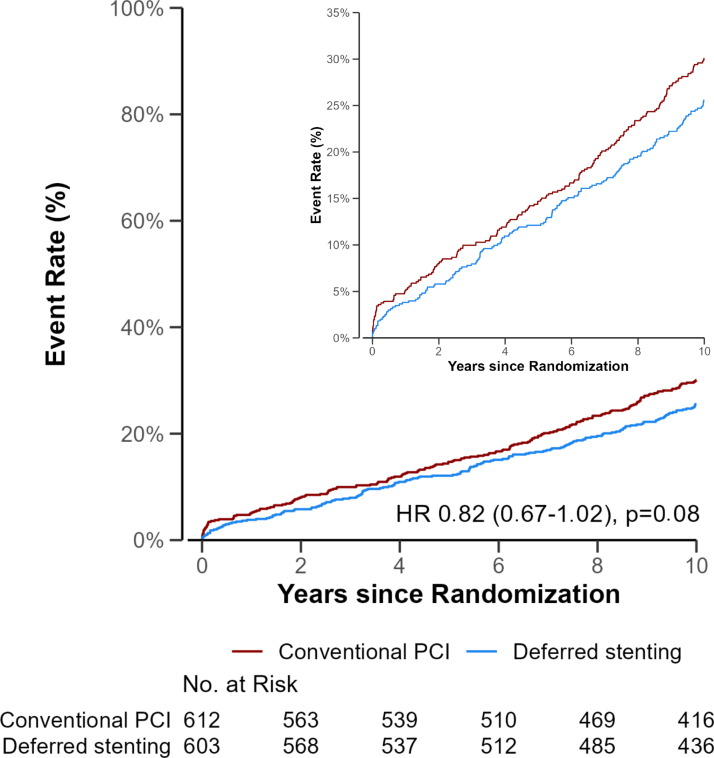
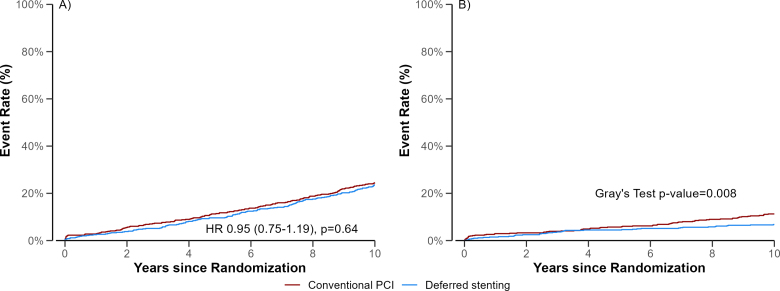
Results: Of 1215 patients, 603 were randomized to deferred stenting and 612 to conventional PCI. After 10 years, deferred stenting did not significantly reduce the primary composite outcome (hazard ratio, 0.82 [95% CI, 0.67-1.02]; P=0.08). In the deferred group, 124 (24%) died versus 150 (25%) in the conventional PCI group (hazard ratio, 0.95 [95% CI, 0.75-1.19]). Hospitalization for heart failure was lower in patients treated with deferred stenting compared with conventional PCI (odds ratio, 0.58 [95% CI, 0.39-0.88]). Target vessel revascularization was similar in both groups (odds ratio, 1.20 [95% CI, 0.81-1.79]).
Conclusions: Deferred stenting did not reduce all-cause mortality or the composite primary outcome after 10 years but reduced hospitalization for heart failure compared with conventional PCI.
Registration: URL: https://www.clinicaltrials.gov; Unique identifier: NCT01435408.
Keywords: heart failure; myocardial infarction; odds ratio; percutaneous coronary intervention; stents.
Conflict of interest statement
Dr Køber: speaker’s honorarium from Astra Zeneca, Boehringer, Novartis, and Novo Nordisk. Dr Lønborg: an advisory board fee, an unrestricted grant, and speakers fee from Boston Scientific and speakers fee from Abbott, unrelated to this topic. Dr Engstrøm: advisory board fee from Abbott, Novo Nordisk and speakers fee from Novo Nordisk, Abbott, Boston Scientific. Dr Clemmensen: previous or current involvement in research contracts, consulting, speakers bureau or received research and educational grants from: Abbott, Abiomed, AliveCor, Inc, AstraZeneca, Aventis, Bayer, Boehringer Ingelheim, Bristol Myers Squibb, CeleCor, Daiichi Sankyo, Eli-Lilly, Evolva, Fibrex, Idorsia, IQVIA, Janssen, Merck, Myogen, Medtronic, Mitsubishi Pharma, The Medicines Company, Nycomed, Organon, Pfizer, Pharmacia, Philips, Regado, Sanofi, Searle, Servier, ViFor Pharma. VP, consultant fees, honoraria and educational grant from Abiomed J&JVP. Dr Jensen: unrestricted research grants to her institution from Biotronik, Biosensors and OrbusNeich. The other authors report no conflicts.
Figures

References
-
- Byrne RA, Rossello X, Coughlan JJ, Barbato E, Berry C, Chieffo A, Claeys MJ, Dan G-A, Dweck MR, Galbraith M, et al. ; ESC Scientific Document Group. 2023 ESC guidelines for the management of acute coronary syndromes. Eur Heart J. 2023;44:3720–3826. doi: 10.1093/eurheartj/ehad191 - PubMed
-
- Lawton JS, Tamis-Holland JE, Bangalore S, Bates ER, Beckie TM, Bischoff JM, Bittl JA, Cohen MG, DiMaio JM, Don CW, et al. 2021 ACC/AHA/SCAI guideline for coronary artery revascularization: a report of the American College of Cardiology/American Heart Association joint committee on clinical practice guidelines. Circulation. 2022;145:e18–e114. doi: 10.1161/CIR.0000000000001038 - PubMed
-
- Rezkalla SH, Stankowski RV, Hanna J, Kloner RA. Management of no-reflow phenomenon in the catheterization laboratory. JACC Cardiovasc Interv. 2017;10:215–223. doi: 10.1016/j.jcin.2016.11.059 - PubMed
-
- Fokkema ML, Vlaar PJ, Svilaas T, Vogelzang M, Amo D, Diercks GFH, Suurmeijer AJH, Zijlstra F. Incidence and clinical consequences of distal embolization on the coronary angiogram after percutaneous coronary intervention for ST-elevation myocardial infarction. Eur Heart J. 2009;30:908–915. doi: 10.1093/eurheartj/ehp033 - PubMed
-
- Nepper-Christensen L, Kelbæk H, Ahtarovski KA, Høfsten DE, Holmvang L, Pedersen F, Tilsted H-H, Aarøe J, Jensen SE, Raungaard B, et al. Angiographic outcome in patients treated with deferred stenting after ST-segment elevation myocardial infarction-results from DANAMI-3-DEFER. Eur Heart J Acute Cardiovasc Care. 2022;11:742–748. doi: 10.1093/ehjacc/zuac098 - PubMed
Publication types
MeSH terms
Substances
Associated data
LinkOut - more resources
Full Text Sources
Medical
Miscellaneous
