


Medication versus globus pallidus internus deep brain stimulation in Parkinson's disease with deep learning video analysis of finger tapping
- PMID: 40394036
- PMCID: PMC12092645
- DOI: 10.1038/s41598-025-02098-5
Medication versus globus pallidus internus deep brain stimulation in Parkinson's disease with deep learning video analysis of finger tapping
Abstract
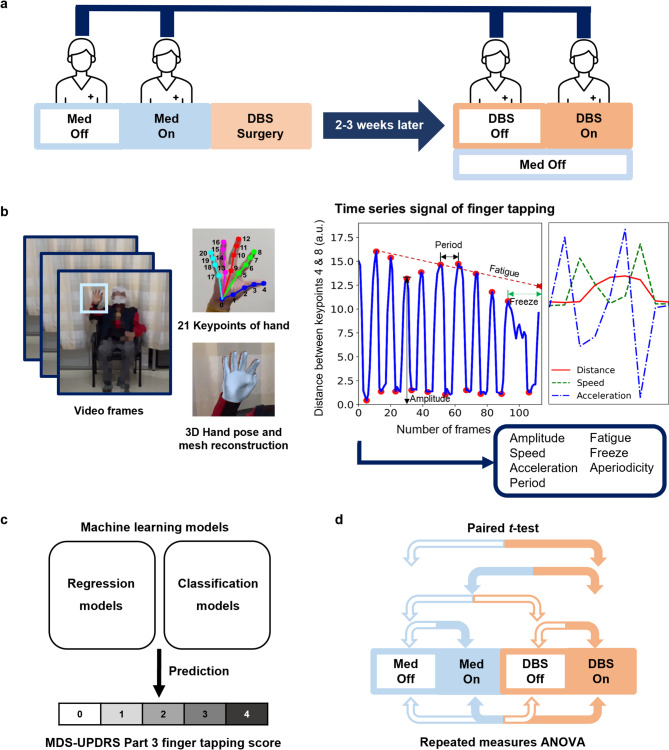
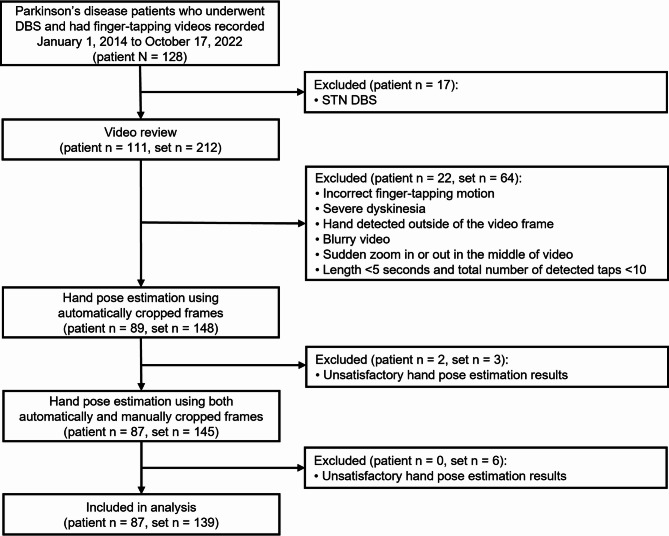
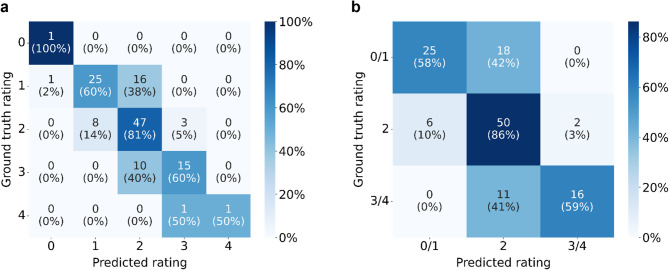
In advanced Parkinson's disease (PD), considerable number of patients receive deep brain stimulation (DBS) surgery, to alleviate symptoms not readily controlled by medication. However, the differential effects of medication and DBS on improving motor symptoms, especially for DBS targeting the globus pallidus internus (GPi), have not been explored in sufficient detail. We studied the finger tapping (FT) task of the Movement Disorder Society Unified Parkinson's Disease Rating Scale Part 3, to evaluate the improvements in bradykinesia achieved through GPi DBS in patients with PD. In this observational study, videos were recorded during the FT task in four different states for each patient, without and with medication in the preoperative setting, and before and after DBS programming in the postoperative setting. Using a deep learning model, we reconstructed the 2D hand motions into 3D meshes to extract 21 motion parameters that characterize hand bradykinesia. We employed these parameters to predict the FT score using machine learning models. Finally, statistical tests were used to compare motion parameters across four distinct states. A total of 556 videos from 87 patients were collected. The best model predicted the FT score with an accuracy of 0.70, which was on par with human experts. Notably, GPi DBS significantly improved speed and acceleration parameters compared to medication. Our study results indicate that GPi DBS and medication might act through different mechanisms, with GPi DBS more directly influencing neural pathways related to speed control in fine rhythmic hand movements.
Keywords: Deep brain stimulation; Deep learning; Levodopa; Machine learning; Parkinson disease.
© 2025. The Author(s).
Conflict of interest statement
Declarations. Competing interests: The authors declare no competing interests.
Figures
References
Publication types
MeSH terms
Substances
Grants and funding
LinkOut - more resources
Full Text Sources
Medical
