


Integration of lipidomics and widely targeted metabolomics provides a comprehensive metabolic landscape of Poa pratensis under cadmium stress
- PMID: 40394484
- PMCID: PMC12090683
- DOI: 10.1186/s12870-025-06709-1
Integration of lipidomics and widely targeted metabolomics provides a comprehensive metabolic landscape of Poa pratensis under cadmium stress
Abstract
Background: Soil cadmium (Cd) contamination poses significant environmental challenges globally. Kentucky bluegrass is considered a viable plant for remediating Cd-contaminated soils due to its high tolerance to Cd and accumulation capacity. Yet, the complete metabolic landscape underlying Cd detoxification mechanisms of Kentucky bluegrass remains incompletely understood.
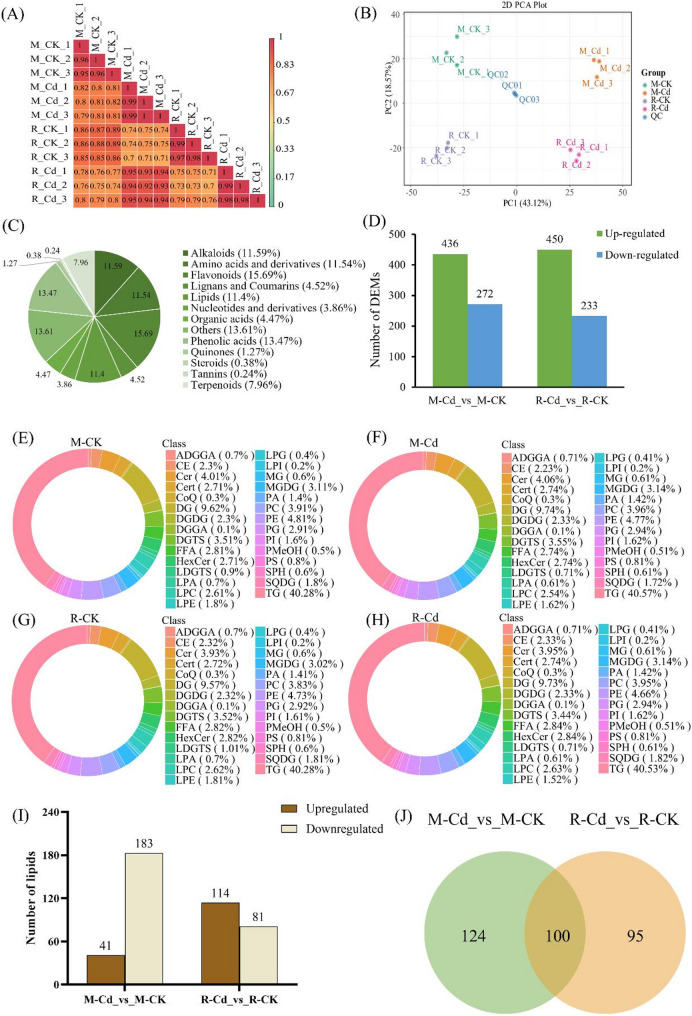
Results: Here, widely targeted metabolomics was used to identify key metabolites of Kentucky bluegrass that were responsive to Cd stress in comparisons between Cd-resistant (M) and sensitive (R) varieties. Moreover, lipidomics analyses were used to assess the content, composition, and saturation levels of lipid molecular species. The M variety exhibited higher levels of free amino acids, saccharides, and flavonoids (flavones, flavonols, isoflavones, and flavanones) after Cd stress that likely enhance its tolerance to Cd stress. Within the M variety, 183 lipid species (81%) were less abundant after Cd stress, representing a much larger number than the 81 lipid species (41.54%) similarly less abundant in the R variety. The lipid species with increased abundances primarily comprised diacylglycerols, monogalactosyldiacylglycerol, phosphatidylcholine, triacylglycerol, and lysophosphatidylcholine that exhibited higher saturation levels. Conversely, the lipid species with decreased abundances largely comprised those with shorter acyl chains including free fatty acids, phosphatidic acid, and lysophosphatidic acid, as well as those with higher unsaturation levels, including phosphatidylglycerol, diacylglycerol, triacylglycerol, phosphatidylcholine, and lysophosphatidylcholine. The elongation of these lipid acyl chains under Cd stress contributes to the increased membrane thickness and rigidity in Kentucky bluegrass, resulting from the dense packing of hydrophobic tails and enhanced lipid-lipid interactions. The changes in these metabolites and lipids may play a significant role in enhancing Cd tolerance, distribution, and accumulation in Kentucky bluegrass.
Conclusion: The results of this study provide a comprehensive metabolite profile for Kentucky bluegrass in response to Cd stress, elucidating the key metabolite characteristics essential for Cd detoxification under Cd-induced stress. Furthermore, the results provide insights into the metabolic regulation of metabolites and lipid homeostasis that contribute to enhanced Cd tolerance in Kentucky bluegrass.
Keywords: Cadmium toxicity; Kentucky bluegrass; Lipidomic; Widely targeted metabolomic.
© 2025. The Author(s).
Conflict of interest statement
Declarations. Ethics approval and consent to participate: This article does not contain any studies with animals or humans performed by any of the authors. This study complies with institutional, national and international guidelines and legislation. Consent for publication: Not applicable. Competing interests: The authors declare no competing interests.
Figures


References
-
- Shi J-J, Shi Y, Feng Y-L, Li Q, Chen W-Q, Zhang W-J, Li H-Q. Anthropogenic cadmium cycles and emissions in Mainland China 1990–2015. J Clean Prod. 2019;230:1256–65. - DOI
-
- Shen C, Huang B, Hu L, Yuan H, Huang Y, Wang Y, Sun Y, Li Y, Zhang J, Xin J. Comparative transcriptome analysis and Arabidopsis thaliana overexpression reveal key genes associated with cadmium transport and distribution in root of two Capsicum annuum cultivars. J Hazard Mater. 2024;465:133365. - DOI - PubMed
MeSH terms
Substances
Grants and funding
LinkOut - more resources
Full Text Sources
