. 2025 May 9;7(3):fcaf184.
doi: 10.1093/braincomms/fcaf184. eCollection 2025.

Drug repurposing candidates for amyotrophic lateral sclerosis using common and rare genetic variants

Affiliations

Drug repurposing candidates for amyotrophic lateral sclerosis using common and rare genetic variants

Zachary F Gerring et al. Brain Commun. .

Abstract

Amyotrophic lateral sclerosis (ALS) is a devastating neurodegenerative condition for which novel disease modifying therapies are urgently needed. Given the increasing bottlenecks in drug discovery pipelines, repurposing existing drugs for ALS may represent a path to expedite translation and improve disease outcomes. However, ALS is a heterogeneous disease for which the aetiology remains poorly characterized, complicating efforts to effectively repurpose drugs. We propose that the polygenic architecture of ALS genetic liability, which ranges from ultra-rare, high-impact variation to common frequency loci of small-individual effect, could be leveraged to prioritize drug repurposing candidates which are more generalizable to the ALS clinical population. Here, we utilize common and rare frequency ALS genetic risk with a novel approach to uncover therapeutic classes that may be prospective repurposing opportunities in ALS. The common variant-led analyses integrated both positional-based and functional gene-based tests on SNP-genotype data from a genome-wide association study of ALS and implicated mitogen-activated protein kinase signalling related downregulation through B-Raf inhibitors as a prospective target for repurposing. The rare variant-led approaches leveraged rare variant burden testing of exonic variation on whole genome-sequencing data from a subset of the common variant genome-wide association study cohort and prioritized B-vitamin related candidates, such as cobalamin and niacin. Clinical characterization of these putative repurposing opportunities revealed genetic support to existing biology for which related compounds are actively proceeding through ALS clinical studies. Moreover, leveraging transcriptomic data from ALS derived cell lines carrying a selection of pathogenic variants in genes that cause familial forms of ALS (C9orf72, SOD1, FUS and TARDBP) suggested that the action of B-Raf inhibitors may be of particular relevance to C9orf72 carriers, whilst the signal for B-vitamin signalling related targets was strongest in SOD1 carriers. In summary, we demonstrate the importance of considering the therapeutic actionability of both common and rare-variant mediated risk for ALS given the immense biological heterogeneity of this disorder. Future pre-clinical and clinical studies are now warranted to further characterize the tractability of these prioritized compounds.

Keywords: drug repurposing; exome-wide association studies; genome-wide association studies; motor neurone disease; stem cells.


Conflict of interest statement

W.R.R. discloses equity held in a genetics company (PolygenRx Pty. Ltd.) unrelated to this work. The remaining authors declare no competing financial interests.

Figures
Graphical Abstract
Graphical Abstract
Figure 1
Figure 1
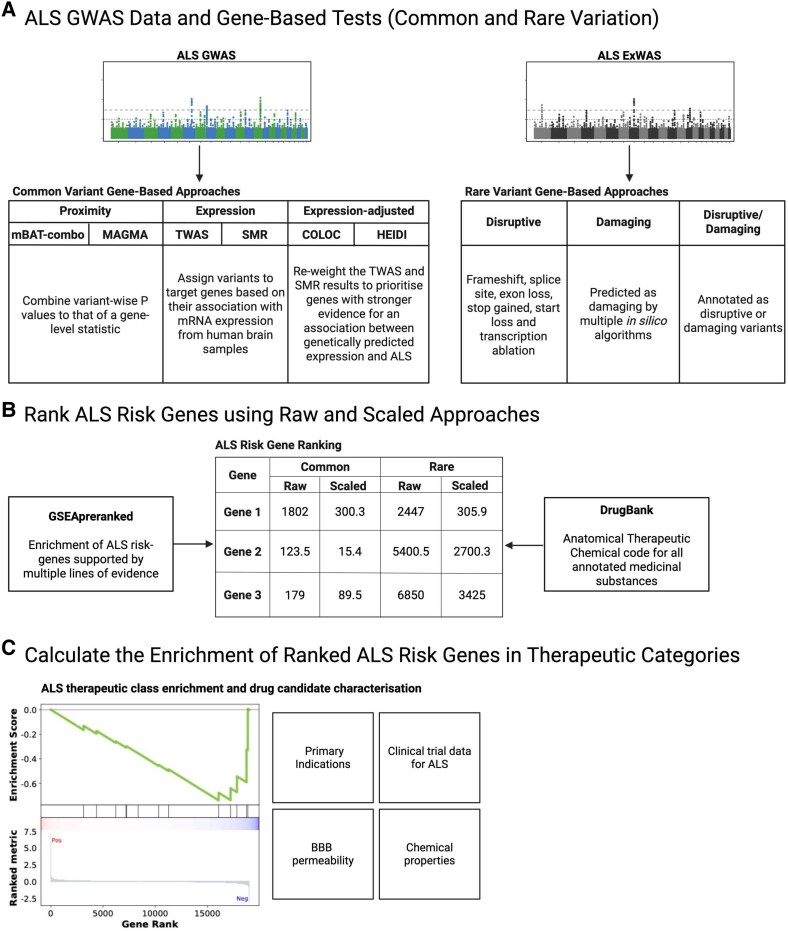
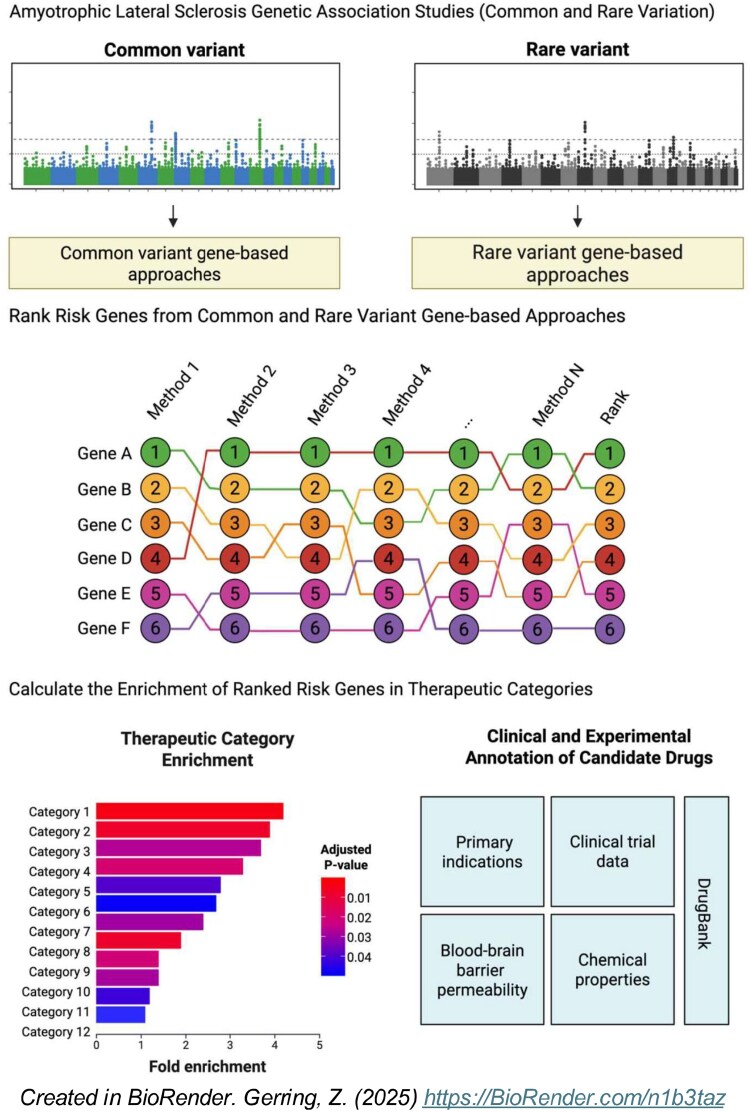
Schematic of genetics led-drug repurposing pipeline for ALS. (A) Common-frequency variants identified by GWAS of ALS were analysed using gene-based proximity (mBAT and MAGMA), expression (TWAS and SMR) and adjusted expression (COLOC and HEIDI) approaches. Low-frequency variants identified by ExWAS of ALS were classified by van Rheenen et al. as being either disruptive, damaging or disruptive/damaging at a gene level. (B) Genes identified from common- and rare-variant approaches were scaled and ranked. GSEApreranked was applied using the ranks to test enrichment amongst ATC codes for anatomic therapeutic code subclasses from DrugBank, resulting in a prioritized list of drug classes enriched for best ranked (closer to 1) genes (C). Created in BioRender. Bhalala, O. (2025) https://BioRender.com/x29f210.
Figure 2
Figure 2
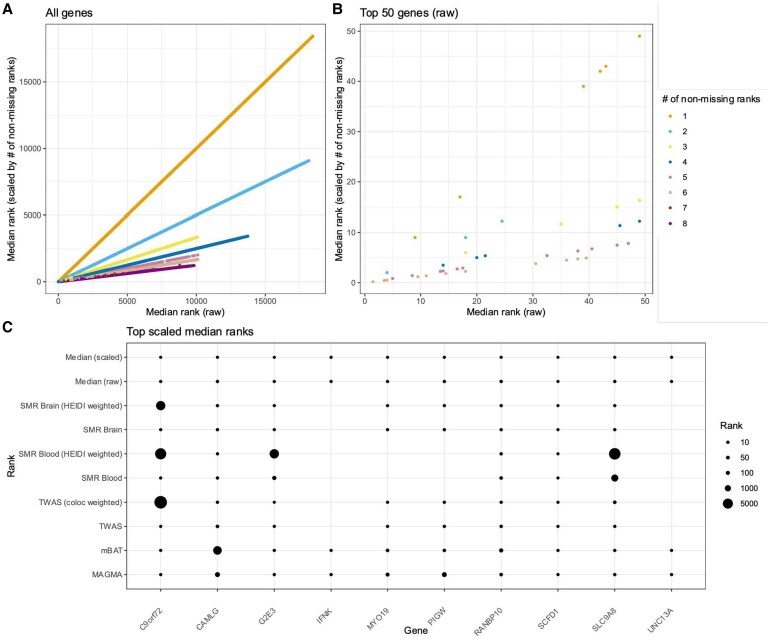
Common variant led ranking of genes using ALS GWAS data. In this approach, eight different gene-based methods are leveraged to rank genes (each point a rank) in an ascending fashion with the common variant GWAS as input (27 205 ALS cases and 110 881 controls), such that the top gene is ranked ‘1’. In panel (A), the x-axis denotes the median rank across all gene-wise input ranks, whilst the y-axis denotes the scaled median rank that upweights genes with a greater number of non-missing input ranks. This scatter plot visualizes the relationship between the raw and scaled median rank, with points coloured by the number of non-missing ranks per-gene (no statistical comparison performed between raw and scaled metrics). The same relationship is plotted in panel (B) for just the genes ranked in the top 50 using the raw median—further demonstrating that genes with only a small number of input ranks are penalized compared to those with less missingness, and therefore, a more representative median estimate. (C) Genes with the top 10 scaled median ranks are visualized in terms of their input rank for each method, with whitespace denoting a missing rank for that method.
Figure 3
Figure 3
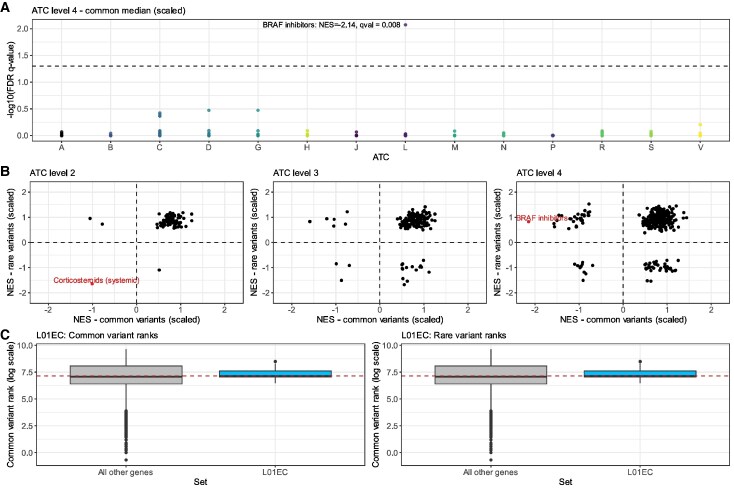
Enrichment of ALS gene-ranks amongst ATC code drug classes. (A) Manhattan-like plot that visualizes the strongest enrichment found in therapeutic category related analyses—an enrichment of best ranked (closer to one) common variant led genes in the level 4 ATC (each point an ATC code) B-raf (BRAF) inhibitors (ATC code = L01EC). Each point represents the −log10 transformed FDR q-value of enrichment is plotted, grouped by overall ATC code level 1 category on the x-axis. The ATC level 1 codes are A = Alimentary tract and metabolism, B = blood and blood forming organs, C = cardiovascular system, D = dermatologicals, G = genito-urinary system and sex hormones, H = systemic-hormonal preparations (excl. sex hormones and insulin), J = anti-infective (systemic), L = antineoplastic and immunomodulating agents, M = musculoskeletal system, N = nervous system, P = antiparasitic, insecticides and repellants, R = respiratory system, S = sensory organs and V = various. The dashed horizontal line represents FDR q < 0.05. (B) Scatterplot with each point denoting the rare and common variant NES from gene-set enrichment analysis (GSEApreranked) for each ATC category level (left to right, level 2, level 3 and level 4). Our categories of interest are those with NES <0 as this represents an enrichment of genes ranked closer to 1. Common variant led GSEApreranked results (NES) are denoted on the x-axis, and rare-variant led NES on the y-axis. Rare variant ranks derived from ExWAS with sample size of 6538 ALS cases and 2415 controls, whilst common-variant ranks derived from genome-wide association study (27 205 ALS cases and 110 881 controls). (C) Distribution of common variant (left) and rare variant (right) ranks, respectively, within the BRAFi ATC code (natural log scale) relative to that of all remaining genes that were ranked. Each point denotes the rank of a gene in that ATC code set. The GSEApreranked derived enrichment of common variant ranks was P < 0.0001 (lowest P-value that can be achieved with 10 000 permutations) with a q-value of 0.0085. Conversely, there was no significant enrichment of rare variant ranks closer in the BRAFi ATC code (P = 0.794).
Figure 4
Figure 4
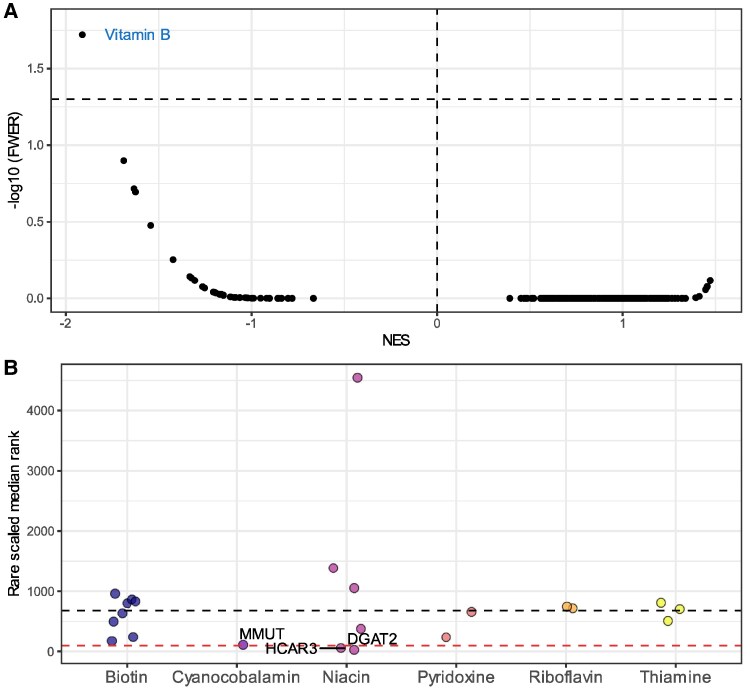
Rare-variant led enrichment within drug mechanism of action groups. (A) Volcano plot that visualizes the GSEApreranked derived enrichments within mechanism of action groups using rare-variant scaled median ranks as input (GSEApreranked algorithm with default rankings). Each point denotes the GSEApreanked results for a mechanism of action group tested. Rare variant ranks derived from ExWAS with sample size of 6538 ALS cases and 2415 controls. A NES < 0 denotes an enrichment of best ranked (closer to one) genes. The −log10 transformed Bonferroni correction derived FWER is plotted on the x-axis, with the dotted horizontal line denoting a Bonferroni corrected P-value <0.05. (B) Each point represents the scaled median rare-variant rank of specific B-vitamin targets that compromise the vitamin B mechanism of action group. The black horizontal line denotes the median rank amongst the entire mechanism of action group, whilst the red-dotted horizontal line indicates genes ranked ≤100.
Figure 5
Figure 5
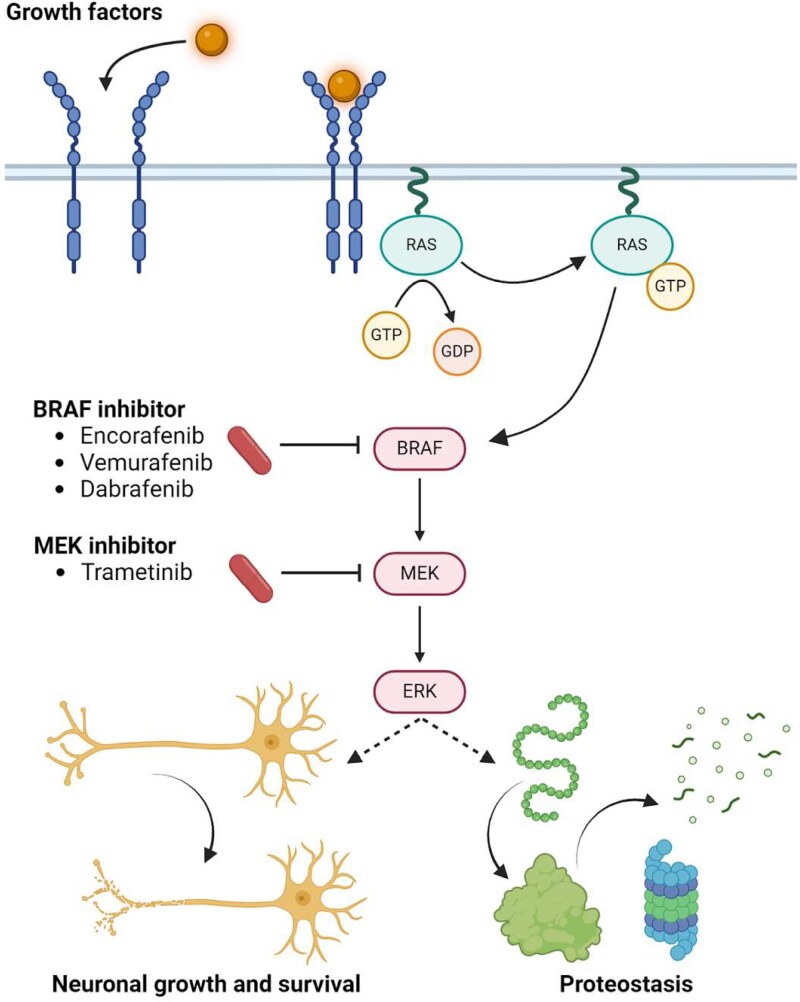
Schematic of the biological context of BRAFi as a repurposing candidate in ALS. The RAS/RAF/MAPK pathway mediates the transduction of extracellular signals to the cell nucleus via a phosphorylation signalling cascade, where target genes are activated for several processes in all cell types, including cell proliferation, differentiation and growth and apoptosis and autophagy. Somatic mutations in the RAF/MAPK pathway are present in many human cancers, such as the BRAF V600E mutation in malignant melanoma. Several antineoplastic drugs have been developed to target signalling molecules in this pathway, and include the BRAFi encorafenib, vemurafenib and dabrafenib, and the MEK inhibitor trametinib. Broadly, these drugs decrease ERK activation and thereby inhibit excessive cell proliferation and other dysregulated cellular processes. In particular, the effect of these compounds on proteostasis may be of particular relevance to the pathophysiology of ALS. Generated with BioRender.com. BRAF, B-raf; ALS, amyotrophic lateral sclerosis; RAS/RAF/MAPK, rat sarcoma/rapidly accelerated fibrosarcoma/mitogen-activated protein kinase; MEK, mitogen-activated protein kinase kinase. Created in BioRender. Gerring, Z. (2025) https://BioRender.com/s95p112.

References

    1. Bjelica B, Bartels MB, Hesebeck-Brinckmann J, Petri S. Non-motor symptoms in patients with amyotrophic lateral sclerosis: Current state and future directions. J Neurol. 2024;271(7):3953–3977. - PMC - PubMed
    1. Hardiman O, Al-Chalabi A, Chio A, et al. Amyotrophic lateral sclerosis. Nat Rev Dis Primer. 2017;3:17071. - PubMed
    1. Feldman EL, Goutman SA, Petri S, et al. Amyotrophic lateral sclerosis. Lancet Lond Engl. 2022;400(10360):1363–1380. - PMC - PubMed
    1. van Rheenen W, van der Spek RAA, Bakker MK, et al. Common and rare variant association analyses in amyotrophic lateral sclerosis identify 15 risk loci with distinct genetic architectures and neuron-specific biology. Nat Genet. 2021;53(12):1636–1648. - PMC - PubMed
    1. Nicolas A, Kenna KP, Renton AE, et al. Genome-wide analyses identify KIF5A as a novel ALS gene. Neuron. 2018;97(6):1267–1288. - PMC - PubMed

LinkOut - more resources