


Therapeutic and protective approaches to combat Campylobacter jejuni infections
- PMID: 40395728
- PMCID: PMC12089132
- DOI: 10.3389/fphar.2025.1572616
Therapeutic and protective approaches to combat Campylobacter jejuni infections
Abstract
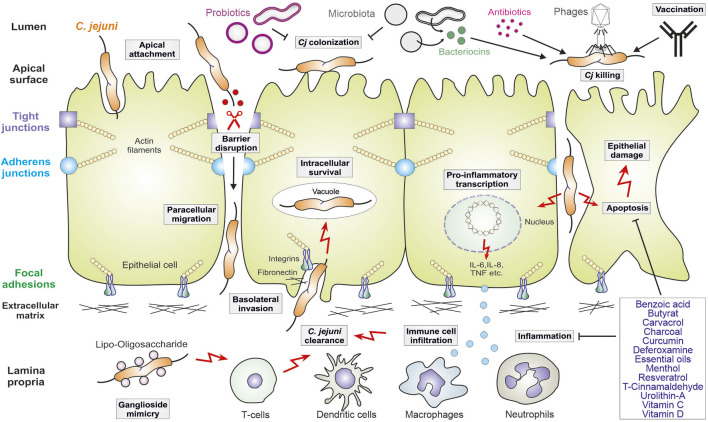
Campylobacter jejuni is a typical zoonotic bacterium, colonizing the gut of many bird species as commensal. In humans, C. jejuni is a major foodborne pathogen. Infection of humans causes campylobacteriosis in the small intestine, constituting a main source of bacteria-dependent gastroenteritis cases worldwide. In particular, the ingestion of under-cooked rooster meat, raw milk and contaminated water, as well as cross-contamination of ready-to-eat food after handling raw chicken meat, are responsible for the majority of C. jejuni infections. As a consequence, infected individuals may acquire watery and/or bloody diarrhea associated with abdominal pain, and eventually post-infection illnesses of the neural system and joints, including the Guillain-Barré, Miller Fisher and Reiter syndromes. One therapeutic strategy is to reduce C. jejuni colonization in chicken farms using vaccination, bacteriocins and phage therapy protocols. Prevention approaches during poultry meat processing comprise the compliance to high hygiene standards. Furthermore, substantial progress has been also made in recent years to combat campylobacteriosis using established mouse and in vitro cell model systems. In this regard, specific C. jejuni colonization- and pathogenicity-associated components were considered as favored treatment structures, targeting bacterial movement, host cell interaction, intracellular survival, propagation and spread of the bacteria. This has been complemented by a number of pharmaceutical compounds to reduce C. jejuni-induced epithelial cell damage, inflammation and apoptosis in infected mice. Here we review these novel treatment and prevention as well as "One World - One Health" approaches that aim to diminish the consequences of acute campylobacteriosis and post-infection sequelae in humans.
Keywords: Campylobacterjejuni; One Health; bacteriophage; epithelial barrier; gut microbiota; phytochemicals; probiotics; vaccine.
Copyright © 2025 Sharafutdinov, Linz, Tegtmeyer and Backert.
Conflict of interest statement
The authors declare that the research was conducted in the absence of any commercial or financial relationships that could be construed as a potential conflict of interest.
Figures
Similar articles
-
Murine Models for the Investigation of Colonization Resistance and Innate Immune Responses in Campylobacter Jejuni Infections.Curr Top Microbiol Immunol. 2021;431:233-263. doi: 10.1007/978-3-030-65481-8_9. Curr Top Microbiol Immunol. 2021. PMID: 33620654
-
Tryptanthrin Reduces Campylobacter jejuni Colonization in the Chicken Gut by a Bactericidal Mechanism.Appl Environ Microbiol. 2023 Feb 28;89(2):e0170122. doi: 10.1128/aem.01701-22. Epub 2023 Jan 18. Appl Environ Microbiol. 2023. PMID: 36651742 Free PMC article.
-
Molecular Targets in Campylobacter Infections.Biomolecules. 2023 Feb 22;13(3):409. doi: 10.3390/biom13030409. Biomolecules. 2023. PMID: 36979344 Free PMC article. Review.
-
Human Campylobacteriosis-A Serious Infectious Threat in a One Health Perspective.Curr Top Microbiol Immunol. 2021;431:1-23. doi: 10.1007/978-3-030-65481-8_1. Curr Top Microbiol Immunol. 2021. PMID: 33620646 Review.
-
Coadministration of the Campylobacter jejuni N-Glycan-Based Vaccine with Probiotics Improves Vaccine Performance in Broiler Chickens.Appl Environ Microbiol. 2017 Nov 16;83(23):e01523-17. doi: 10.1128/AEM.01523-17. Print 2017 Dec 1. Appl Environ Microbiol. 2017. PMID: 28939610 Free PMC article.
Cited by
-
Editorial: Therapeutic and protective approaches to gastrointestinal tract infections.Front Pharmacol. 2025 Jul 30;16:1650144. doi: 10.3389/fphar.2025.1650144. eCollection 2025. Front Pharmacol. 2025. PMID: 40808696 Free PMC article. No abstract available.
References
Publication types
LinkOut - more resources
Full Text Sources
Research Materials
