


Association Between Modifiable Lifestyle Factors and Incident Cardiac Conduction Disease
- PMID: 40396939
- PMCID: PMC12277195
- DOI: 10.1016/j.jacasi.2025.03.009
Association Between Modifiable Lifestyle Factors and Incident Cardiac Conduction Disease
Abstract
Background: The associations between modifiable lifestyles and cardiac conduction disease (CCD) are poorly studied.
Objectives: This study aimed to prospectively assess the association between modifiable lifestyle factors and incident CCD.
Methods: A total of 89,377 participants (aged 18-90 years) free of CCD at baseline were enrolled in the Kailuan cohort. Lifestyle factors, including smoking, alcohol consumption, physical activity, sedentary behavior, and nighttime sleep duration, were collected to test the relations of both baseline and long-term lifestyle factors with incident CCD.
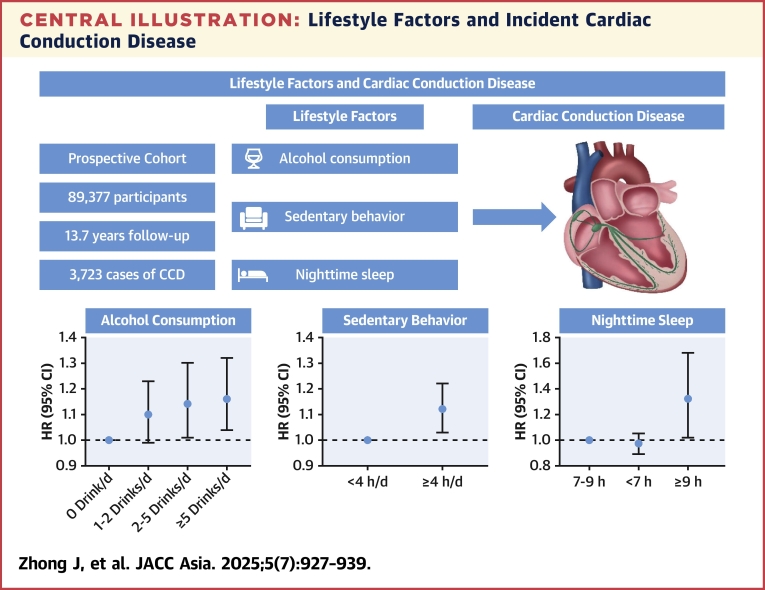
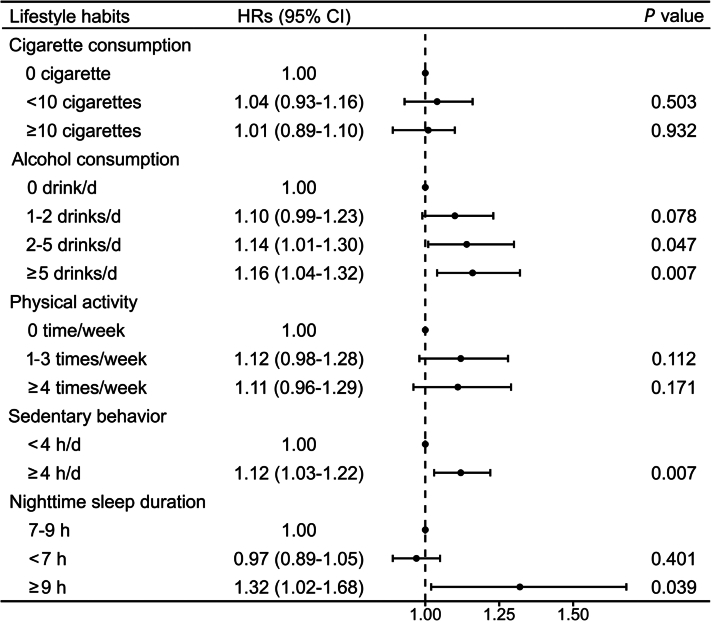
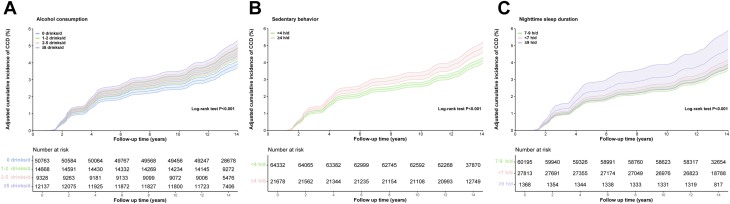
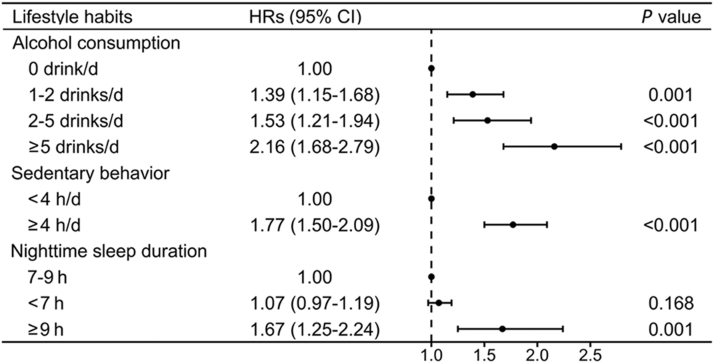
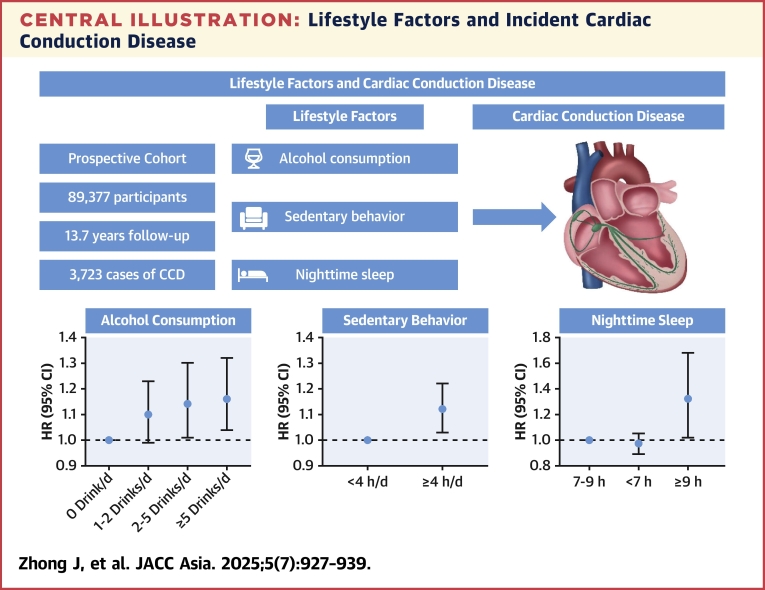
Results: During 1,226,634.1 person-years of follow-up (median: 14.1 years; Q1-Q3: 13.8-14.2 years), 3,723 CCD cases (3.04 per 1,000 person-years; 95% CI: 2.94-3.13 person-years) were identified. Compared with the participants who had healthy lifestyles at baseline, the adjusted HRs for participants who consumed alcohol ≥5 drinks per day, had sedentary behavior ≥4 hours per day, and had night sleep ≥9 hours per day were 1.16 (95% CI: 1.04-1.32), 1.12 (95% CI: 1.03-1.22), and 1.32 (95% CI: 1.02-1.68), respectively. Furthermore, compared with the participants adhered to long-term healthy lifestyles, the adjusted HRs for participants who chronically consumed alcohol ≥5 drinks per day, had sedentary behavior ≥4 hours per day, and had night sleep ≥9 hours per day were 2.16 (95% CI: 1.68-2.79), 1.77 (95% CI: 1.50-2.09), and 1.67 (95% CI: 1.25-2.24), respectively.
Conclusions: The study revealed excessive alcohol consumption, high sedentary behavior, and longer sleep duration were associated with higher risks of CCD in adults. The findings supported the beneficial impact of a low-risk lifestyle on the primary prevention of CCD.
Keywords: cardiac alcohol consumption; conduction disease; lifestyle factors; nighttime sleep duration; sedentary behavior.
Copyright © 2025 The Authors. Published by Elsevier Inc. All rights reserved.
Conflict of interest statement
Funding Support and Author Disclosures This study was supported by the National Key Research and Development Program of China (2022YFE0209900), and Clinical Research Special Fund of the Guangdong Medical Association (2024HY-A4010). The authors have reported that they have no relationships relevant to the contents of this paper to disclose.
Figures
References
-
- Fisch C. Diagnosis and management of cardiac arrhythmias. Curr Probl Cardiol. 1977;1:1–57. - PubMed
-
- Aro A.L., Anttonen O., Kerola T., et al. Prognostic significance of prolonged PR interval in the general population. Eur Heart J. 2014;35:123–129. - PubMed
-
- Piwonska A., Piwonski J., Szczesniewska D., Drygas W. Population prevalence of electrocardiographic abnormalities: results of the Polish WAW-KARD study. Kardiol Pol. 2019;77:859–867. - PubMed
-
- Eriksson P., Wilhelmsen L., Rosengren A. Bundle-branch block in middle-aged men: risk of complications and death over 28 years. The Primary Prevention Study in Goteborg, Sweden. Eur Heart J. 2005;26:2300–2306. - PubMed
LinkOut - more resources
Full Text Sources
