


Comparative analysis of shear bond strength and debonding characteristics of bioactive versus conventional orthodontic adhesives: An in-vitro study
- PMID: 40397265
- PMCID: PMC12133651
- DOI: 10.1007/s44445-025-00002-5
Comparative analysis of shear bond strength and debonding characteristics of bioactive versus conventional orthodontic adhesives: An in-vitro study
Abstract
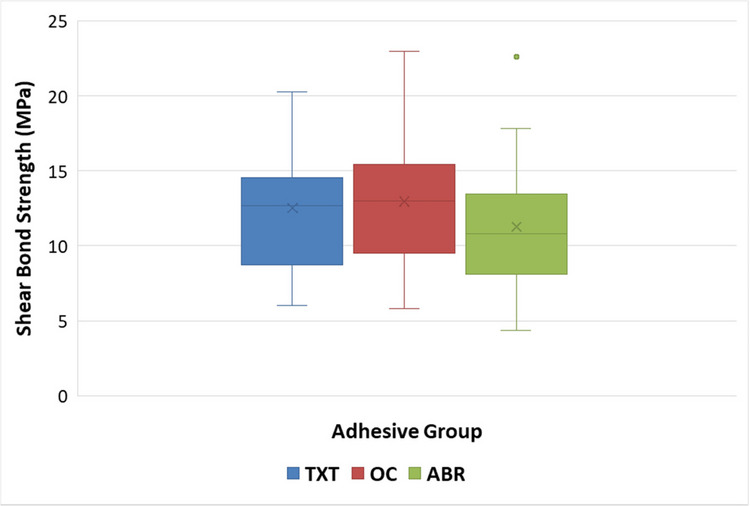
Adhesives are essential for attaching orthodontic brackets to the tooth surface and ensuring safe removal during debonding. ACTIVA™ BioACTIVE-Restorative (ABR) is a bioactive composite with potential advantages. The purpose of this study was to evaluate the shear bond strength (SBS) and adhesive remnant index (ARI) of ACTIVA™ BioACTIVE-Restorative (ABR) with conventional adhesives, including Transbond XT™ (TXT) and Orthocem™ (OC). A total of 51 human maxillary premolars were distributed randomly into three groups (n = 17). Each group was bonded with one adhesive following the manufacturer's protocols. Then were subjected to 5000 thermocycles to simulate oral conditions. SBS was measured using a universal testing machine, and ARI scores were visually analysed under magnification. Statistical analysis was conducted using one-way ANOVA and chi-squared tests, with a 0.05 level of significance. Mean SBS values were 11.26 MPa, 12.52 MPa, and 12.96 MPa for ABR, TXT, and OC, respectively, with no significant differences (p = 0.513). ARI analysis revealed significant differences (p = 0.009) as ABR predominantly exhibited ARI 3 scores, indicating no adhesive remnants on enamel. In contrast, TXT and OC groups showed higher adhesive retention. ABR demonstrated shear bond strength comparable to conventional adhesives, meeting the clinical thresholds for orthodontic use. But demonstrated more complete adhesive failure in the enamel-adhesive interface rather than cohesive failure within the adhesive material like in TXT and OC.
Keywords: Adhesive Remnant Index (ARI); Bioactive materials; Debonding characteristics; Orthodontic adhesives; Shear bond strength.
© 2025. The Author(s).
Conflict of interest statement
Declarations. Ethical compliance: Ethical approval was granted by Taibah University College of Dentistry Research Ethics Committee. The study registration number is TUCDREC/030424/KBukhari. All procedures performed in studies were in accordance with the ethical standards of the institutional research committee and with the 1964 Helsinki Declaration and its later amendments. Conflict of interest: The authors declare that there was no conflict of interest on publication date.
Figures
References
-
- Abd El Halim S (2018) Comparative evaluation of shear bond strength of a bioactive composite and nano-composite: an in vitro study. Egypt Dental J 64(2):1653–9 - DOI
-
- Ali NAM, Nissan LM, Khamis AH, Al-Taai N (2024) Enamel demineralization around orthodontic brackets bonded with new bioactive composite (in-vitro study). J Baghdad Coll Dent 36(2):54–62 - DOI
-
- Amin F, Fareed MA, Zafar MS, Khurshid Z, Palma PJ, Kumar N (2022) Degradation and stabilization of resin-dentine interfaces in polymeric dental adhesives: an updated review. Coatings 12(8):1094 - DOI
LinkOut - more resources
Full Text Sources