


Species diversity and spatial pattern of heritage trees in Taiyuan
- PMID: 40399455
- PMCID: PMC12095643
- DOI: 10.1038/s41598-025-99731-0
Species diversity and spatial pattern of heritage trees in Taiyuan
Abstract
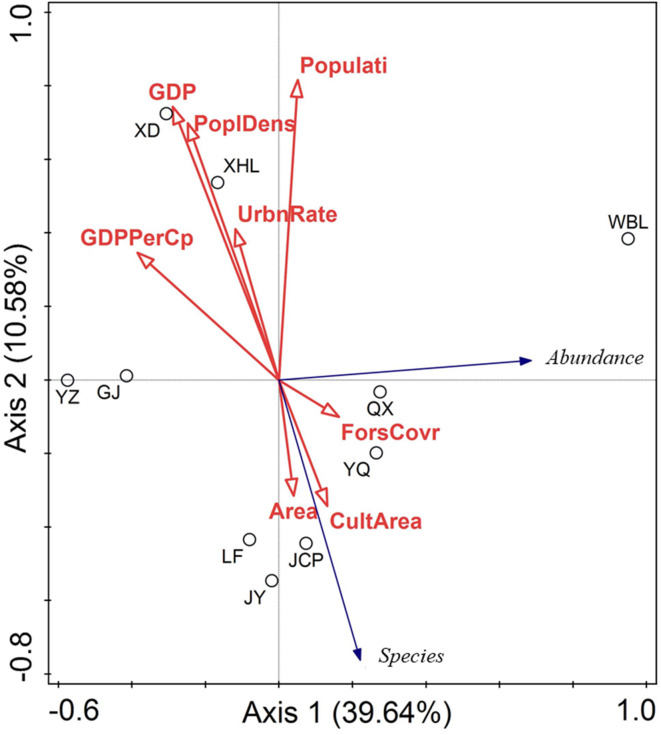
Heritage trees are key to maintaining biodiversity, supporting ecosystem services, and preserving cultural heritage. This study investigates the species composition, spatial distribution patterns, and conservation needs of heritage trees in ancient Taiyuan city in Northern China, focusing on their cultural-ecological significance and urbanization threats. Using redundancy analysis, we surveyed 4737 heritage trees across ten urban core, suburban and rural districts and nine habitat types and calculated their importance values, species diversity indices, and statistical associations with key socio-demographic and environmental factors. The prized stock comprised 57 species, dominated by Ziziphus jujuba, Styphnolobium japonicum, accompanied by four subdominants such as Platycladus orientalis and Pinus tabuliformis, and 39 uncommon to rare species, contributing considerably to species diversity. Spatial analysis and ecological assessments found distinct distribution patterns, with suburban and rural areas accommodating higher tree abundance and species richness than more urbanized districts. Factors such as altitude, cultivated area, economic activities, and particularly urban development, strongly influenced tree distribution. We analyzed their natural-cum-cultural value and threats from fast urban expansion, habitat fragmentation and loss, and insufficient conservation efforts. The findings underscored the urgent need for targeted and reinforced conservation strategies to safeguard these heritage trees, sustaining their precious legacy for future generations.
Keywords: Conservation strategy; Distribution pattern; Environmental factor; Heritage tree; Species composition; Urbanization threat.
© 2025. The Author(s).
Conflict of interest statement
Declarations. Competing interests: The authors declare no competing interests.
Figures



References
-
- Jim, C. Y. in Greening Cities: Forms and Functions (eds Puay Yok Tan & Chi Yung Jim) 279–305 (Springer Singapore, 2017).
-
- Li, K. & Zhang, G. Species diversity and distribution pattern of heritage trees in the rapidly-urbanizing Province of Jiangsu, China. Forests12, 1543. 10.3390/f12111543 (2021).
-
- Blicharska, M. & Mikusiński, G. Incorporating social and cultural significance of large old trees in conservation policy. Conserv. Biol.28, 1558–1567. 10.1111/cobi.12341 (2014). - PubMed
-
- Simon, B. Tree traditions and folklore from Northeast Ireland. Arboricultural J.24, 15–40. 10.1080/03071375.2000.9747260 (2000).
-
- Blicharska, M. & Mikusinski, G. Old trees: Cultural value. Science339, 904–904. 10.1126/science.339.6122.904-b (2013). - PubMed
MeSH terms
Grants and funding
LinkOut - more resources
Full Text Sources
