. 2025 Jun;4(6 Pt 1):101787.
doi: 10.1016/j.jacadv.2025.101787. Epub 2025 May 21.

Long-Term Road Traffic Noise, Air Pollution, and Cardiovascular Disease: AIRCARD: A Prospective Cohort Study

Affiliations

Long-Term Road Traffic Noise, Air Pollution, and Cardiovascular Disease: AIRCARD: A Prospective Cohort Study

Stephan P Mayntz et al. JACC Adv. 2025 Jun.

Abstract

Background: Air pollution and road traffic noise are major environmental stressors associated with cardiovascular disease (CVD). Although their independent effects are well-documented, few studies have concurrently evaluated their relative contributions-particularly in low ambient air pollution settings.

Objectives: The purpose of this study was to investigate the association between long-term exposure to air pollution and road traffic noise and CVD.

Methods: We conducted a prospective cohort study using data from the DANCAVAS (Danish Cardiovascular Screening Trial) (2014-2018) and VIVA (Viborg vascular) (2008-2010) screening trials, including 26,723 men aged 65 to 74 years with pollution exposure data from 1979 to 2019. Residential exposure to air pollutants (particulate matter with a diameter <2.5 μm, nitrogen dioxide, warm-season ozone, sulfur dioxide, and carbon monoxide) and road traffic noise (Lden) were estimated based on residential addresses using the Danish Eulerian Hemispheric Model/Urban Background Model/Air Geographic Information System model and Nord2000. We used Cox proportional hazards models, adjusting for baseline inclusion year, individual-level lifestyle factors, family history of CVD, and socioeconomic status. Major adverse cardiovascular events was the primary outcome.

Results: A 14.9 decibel increase in road traffic noise (IQR increment) was associated with a 7.5% higher risk of major adverse cardiovascular events (HR: 1.075; 95% CI: 1.026-1.128) and an 8.1% increased risk of all-cause mortality (HR: 1.081; 95% CI: 1.027-1.137). No significant associations were found between air pollutants and the primary or secondary outcomes in the pooled cohort after adjustment for confounders.

Conclusions: Long-term exposure to road traffic noise was significantly associated with increased CVD and all-cause mortality. Our findings suggest that studies that do not consider noise exposure may overestimate the cardiovascular burden attributed to air pollution. (Impact of Lifetime Exposure to Air and Noise Pollution on Cardiovascular Disease and Mortality-the AIRCARD Study [AIRCARD]; NCT04353232).

Keywords: air pollution; cardiovascular disease risk; environmental pollution; prospective cohort study; road traffic noise.


Conflict of interest statement

Funding support and author disclosures This work was supported by the Region of Southern Denmark (Odense, Denmark) and by Shipowner Per Henriksen’s Foundation (Copenhagen, Denmark). The sponsors were not involved in the project. The authors have reported that they have no relationships relevant to the contents of this paper to disclose.

Figures

None
Graphical abstract
Figure 1
Figure 1
HRs for Secondary Cardiovascular Outcomes in Model 3 HRs and 95% CI for secondary stroke, myocardial infarction, cardiovascular mortality, revascularization, heart failure, and all-cause mortality. The results are from model 3, which is fully adjusted for baseline inclusion year, smoking status, body mass index, family history of cardiovascular disease, and socioeconomic factors. HRs are shown for PM2.5, NO2, CO, SO2, warm-season O3, and road traffic noise (Lden). CO = carbon monoxide; CV = cardiovascular; Ldm = day-evening-night noise level; NO2 = nitrogen dioxide; O3 = ozone; PM2.5 = particulate matter with a diameter <2.5 μm; SO2 = sulfur dioxide.
Figure 2
Figure 2
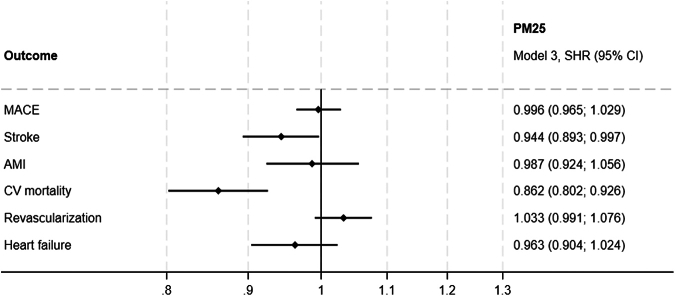
Fine and Gray Competing Risk Analysis for PM2.5 Subdistribution HRs and 95% CIs from the Fine and Gray competing risk model for PM2.5 exposure. The competing risk model accounts for the potential influence of noncardiovascular mortality when estimating the association between long-term PM2.5 exposure and cardiovascular outcomes. Subdistribution HRs are shown for PM2.5 exposure in relation to major adverse cardiovascular events, stroke, myocardial infarction, cardiovascular mortality, revascularization, and heart failure. MACE = major adverse cardiovascular events; other abbreviations as in Figure 1.
Figure 3
Figure 3
Fine and Gray Competing Risk Analysis for Road Traffic Noise Subdistribution HRs and 95% CIs from the Fine and Gray competing risk model for road traffic noise exposure. The competing risk model accounts for the potential influence of noncardiovascular mortality when estimating the association between road traffic noise and cardiovascular outcomes. Subdistribution HRs are shown for road traffic noise in relation to major adverse cardiovascular events, stroke, myocardial infarction, cardiovascular mortality, revascularization, and heart failure. SHR = subdistribution HR; other abbreviations as in Figures 1 and 2.
Figure 4
Figure 4
Dose-Response Curve of Road Traffic Noise and Cardiovascular Risk Dose-response relationship between road traffic noise (Lden, dB) and major adverse cardiovascular events. The solid line represents relative risk estimates, with the shaded area indicating the 95% CI, based on Cox proportional hazards models. Association between residential road traffic noise exposure and the relative risk of MACE. The figure shows the dose-response relationship between residential road traffic noise exposure (Lden, in decibels [dB]) and the relative risk of major adverse cardiovascular events. dB = decibels; Lden = day-evening-night noise level; RR = relative risk; other abbreviation as in Figures 1 and 2.
Figure 5
Figure 5
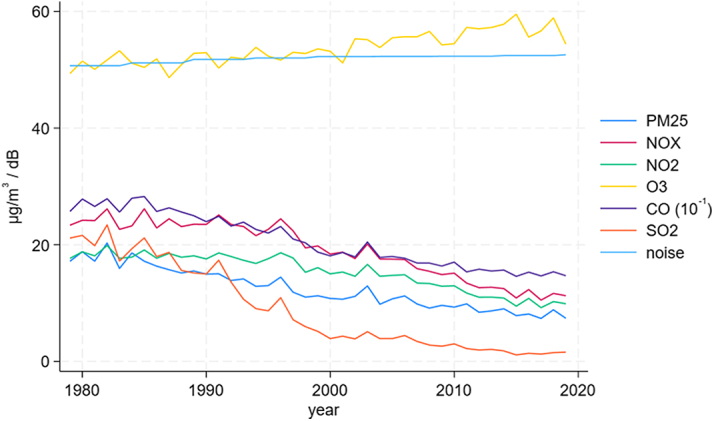
Temporal Trends in Air Pollution and Road Traffic Noise Temporal trends in mean concentrations of PM2.5, NO2, O3, CO (scaled by 10−1), SO2, and road traffic noise (Lden). Air pollution levels declined over time, while noise and ozone remained stable. The temporal trends from 1979 to 2019 in mean concentrations of air pollutants—PM2.5, NO2, O3, CO (scaled by 10−1), and SO2—and road traffic noise. The graph shows a decline in air pollutant levels over the past 4 decades, while ozone and road traffic noise levels have remained relatively stable. NOx = nitrogen oxides; other abbreviations as in Figures 1 and 4.
Central Illustration
Impact of Road Traffic Noise and Air Pollution on Cardiovascular Disease Risk AIRCARD study findings on road traffic noise and air pollutants and their association with cardiovascular events (MACE) among men aged 65 to 74 years. HRs per IQR increase are fully adjusted. Road traffic noise significantly increased MACE and all-cause mortality risk; PM2.5 showed no increased associations at low exposure levels. Findings highlight road traffic noise as an important factor for cardiovascular risk in populations with relatively low air pollution exposure. AIRCARD = AIR pollution and CARDiovascular disease; AMI = acute myocardial infarction; CVD = cardiovascular disease; DANCAVAS = Danish Cardiovascular Screening Trial; other abbreviations as in Figure 1.

References

    1. Lindstrom M., DeCleene N., Dorsey H., et al. Global burden of cardiovascular diseases and risks collaboration, 1990-2021. J Am Coll Cardiol. 2022;80(25):2372–2425. doi: 10.1016/j.jacc.2022.11.001. - DOI - PubMed
    1. Di Cesare M., Perel P., Taylor S., et al. The heart of the world. Glob Heart. 2024;19(1):11. doi: 10.5334/gh.1288. - DOI - PMC - PubMed
    1. Health Effects Institute . Health Effects Institute; Boston, MA: 2024. State of Global Air 2024. Special Report.
    1. Mayntz S.K., Peronard C.R.F., Søgaard J., Chang A.Y. The economic burden of diseases in the Nordic countries: a systematic review. Scand J Public Health. 2024;52(2):234–246. doi: 10.1177/14034948231153025. - DOI - PubMed
    1. Manisalidis I., Stavropoulou E., Stavropoulos A., Bezirtzoglou E. Environmental and health impacts of air pollution: a review. Front Public Health. 2020;8:14. doi: 10.3389/fpubh.2020.00014. - DOI - PMC - PubMed

Associated data

LinkOut - more resources