


Seizure frequency, APOE ε4, and cognitive function in older people with epilepsy
- PMID: 40405274
- PMCID: PMC12100867
- DOI: 10.1186/s42494-025-00213-7
Seizure frequency, APOE ε4, and cognitive function in older people with epilepsy
Abstract
Background: Cognitive impairment represents a major comorbidity among older adults with epilepsy. This study aimed to explore the association between the apolipoprotein E (APOE) ε4 allele and cognitive function in older people with epilepsy.
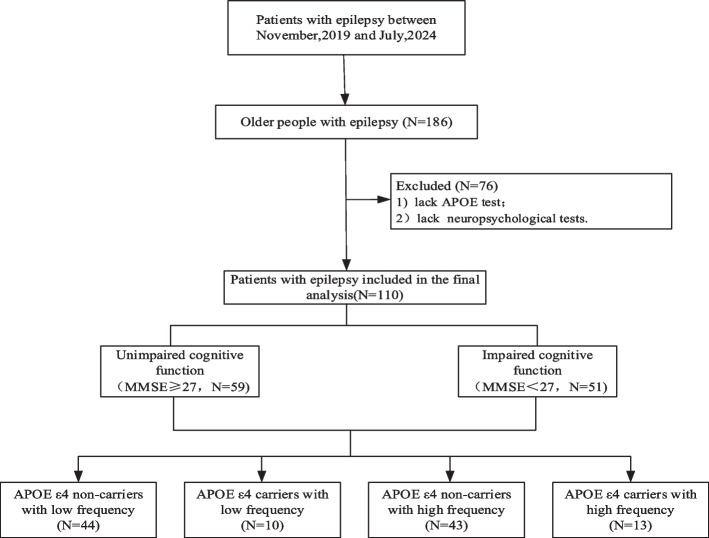
Methods: People with epilepsy aged ≥ 50 years were enrolled at an outpatient clinic of epilepsy from November 2019 to July 2024. Blood samples were collected for APOE genotyping. Participants were categorized into two groups based on the presence of the APOE ε4 allele: APOE ε4 (+/-). Cognitive function was assessed using a battery with neuropsychological tests. Based on Mini-Mental State Examination (MMSE) scores, participants were defined as unimpaired cognition (UC) (MMSE ≥ 27) and cognitive impairment (CI) (MMSE < 27). Seizure frequency was categorized into low (≤ 3/year) and high (> 3/year) groups. Multivariate logistic regression analysis and general linear models were employed to identify factors associated with cognitive function.
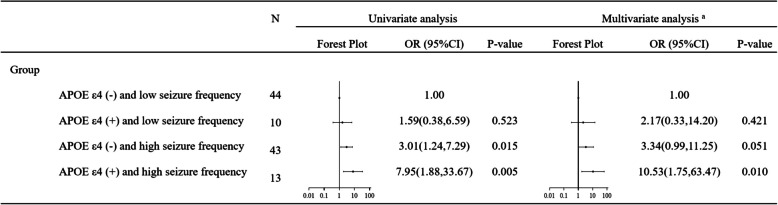
Results: Among 110 participants, 51 (46.4%) were defined as CI. Compared with UC group, the CI group was older (65.1 ± 7.6 vs 60.8 ± 6.8 years, P = 0.002), with lower educational level (9.0 [7.0, 11.0] vs 12.0 [9.0, 13.0] years, P < 0.001), and higher seizure frequency (12.0 [1.0, 24.0] vs 1.0 [0.0, 12.0] times/year, P = 0.005). High seizure frequency (OR = 3.94, 95% CI [1.34, 11.61], P = 0.013) and more APOE ε4 alleles (OR = 3.28, 95% CI [1.09, 9.83], P = 0.034) were risk factors for CI. An interactive effect between the number of APOE ε4 alleles and seizure frequency was observed (P = 0.002). Compared to participants with APOE ε4 (-) and low seizure frequency, those with APOE ε4 (-) and high seizure frequency showed a threefold risk of CI (OR = 3.34, 95% CI [0.99, 11.25], P = 0.051), while those with APOE ε4 (+) and high frequency demonstrated the highest risk of CI (OR = 10.53, 95% CI [1.75, 63.47], P = 0.010).
Conclusions: The synergistic effect of APOE ε4 allele and seizure frequency on cognitive function suggested their importance in clinical assessments and therapeutic approaches in managing older people with epilepsy.
Keywords: APOE; Cognitive impairment; Epilepsy; Older adults; Seizure frequency.
© 2025. The Author(s).
Conflict of interest statement
Declarations. Ethics approval and consent to participate: This study was approved by the Institutional Review Board of Huashan Hospital (No. 2020-065). Written informed consents were obtained from all participants or legal guardians. Consent for publication: Not applicable. Competing interests: Author Ding Ding is the member of the Editorial Board for Acta Epileptologica, who was not involved in the journal’s review of or decisions related to this manuscript.
Figures
References
-
- Dutta R. Epilepsy in elderly population: a comprehensive review. EC Neurol. 2020;12(6):61–71.
LinkOut - more resources
Full Text Sources
Miscellaneous