


White matter microstructure alterations in early psychosis and schizophrenia
- PMID: 40410167
- PMCID: PMC12102172
- DOI: 10.1038/s41398-025-03397-1
White matter microstructure alterations in early psychosis and schizophrenia
Erratum in
-
Correction: White matter microstructure alterations in early psychosis and schizophrenia.Transl Psychiatry. 2025 Nov 12;15(1):469. doi: 10.1038/s41398-025-03740-6. Transl Psychiatry. 2025. PMID: 41224759 Free PMC article. No abstract available.
Abstract
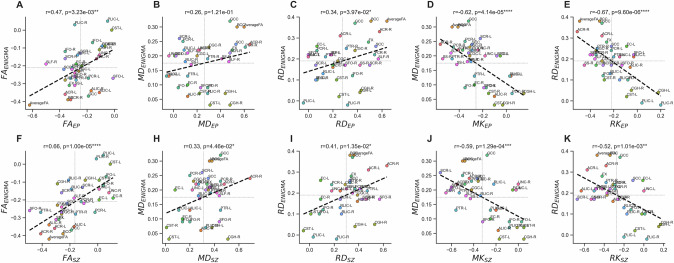
Studies on schizophrenia feature diffusion magnetic resonance imaging (dMRI) to investigate white matter (WM) anomalies. The heterogeneity in the possible interpretations of typical Diffusion Tensor Imaging (DTI) metrics highlights the importance of increasing their specificity. Here, we characterize WM pathology in early psychosis (EP) and schizophrenia (SZ) with increased specificity using advanced dMRI: Diffusion Kurtosis Imaging and the biophysical model White Matter Tract Integrity - Watson (WMTI-W). This enables us to better characterize WM abnormalities, while preserving good sensitivity to group differences, and relate them to the current literature (ENIGMA-schizophrenia), patient's clinical characteristics and symptomatology. dMRI-derived microstructure features were extracted from all of WM and from individual regions of interest in 275 individuals. 93 subjects diagnosed with EP and 47 with SZ were compared respectively to 135 age-range matched healthy controls (HC). WM DTI diffusivities were higher, while kurtosis was lower in EP vs HC and in SZ vs HC. Differences were more widespread in EP than SZ. The regional alterations found in our cohort matched the DTI patterns found in ENIGMA-schizophrenia. WMTI-W model parameters indicate that the WM alterations in patients come primarily from the extra-axonal compartment, consistent with abnormal myelin integrity in the disease pathology. The direct link between WM alterations and symptomatology is, however, limited.
© 2025. The Author(s).
Conflict of interest statement
Competing interests: The authors declare no competing interests. Ethics approval and consent to participate: The study was approved by the local Ethics Committee of the Canton of Vaud (CER-VD 382/11 and 2018-01731, Switzerland) and performed in accordance with the relevant guidelines and regulations. All participants provided their informed consent to take part in the study.
Figures



References
MeSH terms
Grants and funding
- PCEFP2_194260/Schweizerischer Nationalfonds zur Förderung der Wissenschaftlichen Forschung (Swiss National Science Foundation)
- 51NF40 - 185897/Schweizerischer Nationalfonds zur Förderung der Wissenschaftlichen Forschung (Swiss National Science Foundation)
- 51NF40 - 185897/Schweizerischer Nationalfonds zur Förderung der Wissenschaftlichen Forschung (Swiss National Science Foundation)
- PCEFP2_194260/Schweizerischer Nationalfonds zur Förderung der Wissenschaftlichen Forschung (Swiss National Science Foundation)
LinkOut - more resources
Full Text Sources
Medical
Miscellaneous
