


Uncovering potentials of an association panel subset for nitrogen fixation and sustainable chickpea productivity
- PMID: 40413423
- PMCID: PMC12102913
- DOI: 10.1186/s12870-025-06244-z
Uncovering potentials of an association panel subset for nitrogen fixation and sustainable chickpea productivity
Abstract
Background: Chickpea (Cicer arietinum L.) is a nutritious legume that fixes atmospheric nitrogen through Rhizobium symbiosis, enhancing growth and yield. Sustainable agriculture is essential to address food security, climate change, and environmental sustainability. Plant Growth-Promoting Rhizobacteria (PGPR) improve crop productivity, reduce chemical fertilizer use, and support eco-friendly farming. This study highlights PGPR's role in enhancing chickpea yield, resilience, and resource efficiency while minimizing environmental impacts. PGPR reduces chemical dependency, preserves ecosystems, and supports global sustainability goals. Findings demonstrate PGPR's potential to improve food security and promote equitable distribution. This research offers innovative strategies for advancing sustainable agriculture.
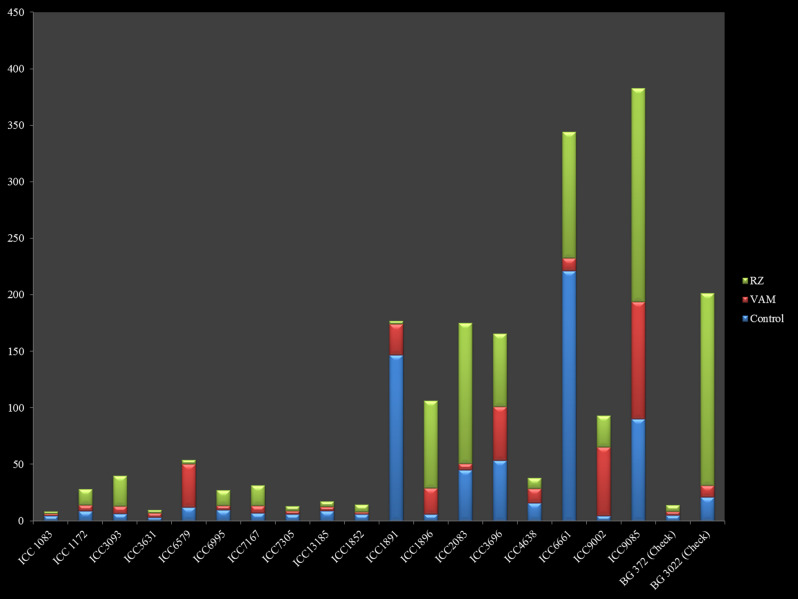
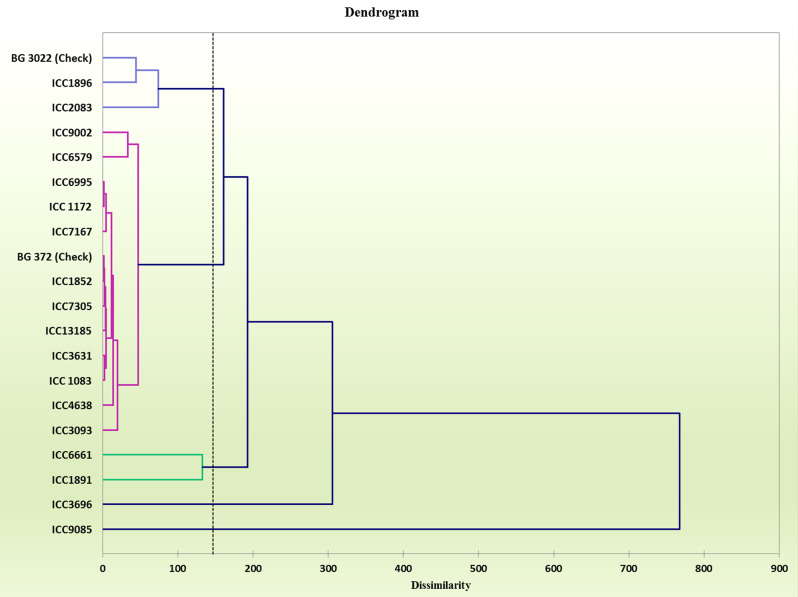
Results: The study revealed significant variability in nodulation, nitrogen fixation, and yield among 20 chickpea genotypes under different treatments, including Rhizobium, vesicular-arbuscular mycorrhiza (VAM), and chemical fertilizers (NPK), applied alone and in combinations. Genotype ICC9085 consistently outperformed others, exhibiting the highest nodules per plant (22.67), nitrogen content (3.65%), and protein content (22.85%), while ICC1083 and ICC6579 showed minimal nodulation (< 5 nodules). Rhizobium treatment proved the most effective, achieving the highest nitrogenase activity (mean: 35.806; max: 189.2) and yielding superior growth-promoting results compared to VAM and control treatments. Molecular genotyping identified 20 out of 128 SSR markers as polymorphic, with an average polymorphic information content (PIC) of 0.35 and two alleles per marker, revealing moderate polymorphism and significant genetic diversity. Cluster analysis grouped the genotypes into four primary clusters, reflecting geographical and genetic diversity in nodulation traits. Environmental factors such as soil nutrients, temperature, and water stress, alongside genetic traits like root architecture and nitrogen-fixing efficiency, contributed to variations in growth and productivity. This interplay of genotype and environment underscores the adaptability and superior performance of certain varieties like ICC9085 under specific conditions.
Conclusion: These observations suggest that the identified superior genotypes can be used to introduce desirable traits into allied chickpea cultivars through marker-assisted selection and crop improvement programs.The research of the chickpea, a crop with significant agricultural and industrial value, will eventually help develop efficient methods for the production of climate-smart food crops to meet the food and feed needs of future generations for a sustainable environment.
Keywords: Rhizobium; Chickpea; Nodulation; Plant growth-promoting rhizobacteria; Vesicular arbuscular mycorrhiza; Yield.
© 2025. The Author(s).
Conflict of interest statement
Declarations. Ethics approval and consent to participate: Not applicable. Competing interests: The authors declare no competing interests. Consent for publishing: Not applicable.
Figures



References
-
- Gil J, Nadal S, Luna D, Moreno MT, Haro AD. Variability of some physico-chemical characters in Desi and Kabuli chickpea types. J Sci Food Agric. 1996;71(2):179–84. - DOI
-
- Ibrikci H, Knewtson SJ, Grusak MA. Chickpea leaves as a vegetable green for humans: evaluation of mineral composition. J Sci Food Agric. 2003;83(9):945–50. - DOI
-
- Atienza SG, Rubiales D. Legumes in sustainable agriculture. Crop Past Sci. 2017;68(11):i–i. - DOI
MeSH terms
Substances
LinkOut - more resources
Full Text Sources
